

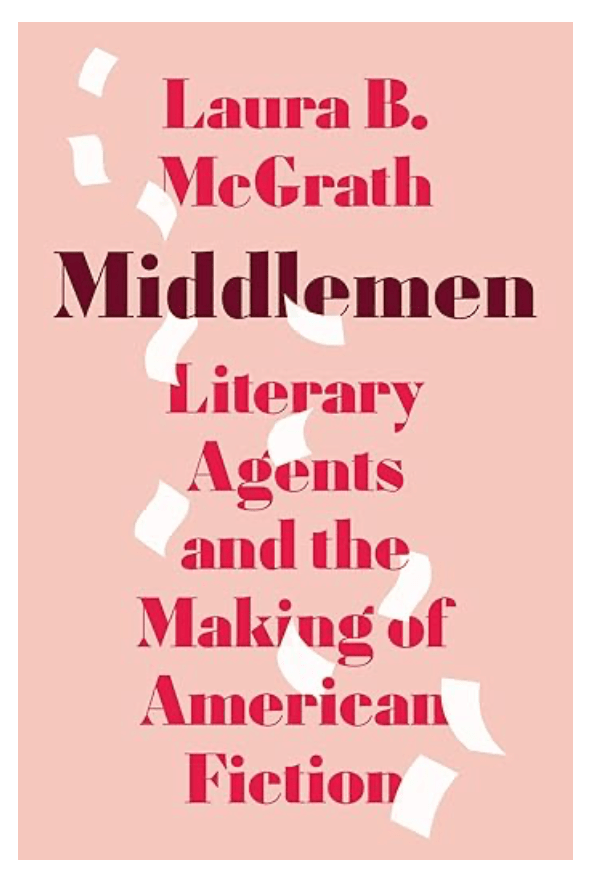
Laura McGrath, assistant professor of English at Temple University and a National Endowment for the Humanities fellow, in Middlemen reveals the critical role in the making of American literature, from the famed three-martini lunch to the Frankfurt Book Fair, and shows how agents influence what we read and explains why many debut novelists never publish another book, why agents champion short story collections even though they sell poorly, and how agents advocate for writers of colour in a system that values whiteness, and why there are so many New York novels. Middlemen demonstrates that agents-eighty percent of whom are in fact women- are much more than middlemen. As intermediaries between author and publisher, agents act as advocates, matchmakers, negotiators and tastemakers, and they must balance artistic values with the commercial imperatives of publishing conglomerates. The decisive role agents has influenced in celebrated novels- from Jack Kerouac’s On the Road to Colson Whitehead’s The Intuitionist- but also in the creation of entire literary categories like the debut novel, the story collection, postmodernism, multi-ethnic fiction, and world literature.
Featuring profiles of agent’s past and present such as Sterling Lord, Lynn Nesbit, Canada Donadio, Marie Brown, and Andrew Wylie, along with perspectives from agents at all ages of their carriers, Middlemen is an entertaining and eye-opening account of how literary fiction- and the literary canon is made.
Literary agent Andrew Wylie aka “The Jackal”. Philip Roth though famous had been getting a pittance for his books, and Wylie boasted that, if hired he could get him $2million for a three-book deal. Roth said yes, and his income skyrocketed and rest is history.
Agents have been the focus of lots of literary gossip. By assembling an international list that includes writers like Orhan Pamuk, Chimanda Ngozi Adichie, and Salman Rushidie- alongside the estates of figures like Jorge Luis Borges- Andrew Wyklie has enmeshed himself in foreign markets. Wylie famously poached Martin Amis from his long time literary representative Pat Kavanagh, the wife of Julian Barnes, to the outrage of the literary world. Laure McGrath claims nobody had yet written “a definitive account of the literary agent’s influence over American literature.”
McGrath’s subjects are the gatekeepers to the world of literature, able to make or break beginners, curate literary movements and even influence the topics chosen by overseas writers who want to be published in America. They work closely with their writer clients, often editing their manuscripts and advising on plot. McGrath focuses on agents rather than publishers, editors or reviewers, divides her argument into six agenting tools: The Pitch, The Debut, The Collection, The Lunch, The Advocate and The Export.
Although literary agents have existed in the UK since the 1870s, but in the US, writers were still sending their books directly to publishers until the 1920s, the same still happens in continental Europe. But in the US most publishing houses now rely on agents, of whom there are over 1, 500 to filter, to certify quality and to pitch. The Pitch has become almost as important as the book itself.
As gatekeepers, agents have at times made history. In 1952, at the start of his agenting career, Sterling Lord met a writer with a second book to sell. The first one had been a flop, but Lord saw potential. Four years later, Jack Kerouac’s On the Road launched the Beat Generation on the popular scene. So different style from the first one, which nobody remembered anyway, it was treated as his launch novel. Modern publishing was created: The Debut. In America or the UK, when a writer writes a novel, they send to it an agent. If the agent takes them on they will probably work with them on the draft, advise on plot and themes and even line edit. For their work they take a cut of about 15 per cent. Some become wildly rich, such as Christopher Little, whose agency discovered JK Rowling.
“A debut novelist without a track record has nothing but potential. Their track can only go up” McGrath writes. Publishers pay a seven figure advance – as Knopf did for Ghanaian-American novelist Yaa Gyasi’s Homegoing (2016) for a leap into the unknown, but became a huge bestseller in the US.
Sixty per cent of debut writers never publish a second book as this can be down to agents pushing it too far in the first place: if debut sales do not deliver, a massive advance can end a writer’s career. Agents have curated entire genres. Lynn Nesbit was the guardian of the US short story by championing Donal Barthelme and John Cheever. Candida Donadio, a secretary and lacking higher education, discovered Joseph Heller’s Catch-22 in the slush pile and became famous for her impeccable literary taste that editors sent her writers they felt incompetent to assess. Marie Brown, who helped Terry McMillan, author of Waiting to Exhale (1992), which became a number-one bestseller by encouraging her to find Black readers, have championed Black writers, in an industry where minorities can struggle to be fairly represented, by creating a different public for them.
Middlemen: Literary Agents and the Making of American Fiction by Laura B McGrath, Princeton University Press £25, 296 pages.

