

Controversial Aurangzeb “Alamgir, last of the “Great Mughals”, whose empire touched Kabul on one side and Arakan on the other, was described by British Imperialists as “Crooked and Cruel, Dark and Devious”. The Raj-era historian Jadunath Sarkar described him as a bigotd despot who precipitated the “decay of Indian civilization”. Aurangzeb’s death in 1707 left a divided legacy.
India’s current Hindu nationalist government wants to send a bulldozer and raze his grave. His dynasty survived, in one form or another, until the British laid waste to its capital at Delhi in 1857, which lives on the political consciousness of over billion Hindus and 600 million Muslims across South Asia today.
Berkeley historian Munis D Faruqui provides insights into the emperor’s rise to power, his administrative and religious policies, the role of imperial eunuchate and harem, and cut through the myths to create the texture and detail of Aurgangzeb’s court. Persian language reports, known as the Akhbarat, compiled daily for Aurangzeb’s courtiers, and fortunately several thousand bulletins were left for centuries in the cool, dry cellars of the Maharaja of Jaipur’s hilltop fort. After examining these reports Faruqui uses them to disprove the popular perception that Aurangzeb systematically destroyed temples and subjugated Hindus for their religion. Aurangzeb remains a controversial historical figure: castigated for religious intolerance and place at the centre of a narrative Mughal decline by some, considered a great Muslim hero by others.
Although Narendra Modi’s BJP government sees Aurangzeb as the archetype of Muslim rule: oppressive and foreign, in recent years it has removed him from street signs and school textbooks. One of the ideological forefathers of Pakistan put it, Aurangzeb was “the founder of Musalman nationality in India”.
Both images according to Faruqui are wrong, Aurangzen was in fact the product of a diverse political entity, rich in cultural exchange. The First Mughal emperor Babur was a globetrotting warrior of the line of Tamerlane and arrived in India in the 1520s from the distant plans of Centre Asia. By 1658, when Aurangzeb came to power, the dynasty had taken a distinctly Indian flavour. Aurangzeb himself was related to half the Rajput prince of India, while he counted Hindus and Muslims alike among his allies and enemies.
Unlike his father Shah Jahan, who built Taj Mahal and the tiled frieze of beasts and men on the Picture Wall of the Lahore Fort, Aurangzeb did not patronise artists and musicians. The book argues on evidence that violence targeting Hindus – forced conversations and destruction of temples- was motivated not by religion but desire for political control. Aurangzeb patronised temples and destroyed mosques too when it suited him for political gain for the Mughals. He drew every last rupee from territory thousands of miles across including through a Jizya tax on non-Muslims, Faruqui sees this as a pragmatic economic measure rather than the ideological imposition of an Islamist zealot.
Faruqui focuses on Aurangzeb’s centralisation of authority- and an extensive paper-based bureaucracy that would not be out of place in modern India. He deployed scorched-earth tactics on Pashtun tribes. Faruqui recreates the last days of Aurangzeb’s long life, in fine relief thanks to the Akhabarat, where the ailing emperor Aurangzeb says “ My life has been spent in vain”.
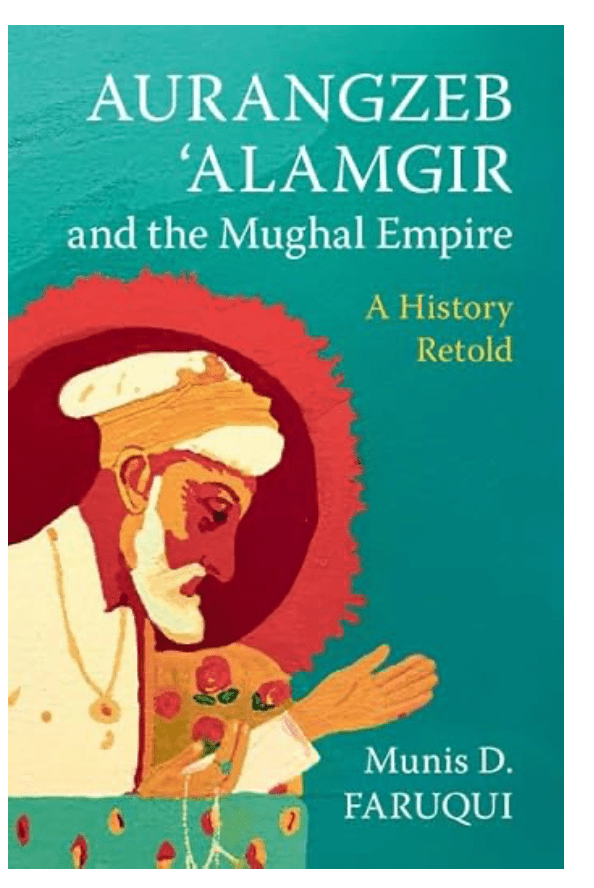
Aurangzeb “Alamgir and the Mughal Empire: A History Retold by Munis D Faruqui, Cambridge University Press £35, 416 pages.
 The neptune Herald