

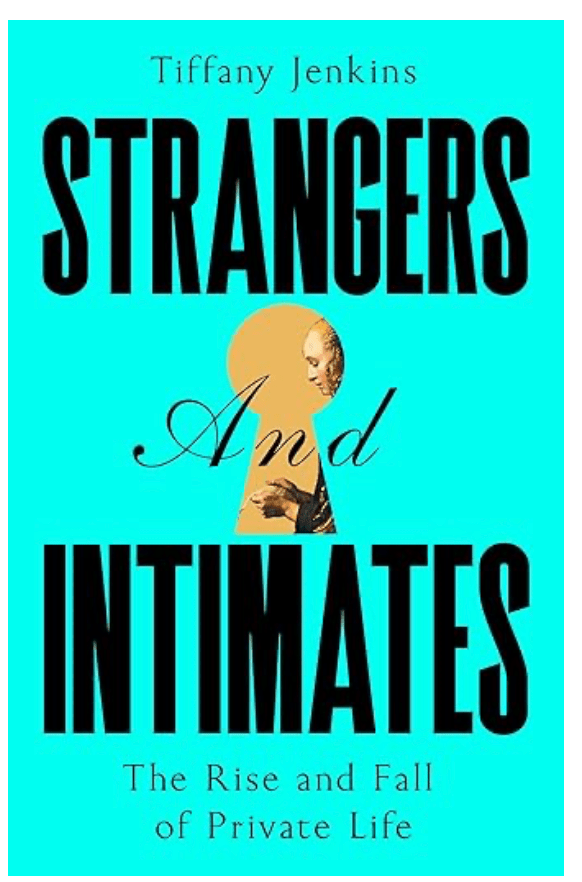
Private life is now in mortal danger according to acclaimed cultural historian Tiffany Jenkins, who takes readers on an epic journey, from the strict separations of public and private in ancient Athens to the moral rigidity of the Victorian home, and from the feminists of the 1970s who declared that “the personal is political” to the boundary-blurring demands of our digital age.
Strangers and Intimates is both a celebration of the private realm and a warning as social media, surveillance and the expectations of constant openness reshape our lives, Jenkins asks a timely question: Can private life survive the demands of the twenty-first century?
A typical example of blurring of public and private spheres is the catastrophic episode involving, breaches of security protocol by US politicians on private messaging app Signal, in which information about military strikes in Yemen was shared with family members in one group and with the editor-in-chief of The Atlantic magazine in another, attracted global attention and led to the firing of national security adviser Mike Waltz and his deputy.
The boundaries around personal lives are no longer tightly defined, and Jenkins claims the private realm is now under assault from both indifference and from a growing suspicion of privacy itself, by quoting the seventeenth-century adage “Do nothing publicly that you wouldn’t do privately” and her observation “privacy is for adulterers and murderers resonate strongly”.
Big Tech’s invasion of our private life and their data mining about our likes and dislikes, our viewing and shopping habits. Jenkins explores the state policing of private views, citing the 2023 case of Michael Chadwell, a retired police officer who sent a racist joke to his former colleagues which ended in him and others being found guilty under the Communications Act and receiving a suspended sentence.
Jenkins also cites as evidence what Rupert Bell, TalkTV’s royal correspondent said of Prince Harry: “If he really wants his privacy, then surely he must shut up”.
Jenkins writes: “It is natural nor universal to have a private life, neither fixed in definition nor eternal in form”. In ancient Athens, “Everything essential to life’s maintenance and reproduction- work, economic, sex, eating, cooking, birth and death was hidden from public view”. Yet in other eras Jenkins reveals “medieval Europe the two spheres had blurrr4ed into one”.
In the case of Cambridge Analytica, she notes, “committed a privacy violation” by mining personal data from millions of its conseuqences swinging Brexit and Trumps 2016 win are over-reach.
Jenkins claims the private space is valuable and must be defended, not because it is a hidden stage for intimate relations, and respite from the world outside, but because it is a place to arrange our ideas, to practise our speech and behaviour, so that we can deliver a more vigorous and thoughtful contribution to the public arena.
Strangers and Intimates: The Rise and Fall of Private Life by Tiffany Jenkins, Picador £20/ Pan Macmillan $28.99, 464 pages.
 The neptune Herald
The contents of this book seems like a warning to us all. Some people who make comments may have been victim of the group etc who bear a different backgtround to the norm but if they make a comment then they find themselves in trouble. Such is the vicissitudes of modern life. Peace. Aymen.
LikeLike