

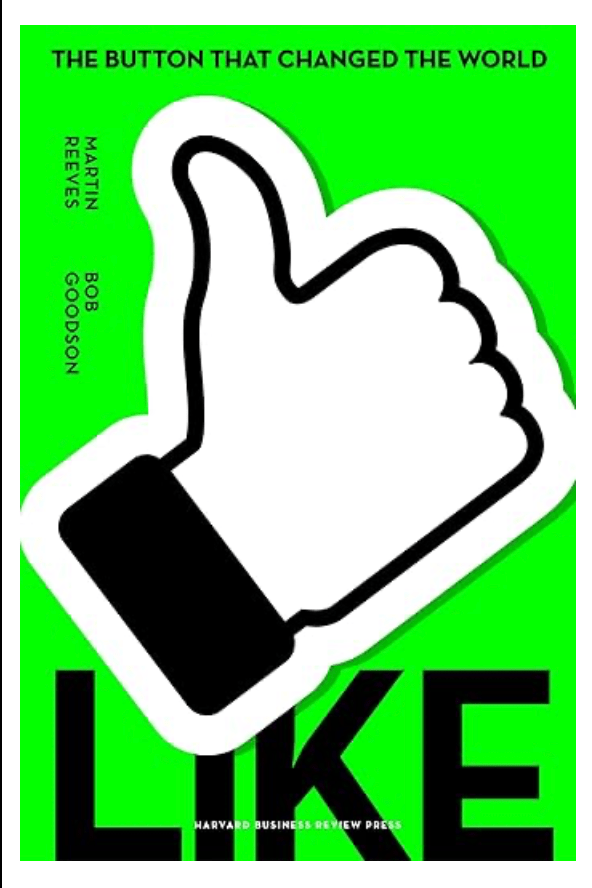
Early 2000s, Yelp a start-up came up with a novel and friendly feature for the emergent world wide web. Ordinary users could post reviews of restaurants that everyone could read. As there were very few people who were really interested in writing things on the internet. Yelps engineers needed to give them a reason to. The story of how they incentivised this user-generated content is the jumping off point for Like.
Yelp reckoned people might be compelled to post reviews if they received compliments from others. Did you know, over 160 billion times a day, someone taps a like button. How could something that came out of nowhere become so ubiquitous and even so addictive? How did this seemingly ordinary social media icon go from such a small and unassuming invention to something so intuitive and universally that it has scaled well beyond the original intent?
Like many features of online life, what is taken for granted was until recently far from self-evident. The authors Martin Reeves and Bob Goodson note that in the internet’s early days it was assumed that “just 1 per cent of people would write and create content that people would actually read”. The successes of the like button and Yelp “exploded that percentage”, creating an online world in which everyone was a content creator.
Goodson in his twenties, after training as a medievalist, he played an instrumental role in the development of like, sketching its “thumbs-up” iconography, thinking through the concept and discussing the code that made it possible to log a reaction without leaving a page. Imagine a time when the web was a sandbox full of smart, excited people inventing the future. We see how current ways of relating to each other- from expressing frictionless praise to instant messaging or posting stuff online- were the result of often quirky design choices made a couple of decades ago.
The book also explores issues such as smartphone addiction and mental health problems among children, dependence on regular virtual micro-validation, or the industry that aggregates vast amount of personal data from users, without compensation, then uses it to sell them tailored adverts.
Discussing the UK Information Commissioners’ 2019 targeting a like as a “reward loop” technique that encourages users to engage with a service that collects their data, they appear shocked. “How could this be? They cry. “A single technical feature among many, rooted in human sociality and embrace by millions. Why would anyone want to crack down on it?”
According to the authors the like button was invented for “narrow purposes” – such as encouraging user-created content – but was applied to “wholly different ones” and embedded into new business models.
Boosting user-generated content is hardly a narrow purpose, and creating a reward loop to incentivise users to post more seems a fair description of what the designers of the like button were doing.
In future, could the button end up in eternal conversations with AI? Might we register a like using only a thought? The author write “ History is full of predictions of dystopian futures that never materialized”.
Through insights from key players, including the founders of Yelp, PayPal, YouTube, LinkedIn, Gmail, and FriendFeed, you’ll hear first-hand the disorderly, serendipitous process from which the like button was born. It’s a story that starts with a simple thumbs-up cartoon but ends up with surprises and new mysteries at every turn, some of them as adeep as anthropological history and others as speculative as the AI-charged future. Drawing on business and innovation theory, evolutionary biology, social psychology, neuroscience, and other human-centered disciplines, this deeply researched book offers smart and unexpected insights into how this little icon changed our world – and all of us in the process.
Like’s breezy tone seems discordant and instructive.
Like The Button That Changed the World by Martin Reeves and Bob Goodson, Harvard Business Review £25/ $32, 288 pages.


The info in this book shows that even very clever analysts get things wrong and make faulty forecasts. The Like button is everyone’s favourite and gives a sense of power to all users!
LikeLike