
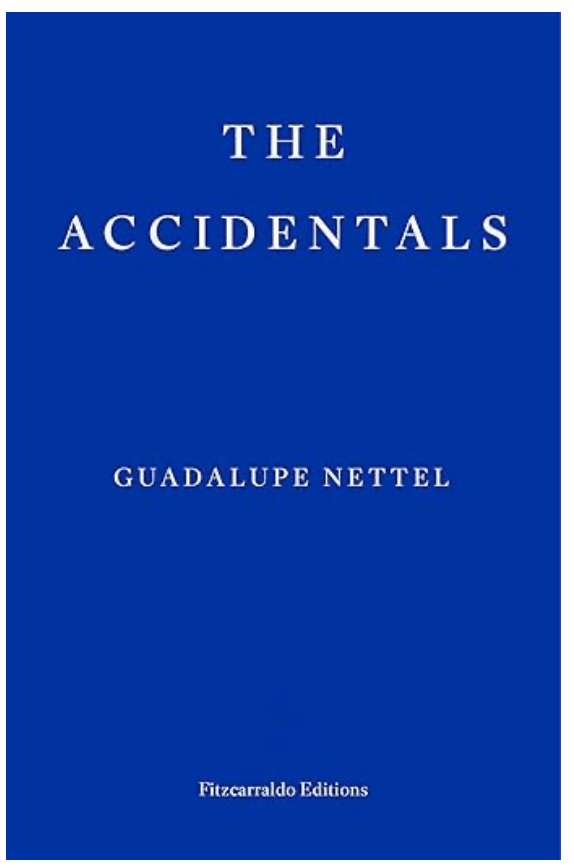
Mexican author Guadalupe Nettel’s novel Still Born, about motherhood, shortlisted fort the 2023, International Booker Prize, “Being a mother means being worried about someone else all the time”, mused its narrator Laura, explaining why she preferred to remain childless. Her latest book The Accidentals feature Mothers and labours of parenthood, where conventions of family life are examined, challenged and subverted.
The protagonists of these eight stories each find the ordinary courses of their lives disrupted by an unexpected event are pushed into unfamiliar terrain: a girl encounters her uncle in hospital, who was cast out of the family for reasons unknown, a menacing force hovers overs a fracturing family on a rural holiday; a couple and their children inhabit a stifling world where it is better to be asleep than awake; a man’s desire for a solution to his marital dissatisfaction has unforeseen consequences. Deft and disquieting, oscillating between the real and the fantastical, The Accidentals is the brilliant new book translated by Rosalind Harvey.
“Having children is to always be waiting for someone,” says the narrator of “Playing With Fire”, in which an idyllic family escape to the Mexican countryside turns sour. It is one of this volume’s two pandemic-related stories.
“The Torpor”, a dystopian tale set in a locked-down world in which the free press has been abolished (as journalists are rumoured to be highly active agents of infection) and news bulletins claim that climate change is “superstition held by an uninformed people”. The protagonist is a teacher who has only met her students online. Sleep offers the best escape – and almost becomes an act of rebellion.
“In dreams,” says the narrator, “ I am not married, or not always, and nor do I have a family, dreams are the most interesting thing going on in my life.”
The absence of maternal affection is conspicuous in “The Fellowship of Orphans”, in which the protagonist recalls growing up, “in a public institution where I shared a room with fifteen other children who cried, as I did, in their bunkbeds at night whenever they thought about the families they had lost or the ones they wished they had”.
In “Imprinting”, a hospital visit leads to a young woman’s chance encounter with an estranged relative, inexplicably banished from family events. “I had read something about the traces left in our memory by the touch and scent of those we come into contact with in the first few years of our lives,” she writes. According to the article, this bodily mark is where family ties are cemented.” The real nature of those family ties, however, often conceals darker corners. Another story, “A forest Under the Earth”, suggests that, tangled as they are, family bonds are difficult to escape.
In “The Pink Door” where a new neighbourhood arrival disrupts his marital routine, a mildly dissatisfied husband discovers the wisdom of the time-honoured adage: be careful what you wish for. “When I recall that day, It is all I can do not to blush and feel flooded by a profound nostalgia, because since then, my life has never been the same again.”
In “Life Elsewhere”, a failed actor living in Barcelona becomes obsessed with the tenants of an apartment he and his wide were unable to secure. He covets- and ends up vicariously inhabiting- the life of a more successful fellow performer. The Titular story focuses on a friendship between the unnamed narrator- a young girl- and Camilo, the son of Uruguayan political refugees living in Mexico in the 1970s. When an albatross strays too far from its home, or loses its bearings, it becomes an “accidental”, an unmoored wanderer.
The Accidentals are delightful and disturbing.
The Accidentals by Guadalupe Nettel, Translated by Rosalind Harvey, Fitzcarraldo £12.99,/ Bloomsbury $25.99 , 128 pages.

 The neptune Herald
Leave a reply to pennynairprice Cancel reply