
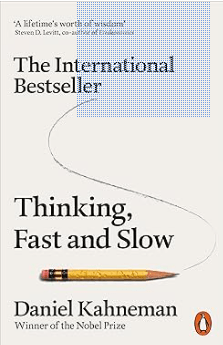
Why do we make critical decisions we do? Psychologist Daniel Kahneman, the godfather of behavioural science, whose work on prospect theory won him a Nobel Prize in Economics in 2002, an award he acknowledges he would have shared with collaborator Amos Tversky, had Tversky lived. Prospect theory means that investors value gains and losses differently, placing more weight on perceived gains than perceived losses.
His research come to a conclusion that women make better investors than men because they hold on to their investment where as men panic and sell when the market dips, thereby missing out on upswings. Kahneman estimates that the average person makes 35, 000 decisions a day – the fast kind, such as when to get up. What to eat for breakfast, what to wear and the slow kind that involve deliberate thinking, such as whether and whom to marry, which career to pursue, or where to live.
We make choices : fast, intuitive thinking , and slow rational thinking . Kahneman reveals how our minds are tripped up by error, bias and prejudice even when we think we are being logical, and gives practical techniques that enable us all to improve our decision-making. This profound exploration of the marvels and limitations of the human mind has had a lasting impact on how we see ourselves.
Kahneman’s analysis of the human mind and its many flaws remains perhaps the most useful guide to remaining sane and steady.
Best for Decision-Making Skills:
Thinking, Fast and Slow by Daniel Kahneman Penguin £28.05

 The neptune Herald
Leave a comment