
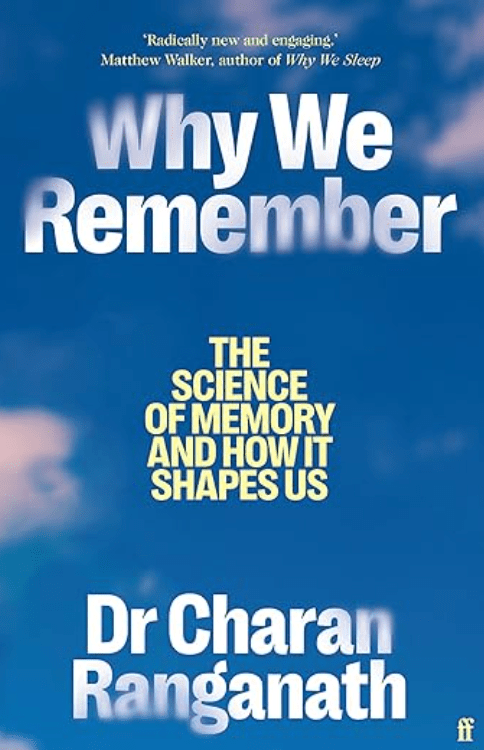
We talk about memory as a record of the past: but we aren’t supposed to remember everything. In fact, we’re designed to forget. We talk about memory as a record of the past, over the course of twenty-five years, eminent neuroscientist, Charan Ranganath, director of the Memory amen Plasticity Program at the University of California, Davis, studied the seemingly selective and unreliable nature of human memory to find that our brains haven’t evolved to keep a comprehensive record of events, but to extract the information needed to guide our futures.
Why We Remember, unveils the principles behind what and why we forget and shines new light on the silent, pervasive influence of memory on how we learn, heal and make decisions, By examine the role that attention, intention, imagination and emotion play in the storing of memories, it provides a vital user’s guide to remembering what we hold most dear.
Memory helps us notice e disruptions in familiar patterns. Memory can prompt joy, when recalling happiness of the past, or pain when trauma overwhelms us.
We respond only to our circumstances based on our memories of similar events in the past. Memory is a playbook, providing rules to live by. Memory can be flexible and adaptable to serve us best – which is what makes it so complex and so challenging to understand. Memory is never static and enable us to survive as a species.
The book is divided into three sections, “ The Fundamentals of Memory”, “The Unseen Forces” and “ The Implications” The first section explains how neuroscience has worked to discover the roles different areas of brain have played in how we retain, form and use memories from the hippocampus, long considered “ the area that determines whether you will remember or forget something., to the prefrontal cortex, which is like the chief executive of the brain, coordinating larger aims across networks.
In the second section Ranganath reveals how much memory springs from the imagination “ memories are neither false nor true: they are constructed in the moment, reflecting both fragments of what actually transpired in the past and the biases, motivations, and cues that we have around us in the present.Dynamic memory is an active shaping force.
Calling up memory is not like pressing play on a tape machine, but it’s like pressing play and record together, layered into the present moment of reflection.
This is how memories can be influenced by how they are c called up, and false memories layered into authentic ones. He discusses the memory wars of the 1980s and 1990s, which exposed a problematic rift between researchers studying the fallibility of memory and practitioners treating trauma survivors.
In the last section, we see both the perils of collective memory- consider the false narrative around the events of January 6, 2021, promoted. By followers of Donald Trump – and its positives: how recalling events with loved ones can both strengthen memory and social ties,
Ranganathan asks “ Why do we remember?
Why We Remember: The Science of Memory and How It Shapes Us by Charan Ranganath, Faber £20, 304 pages
 The neptune Herald
Leave a comment