

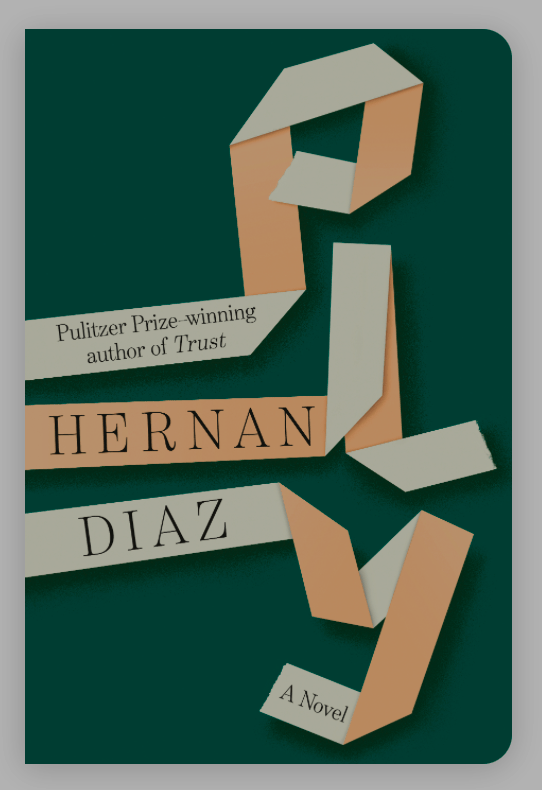
Imagine the place of future technology in American, as the Pulitzer Prize winning author of Trust turns to the future with an extraordinary novel that examines the palce of technology in the American imagination.
Centuries from now, at the dawn of a historical epoch filled with both uncertainty and promise, an orphan is adrift in a city on the brink of a great transformation. The state has been dismantled, and humans are reinventing social bonds and learning new ways to co-exit with nature. Following a childhood defined loss, survival and found family, the orphan grows up to become a “pincher,” someone who steals electricity from the grid to sell it on the black market. It’s a high-risk life, one that brings her into a rich art and music scene where she powers underground concerts. It also leads her to a colossal scientific invention that could change the very fabric of reality.
After rewriting America’s past with two previous novels, Herman Diaz defies expectations with his third and reveal us a breath-taking glimpse into the future. A major achievement from a major contemporary writer, Ply questions the place of technology in the American experiment with a plot that grabs both heart and mind. Newly-weds Callum Turner and Dua Lipa first bonded over a Hernan Diaz’s Trust (2022), a fiction of finance. In the Distance his 2017 debut, a spin on a western in which a Swedish émigré crosses the US during the gold rush, and in Trust , the story of a tycoon in the roaring twenties, “is about capital”. And the third side of this triangle in the way I see it the United States, is technology”.
Set in “a few centuries” in the future, Ply features a postmodern society in decline. Democracies and the legal scaffolding they provide have collapsed. Social mobility has given way to a caste system; literacy and life expectancy are down. “Even the concept of the human itself is lost its central position”, a character says of the shift. “Our devices re-defined what both “intellect” and “consciousness” meant; the very notion of experience which is how we meet reality, was challenged.” Ply is a novel of ideas built from a story of people. Combining both Dickensian odyssey, family drama, and scientific thriller, Ply charts the tenuous boundaries of selfhood and the distance that inevitably stands between us and those we love.
The unnamed protagonist of Ply is an orphaned since the age of 11, who steals power from the grid to fuel batteries that she uses to power underground concerts and trade as a form of currency. She is approached by an older woman trying to enlist her help to power a particle accelerator to fold the space-time continuum. “One character says it’s the end of the Renaissance, which I kind of like as an idea, but you could say it’s the end of humanism, you could say it’s the end of enlightenment…It’s the end of those paradigms but also the beginning of a new one.”
Argentina-born Diaz, left for Sweden with his parents, who were fleeing the 1976 military coup, when he was two. The family returned when democracy was restored eight years later. Having fallen in love with English in his teens, Diaz pursued an MA in literature in London, followed by a PhD in New York. “As I moulded my mind in the shape of the English language, there was this hyper-awareness of its syntactic architecture, it’s still a source of wonder” Diaz explains. Grammar comes to the fore in the second part of Ply which switches from the pinchers first person narration to third person. Shuffling with point of view, pronouns and tenses allowed Diaz to query not only consciousness but politics, he says.
“This book is intentionally presenting ideas I think are beautiful, but that demand a different gear in reading that slows you down. I’m very interested in that tradition of trying to marry aesthetic pleasure with intellectual audacity.” Diaz was also a writer in residence at the Zuckerman Mind Brain Behaviour Institute at Columbia University, which fosters dialogue between scientists and artists. “What started out as a book about technology in the United States, ended up being really a book about connection, and who are we, and how can this “I” relate to another” Diaz says.
.Ply by Herman Diaz, Picador/Riverhead, $34, 574 pages.
 The neptune Herald