

The Venice Biennale, founded in 1895, is one of the most important and oldest international art exhibition as the tide of change is surging, the map of Europe is redrawn, the artist ride the wave with a spirited seriousness and exuberant originality. Every two years, a selected curator is given the unique opportunity to prepare an exhibition that reflects their vision of the contemporary art of their times with artists from around the world and that is visited by hundreds of thousands of art afficionados. Though painted red and festooned with gaudy flags and stars, the Russian pavilion contains piles of rubble – Ilya Kabakov’s metaphor for the collapsed Soviet dream. In Hans Haacke’s smashed-up pavilion of the newly reunified Germany, viewers kick the dust of fascist history as they stumble over broken marble slabs, while in adjacent rooms Korean Nam June Paik’s video sculptures “Electronic Superhighway: from Venice to Ulan Bator” with good global connectivity.
Chinese artists attend the biennale for the first time, America is represented by a French national, Louise Bourgeois, and director Achille Bonito Oliva shuts down the Serbian pavilion on political grounds. Massimiliano Gioni, Artistic Director of the New Museum, New York who himself curated the 55th Venice Biennale in 2013, had the idea to interview the curators of the Venice Biennale long before he created his own, after having seen his first curated by Achille Bonito Olivia in 1993. What moves Gioni is his dedication to understanding the ins and outs of how one goes about tackling such an extraordinary task: “One should keep in mind that the Biennale- like any exhibition – is a complex creature with heads and limbs sprouting in every direction. The most visible manifestations of this strange organism are the artists and the artworks, which inspire, transform, and expand the narrative frameworks conceived by the curators. There are also a horde of other figures: designers, architects, lighting experts, manual workers, painters, and transporters – the Biennale staff, who arrange the shipment of masterpieces from the four corners of the globe, renovate buildings, produce performances, oversee maintenance for the Giardini, and the president, who chooses and appoints the curators, and there is the general director of each sector, and so on. The Biennale is made by everyone and belongs to everyone, not just the curators”.
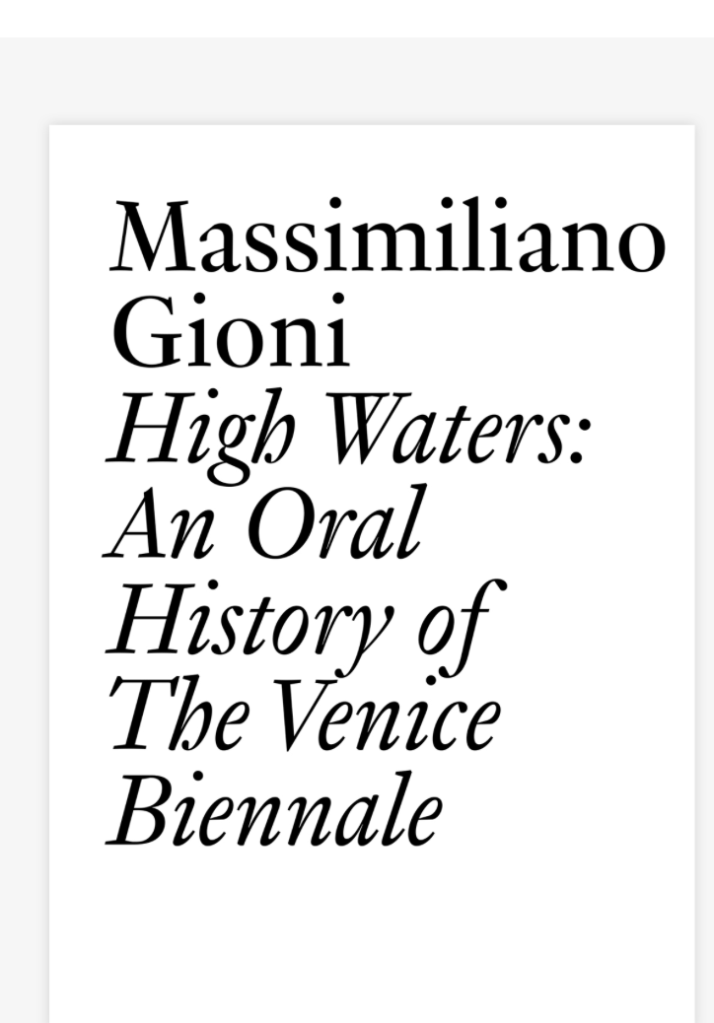
High Waters, Massimilano Gioni’s account of the world’s oldest, most prestigious biennale from 1993 to 2026, plunges you into year after year of glittery scenarios with an immediacy and light touch rare in art writing.
Swiss curator Bice Curiger’s enchanting 2011 edition turns on “The Shape of Time”, placing Tintoretto with Christian Marclay’s 24-hour video piece “The Clock” and Urs Fisher’s life-size candle replica of Giambologna’s “Rape of the Sabines” melting away through the summer. The 2015 binnale by Okwui Enwezor, the “Kofi Annan of contemporary art”, shows a majority of works from the global south, displayed to the soundtrack of Karl Marx’s Das Kapital read in different international voices. In Cecilia Alemani’s 2022 biennale, 90 per cent of the artists are female, drawing a record 800, 000 visitors. Maurizio Cattelan’s pope stricken by a meteorite “La Nona Ora” in 1999, Joana Vasconcelos’s chandelier of 14, 000 tampons :The Bride” , dangling in the Arsenale, 2005; Yang Pudong’s fabulist film masterpiece “Seven Intellectuals in Bamboo Forest”, 2003, are among framed moments vividly recalled.
Quaint then, it conjures a lost world now, yet still its ideas inform Gioni’s overarching concerns here: modernism’s utopia and dystopias; how culture survives when we ”suffer from a surfeit of information and a deficit of meaning”; the risks, as art is increasingly politicised, of dumbing down into didacticism-“the dictator of the Like”.
In 2024’s “Foreigners Everywhere” Adriano Pedrosa magnificently trod the tightrope. Pedrosa’s choices included Pakistani-American Salman Toor’s Emerald-tinted rococo-reminiscent paintings of queer experience of belonging and distance, and Dalton Paula’s beautiful gold-leaf portraits recovering Afro-Brazilian history. Gioni’s detailed account captures that exhilarating mix, and why it matters beyond the art world.
High Waters: An Oral History of The Venice Biennale by Massimiliano Gioni, JRP Editions £22, 240 pages.
 The neptune Herald