

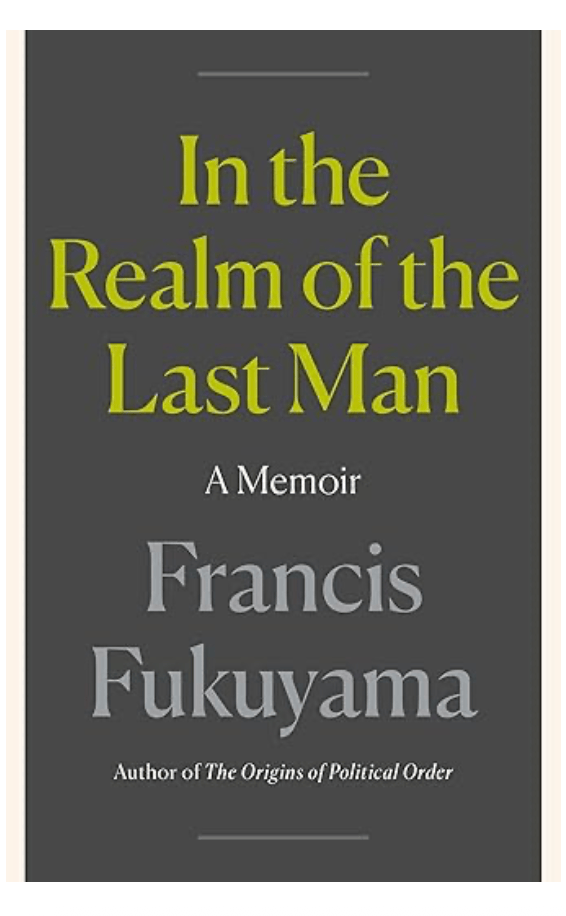
Francis Fukuyama, a leading public intellectual, for the first time, charts his political and intellectual evolution across fiv3e transformative decades. We follow him from the circle of students around the conservative intellectual Allan Bloom at Cornell, into the halls of power in Washington and at the RAND Corporation, and into private conversations with world leaders from Muammar Qaddhafi to China’s powerful elite. Fukuyama touches on his family’s story, including his relatives’ internment during World War II along with other Japanese Americans. And, in surprisingly personal terms, he reflects on the experiences that led him to reevaluate his own thinking, most notably his dramatic public break with the neoconservative movement over the invasion of Iraq.
In the Realm of the Last Man is personal and political history- the story of a life that illuminates the troubled fate of democracy and liberalism over the last fifty years. Fukuyama brings richness of personal experience and pathbreaking scholarship to illuminate the crises of the twenty-first century.
In 1974, Fukuyama, who excels at woodworking, and build his own furniture, fresh out of Cornell, spent several months in Paris studying the era’s towering French theorists- Roland Barthes, Jacques Derrida and their respective circles. A student of Allam Bloom, Fukuyama had been intellectually informed by classical political philosophy and so was jolted by turning up at ground zero of post modernism. He learned from French theory encapsulated by a conversation he had with literary scholar Julia Kristeva, who assured him that “Stalin had a point.”
Fukuyama writes “ I always preferred photography to painting, because the photograph recorded something that someone actually saw.”
What made cold war exceptional was not the collision between two visions of the future but the fact that both antagonists were regulated by a single vision. Communism and liberalism were rival tenses of the same grammar. They shared the founding premise of modern politics that tomorrow is not merely different from today, but better, and that people have the power to shape it. The future was not a horizon but a project or rival projects. Legitimacy was borrowed from a time that had not yet arrived. That is what made the 20th century at once so political and so murderous.
In the Realm of the Last Man by Francis Fukuyama, Profile £20/ Farrer, Straus and Giroux $29, 304 pages.

