

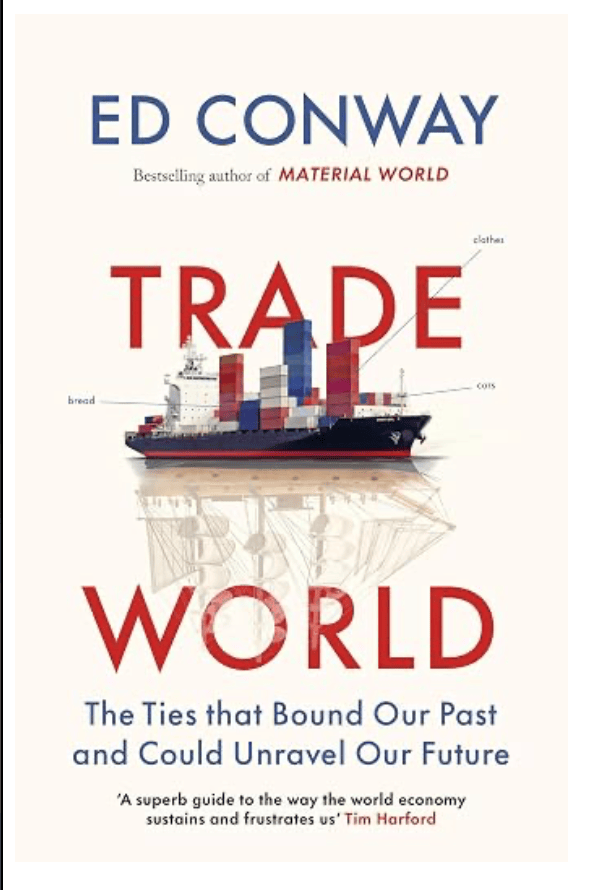
Ed Conway, Economic Editor at Sky News, award-winning and Sunday Times bestselling author of Material World, whose latest book Trade World, focuses from ancient civilizations, empire and globalisation through to the most influential geopolitical issues of our times. This is the story of humanity. From the copper in Mesopotamian ploughs to the silicon atoms within the chip inside your smartphone, intricate global trading networks have evolved over millennia to fulfil the distinctly human desire to buy and sell.
Trump’s traffics hasn’t reined in global commerce, In fact, it is growing every further and stronger. This surge is doubly surprising, given President Trump’s series of tariffs and talk of fracturing of international commerce. This is the story of resilience “The death of globalisation has been declared man y times in the past few years, but a glance at the data shows nothing of the sort has happened. On contrary the volume of goods being carried around the world keeps rising” write Conway.
He throws some light on the clever systems that move goods around, like Irina the world’s largest container ship, a Megamax 24 vessel some 400 meters lone, capable of carrying 24 rows of containers across its vast deck, and it carries more cargo than the entire 100-vessel fleet of the British East India Company.
Their sheer scale explains the resilience of the global system, allowing companies to reroute around pesky tariff or unexpected political conflicts.
Trade as a share of world GDP has been climbing steadily for decades until the early 2010s, creating an era of “hyper-globalisation” driven by multi-national corporations. The global trade reached record volumes last year, growing roughtly at 5 per cent, even as US tariff rates hit levels unseen in the modern era.
The US now takes in more imports from Taiwan than from China, a vastly larger economy. Since the pandemic, global companies have learnt to navigate disruption by mapping vulnerabilities, shortening supply chains, and moving some production closer to home.
Conway writes “ One of the defining features of Trade World is there… is a fragility… to the way we have arranged the global economy”.
China’s decision to restrict critical minerals demonstrated last year, Conway explains, the shift from an era of untrammelled flows of goods is giving way to a new world of restrictions, intervention and conflicts.
Trade flowing depends on global powers being willing to keep sea lanes open, a role played first by the UK in the 19th century, and by the Us ever since. This is one reason Trump’s attack on Iran remains so consequential, raising the prospect of a return to tolls on shipping passing through natural waterways like in the Strait of Hormuz. The old toll system ended when Denmark abolished tolls to pass through the Øresund Strait back in 1957.
Conway tells extraordinary story through these three commonplace products- bread, cloth and cars. With a compelling blend of economic history and first-hand access to key figures and institutions, he takes us from policy treaties to ground level to show us the people who make, ship and sometimes smuggle the products we buy on a daily basis.
Discover the hidden, shifting trade world behind everything you see around you.
Trade World: The Ties That Bound Our Past and Could Unravel Our Future by Ed Conway, WH Allen £25, 512 pages.

