

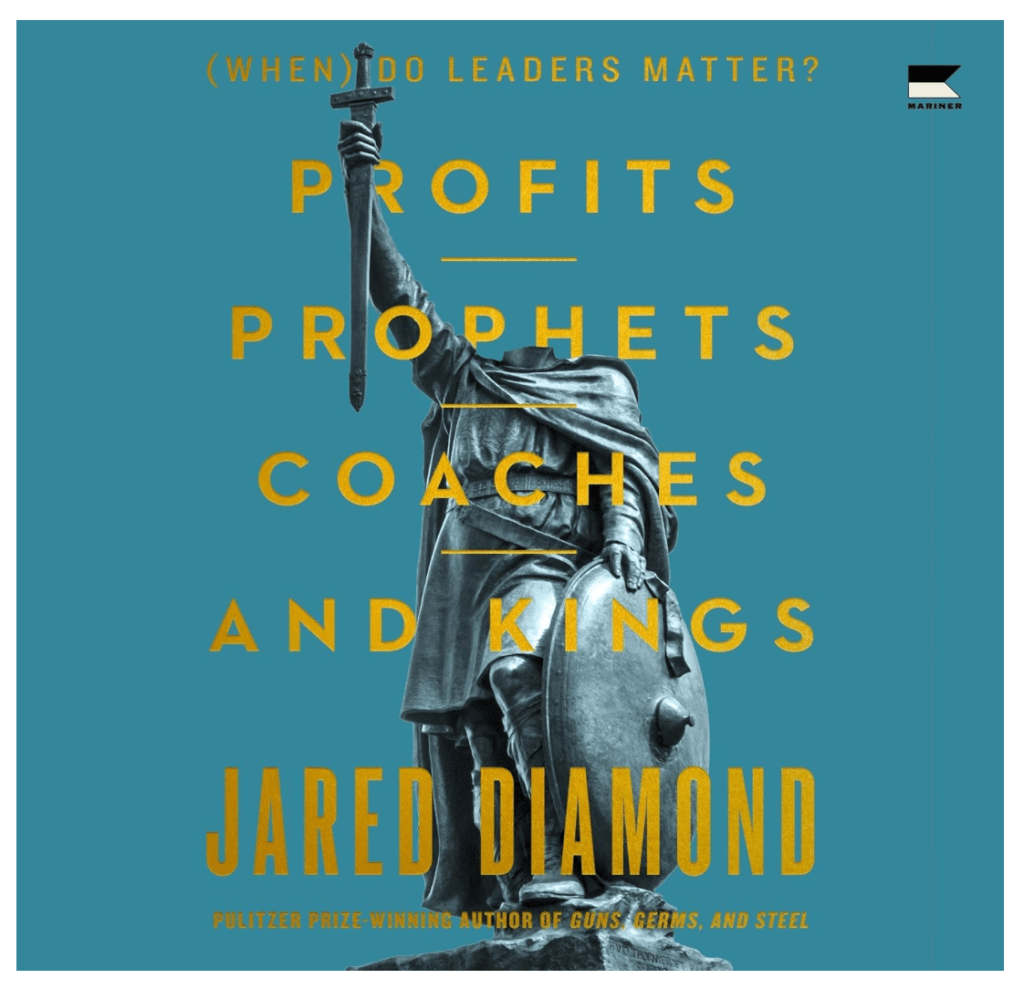
American scientist, historian and Pulitzer Prize winner, Jared Diamond poses the big question whether leaders or luck play a greater part in steering the course of history. In Profits, Prophets, Coaches and Kings, Diamond announces at the start that he will pursue a middle path- more realistic than taking one side, but a warning that what follows will fall short of a resounding theory. Researching the life of one striking individual creates a temptation to attribute more influence to them than is justified. Inspired by the rigour of laboratory scientists using controls, he cites as a natural experiment- thrown up by the course of events- how “dozens of modern political leaders have been assassinated, while hundreds of others haven’t” and every year “thousands of business CEOs do or don’t get fired”. His best example is Seretse Khama, the first leader of an independent Botswana from 1966. For several decades after independence, Diamond points out, Botswana had the world’s fastest-growing economy. “It’s now attractive to foreign investors as the best governed, least corrupt, safest, and nearly the richest country in Africa. It has always had free elections, and has never had a civil war.”
Diamond writes citing George Washington and Lee Kuan Yew, Singapore’s first prime minister, as well as Jeff Bezos and Steve Jobs of Amazon and Apple.
On 13th March 1930, a truck sped into an intersection, headed straight for another car’s right front door. The passenger of this chauffeur-driven car happened to be Adolf Hitler. If the truck had hit the door, Hitler would have been crushed the Holocaust and World War II if the chauffeur had been slower to react? Some believe Hitler was unique in his evil abilities, while others think the war was guaranteed by the harsh conditions imnposed on Germany post-war.
Do leaders like Hitler, Margaret Thatcher, Genghis Khan, Mark Zuckerberg, Bill Belichick or Christ really change our world? If yes, what qualities and circumstances are required of a leader to make their mark?
Drawing on his deep study of life and career of a diverse cast of leaders famous and obscure- from Botswana President Seretse Khama to environmentalist Rachel Carson, to legendary UCLA basketball coach John Wooden – Diamond reveals how leadership effectiveness is determined by a range of complex interrelated factors. Understanding their successes and failures and the opportunities leaders did (or did not) seize illuminates the influence of today’s leaders and helps us to reflect on the value of our faith, our passions, and the people who happen to steer our ship.
A year after Botswana became independent, diamonds were discovered, offering a route to riches in the until then poor and under-developed country- but as others have found, also carrying the potential for waste, corruption and intertribal conflict. Khama came from the tribe on whose land the diamonds were found and made the transforming decision to give the rights to the national government. When he moves to business leaders, religious leaders, and sports coaches, the examples remain stimulating but conclusions are even more elusive. He is on the whole dismissive of the contribution of CEOs arguing that someone else would have done what they did, even if resulting in a different corporate structure. His desire not to give too much weight to “the right person: and to search instead for the “right” circumstances suggests by the end another possibility: that he gives too little weight to ideas, innovations or techniques.
Profits, Prophets, Coaches and Kings: (When) Do Leaders Make a Difference By Jared Diamond, Allen Lane £25, Mariner Books $32, 288 pages.

