

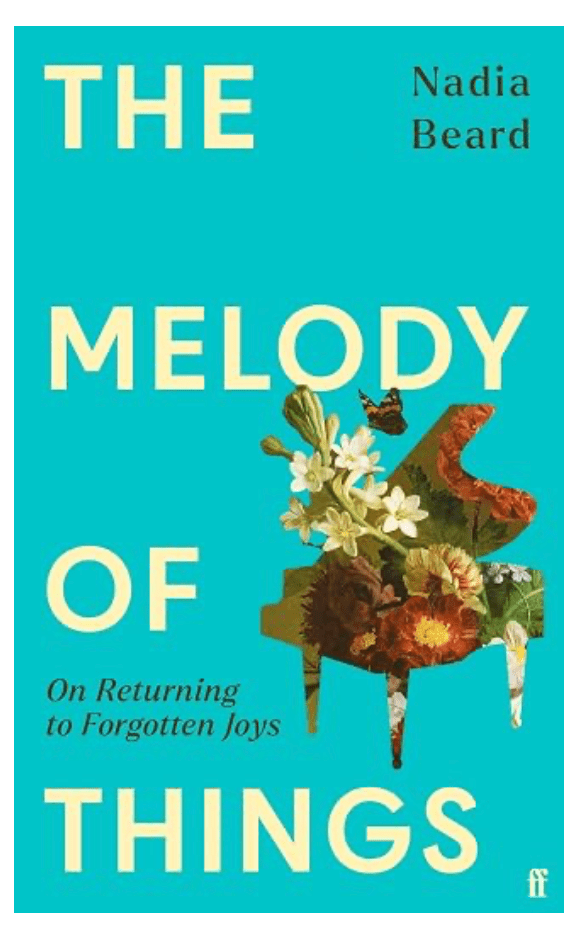
How do we lose touch with things we love? And is it possible to find out way back to them? These questions drive professional writer and managing editor of news organisation Coda Story, Nadia Beard on a quest to reclaim the dreams of her childhood for her adult self.
Swimming and cycling once you learn you never forget is the same true with piano?
Beard frames her musical homecoming as a journey of personal rediscovery after turning away from music following university. Until them, “playing the piano and cello was the core of my life” Nadia remembers. Growing up in the south-east of England, a shared love of music had connected her beloved grandmother, who made sure Beard and her sister learnt to play the piano, and her ability had proven strong enough to earn her a private school scholarship. Many, if not most of us, set aside the pursuits of youth once the reality of working life sets in, leaving the joys and skills of those days far in our slipstream. The Melody of Things depicts what coming back to those early love entails, as Beard uproots her life to return to study the piano, years after she had stopped playing as a teenager.
By thirty, she had become consumed by her journalistic career. So much so that she surprised herself when, on a visit to friends in Germany, she discovered a grand piano in an otherwise empty room and on an impulse sat down and began to play. The remembered fragments of Handel and Schumann her fingers produced left her amazed and elated. Just as astonished were her friends, who had no idea she had ever played at all.
“Their surprise stood as a daunting testament to how completely I’d neglected music,” Beard writes. Even more potent was the rush of emotions that sprang from creating music through her own efforts, which she seductively describes as “the elusive, addictive feeling I recognized as that which also braids itself through the first moments of falling in love”. Music had hooked her once again. No matter her technique had atrophied. Beard records how, as if led by a siren call to recapture a lost love, she pursued her passion.
The next year and half squeezing in three hours at the piano daily before and after her full-time editorial job, not caring that the gruelling schedule blotted out the possibility of a social life. Beard explores the pleasures, frustrations and revelations of re-dedicating herself to the instrument as an amateur. Her story is an invitation: to seek out the restorative power waiting to be discovered in the pieces of ourselves we have, perhaps unknowingly, lost to time. Her first priority was to prepare the audition programme of works by Bach, Beethoven and Scriabin that she hoped would earn her entrance to a one-year course at the music conservatoire in Tbilisi, Georgia.
When she attended a bucolic springtime piano residency in France to prepare for the audition, she admitted she felt like an “imposter” beside the many accomplished musicians there. But she persevered, reflecting, “What an uncanny resemblance music lessons can bear to therapy,” when her piano coach counselled her “to get out of her own way”. The acceptance letter arrived in the summer of 2020. She jubilantly viewed the coming school year as “a starting point, the beginning of an attempt to deepen my relationship to music, to heighten it, to make it mean something”. She was not deterred by the need to move to an unfamiliar country or the taxing number of hours needed to continue her job remotely while also putting in needed practice hours.
Her memories of her teenage self, keeping coming back, nonchalantly skipping practice and “assuring myself and others I wasn’t good enough” to pursue a professional career.Her conservatoire music teacher Manana Gotsiridze nurturing her was enough. “Choose the music you love, and I’ll teach you how to play it,” she said. Beard with her self-doubt persisting and the re-emergence of her years-long battle with stage fright, her fears became reality, when she was given the opportunity to play the very piano her hero the Soviet superstar Sviatoslav Richter had performed on when visiting Tbilisi years before. Beard’s fingers flailing for the right notes, only to find the wrong ones. “While I began this year as a pianist, I might not end it as one,’ she worried.
When Canadian cellist called Arlo, who was nonchalant about the need for practice as Beard was zealous about it. But his good natured exuberance buoyed her confidence, persuading her to begin playing first for small groups, then larger ones.
Beard completes her year with the self-assurance to perform as a soloist with a small chamber ensemble in Europe. She had learnt to face the music, and taught everybody how to withstand the wrong notes even as we find the melodies.
The Melody of Things: On Returning to Forgotten Joys by Nadia Beard, Faber £18.99, 256 pages.

