

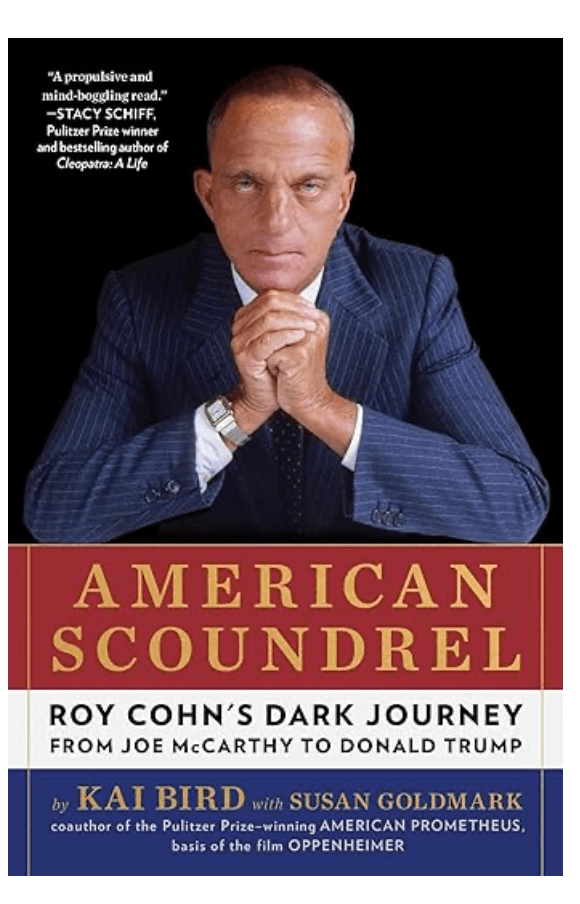
Roy Cohen is a super-lawyer and political fixed, whose shocking exploits over four decades have shaped the modern political era, most prominently the ascent of Donald Trump.
In October 1973, Donald Trump was an ambitious 27-year-old from Queens trying to push his way into the world of Manhattan real estate. He met Roy Cohn, the notorious New York lawyer whose clients included mobsters and celebrities, one evening at the members-only Le Club Restaurant. Trump and his developer father had just been sued by the US government for discriminating against Black people seeking apartments in their properties. Trump asked Cohn “What do you think I should do?” to which Cohn replied “ Tell them to go to hell and fight the thing in court and let them prove you discriminated.” Cohen became Trump’s lawyer and his mentor. Roy Cohn, in his thirties Cohn had begun working as the Mafia’s hired legal gun. In his forties, he was an informal adviser to Richard Nixon. In his fifties he partied with the glitterati at Studio 54 and visited the Regan White House where he traded gossip with the first lady. Trump phone the older Cohn daily and studiously emulated not only his mannerisms but core philosophies. Years after his death in 1986 from AIDS- related complications, Cohn emerged as a central figure in Tony Kushner’s Pulitzer Prize-winning play Angles in America. Cohn’s feistiness, his surly defiance and his charm were frequently flourished to conceal vast insecurities, particularly regarding his closeted sexuality. Cohn, a street fighter, self-promoting hustler, and a true Zelig of the dark side, was a nefarious actor in a startling number of history-shaping events whose influence resonates to the present day.
“Cohn’s right wing, anti-intellectual spirit haunts us from his Queens mausoleum. He is right here beside us, the ghoul of our nightmares, a man whose personal immorality planted the seeds of American’s descent into the political folly of the twenty-first century” Kai Bird and Susan Goldmark writes in American Scoundrel. Brilliant Cohn grew up in privilege, his father, Albert Cohn, was a New York Supreme Court Justice, his mother the daughter of a wealthy banker. By the age of eight, Cohn was reading his father’s court briefs. He started Columbia University at 16, and went on to attend Columbia Law. Through his father’s connections, he became an assistant US attorney at 21. Although inexperienced, he had other talents like a photographic memory for documents, a gift for examining witnesses and a flair for hyping his cases to the press.
Cohn became national figure during the espionage case against Julius and Ethen Rosenberg, who were accused of transferring documents about the atomic bomb to the Soviets. Cohn was instrumental in selecting the judge: Irving Kaufman, who got a judgeship with the support of Cohn’s father.
FBI chief Edgar Hoover labelled the Rosenberg case the trial of the century, the case lasted only three weeks as Cohn persuaded the judge and jury that the Rosenbergs were guilty, and they were both sentenced to death by electric chair. After two years of appeals, they were executed.
The case revealed Cohn’s “guiding principles, never waste time on regrets, never show any doubts, and never apologise” writes Bird.
Cohn became the chief counsel for Joseph McCarthy, the public face of the Red Scare. From McCarthy, Cohn would learn “how to get away with being a demagogue”. McCarthy and Cohn ruined the reputations of military men, diplomats and many others before the undoing in the 1954 Army. McCarthy hearings, watched on television by 20mn Americans. Cohn lied under oath numerous times, but escaped prosecution. He returned to Newe York, joined a law firm and cultivated friendship with Barbara Walters, Ayn Rand and media figures. During 1960s and 1970s he represented all five of the city’s Mafia families. He also fended off three investigations into his own conduct by Robert Morgenthau, the Manhattan district attorney.
In 1967, Cohn’s mother died, and he used his inheritance to buy a five-storey 28-room townhouse to act as a base for his law firm and his residence. Cohn represented Trump in his real estate deals, and he arranged a lopsided prenuptial agreement when Trump married his first wide, Ivana. He also introduced him to Studio 54, the night club where Truman Capote, Bianca Jagger, Calvin Klein and various other A-listers partied. Cohn became close to the Reagans and was their guest at the White House. Trump’s cousins noted difference between Trump and Cohn. Trump had “narcissism combined with insecurity. But in Roy there was a total security in who he was- except for the fact that he didn’t want people knowing in public that he was gay.”
“His values, his unethical behaviour, and his political mindset have survived and replaced the values of the establishment he so resented” Bird writes.
American Scoundrel: Roy Cohn’s Dark Journey from Joe McCarthy to Donald Trump by Kai Bird with Susan Goldmark, Simon & Schuster £30/Scribner $32, 528 pages.

