

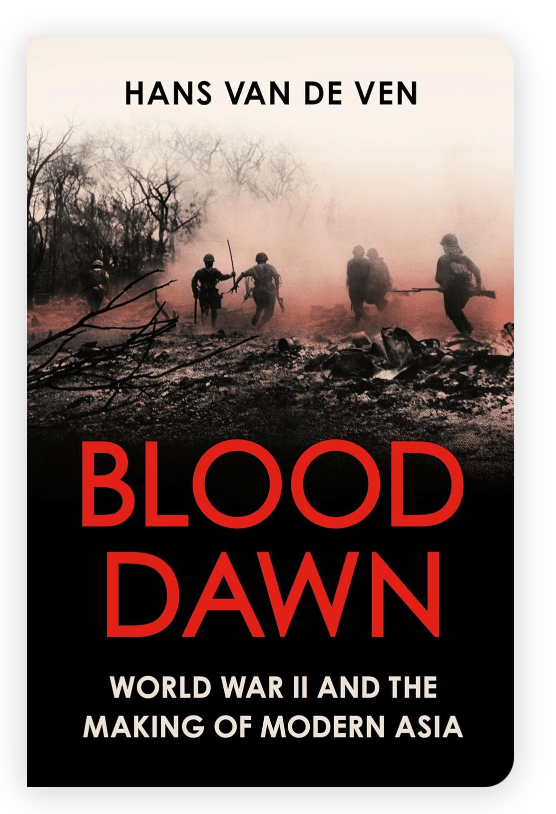
Sinologist at the University of Cambridge, Hans van de Ven, in Blood Dawn, complains while Western histories of the second World War, focuses on the events in Europe, the US and the Russia, Asia remains “insufficiently examined, inadequately narrated, and rarely remembered in public discourse”. In Blood Dawn, he offers a vital corrective restoring the Asian war to its proper place, and tracing the destruction of empires and the emergence of the nation-state in Asia. van de Ven tells the Asian story deftly, including the depression which helped finish off the parliamentary experiment of Taisho democracy in Japan, empowering soldiers for whom liberalism smacked of decadence and racial grievance. Prince Konoe Fumimaro, the future prime minister who would lead Japan into war with China, returned from the Paris Peace Conference in 1919 convinced that western universalism was liberally humbug, “ that the white people – and the Anglo-Saxon race in particular abhor coloured people is an apparent fact, so blatantly observable in the US treatment of black people.”
Resentment of the white man’s racial hierarchy, however, did not prevent Japan from devising one of its own. Konoe’s Greater East Asia Co-Prosperity Sphere promised liberation from western imperialism while demanding oil and submission to Tokyo. Anti-imperialism served as a paradoxical prospectus for a new empire.
Marco Polo Bridge where in July 1937, a missing Japanese soldier during night exercises near Beijing resulted in gunfire, and ultimately, a full-blown war between China and Japan. Chiang Kai-shek, China’s military leader, retreated inland to Chongqing and fought on. By Pearl Harbor, China had already endured four years of war. Japan then swiftly swallowed the Philippines, Malaya, Burma, and the Dutch East Indies in four months. The fall of Singapore in 1942 left Churchill bewildered: “ How came 100, 000 men half of them of our own race to hold up their hands to inferior numbers around 35, 000 of Japanese?
Asians with common cause with Japan against their colonial masters, in particular Burma’s Aung San, who raised an independence army under Japanese patronage before turning coat, and Subhas Chandra Bose, the charismatic Indian Congress rebel who travelled via Nazi Germany to take command of the Japanese-backed Indian National Army.
Bose’s Indian National Army only counted 30, 000 men, the Allied Indian Army, by contrast mobilised 2.5 million. It was the latter under William Slim, that clawed its wayback through South-East Asia. Then came the Atomic era with ministers fearing open protests and the war council divided over surrender, Hiroshima and Nagasaki furnished a face-saving explanation for defeat: Japan had succumbed to overwhelming force rather than disorder at home. Navy Minister Yonai Mitsumasa accordingly called the bombs “gifts from gods”.
van den Ven details Bengal famine of 1943-44 and Java famine of 1943-45 where British requisitioning and Dutch Scorched-earth policies helped turn wartime scarcity into catastrophe. Both went a long way in discrediting colonialism. Out of the Imperial wreckage, postwar, emerged the nation states of India, Pakistan, Burma, Ceylon and Indonesia.
By early twentieth century, from India to China, Western imperial powers dominated Asia. Then, in 1930s, Japan began to tear down this old order in pursuit of its own imperial ambitions-first by invading China, and then by launching its assault against British, Dutch and American outposts across Asia and the Pacific in December 1941. As Japanese forces seized vast swaths of territory and pressed toward India, the brutal fighting cost millions of lives across the continent. Simultaneously, the war’s chaos and suffering supercharged anti-colonial movements from India to Dutch Indonesia. Ultimately, it was charismatic leaders of these movements- Mao, Nehru, Sukamo who built the new Asia of independent nation-states that emerged in the war’s bloody wake.Blood
Dawn: World War II and the Making of Modern Asia by Hans van de Ven, Basic Books £30/ 435, 464 pages.

