

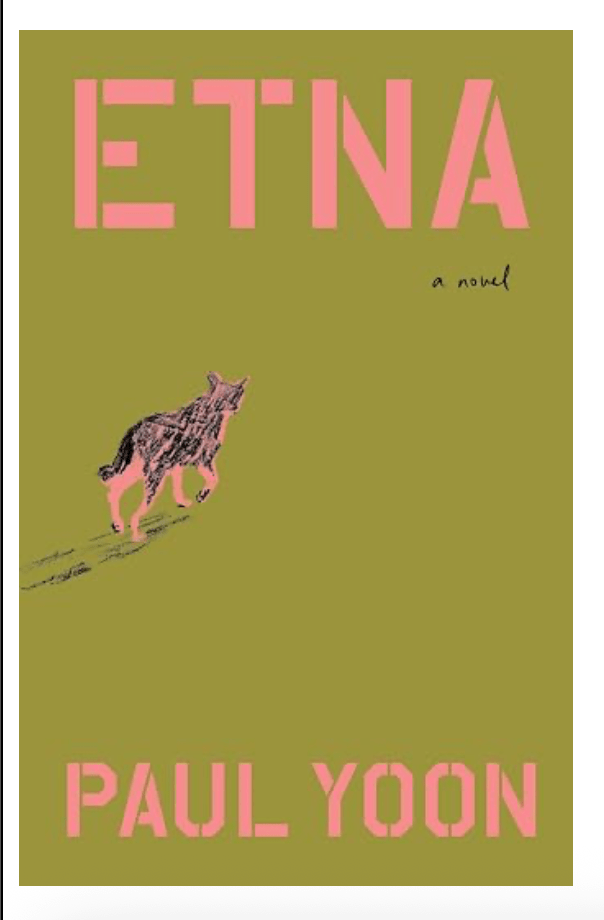
Paul Yoon’s Etna is set in a fictional country in the present day, this is story told through the eyes of an ex-military dog, Etna. Etna after surviving years of a devastating war, decides one night to leave the men he has fought alongside for years and returns home- to the place where he has taken from when he was young, in the thin but persistent hope that if a home exists for him, it might be there.
This exhilarating odyssey told through the eyes of a war dog in his own battle-weary, gritty voice, as he traverses across ruined landscapes and fights to survive in world that, even in peacetime, proves to be just as precarious. His story is timeless, iridescent feel of a modern parable that draws on a fabulous ancestry of storytelling.
Along the way, he encounters other animals and humans who are attempting to figure out how to start again. What makes a life when there is no home to go back to? How do we begin to trust each other again after such profound loss?
This novel is about the power of an idea, about never giving up, and ultimately a novel about finding hope in the most-dire times.
“I was born near water,” our narrator begins in “The Field”, the first of four sections that the story traverses through. “An early memory: waking up to a den of pale noses surrounding me before our mother came, the silhouette of her face looming over us in the sky, the tall triangles of her ears pocketing the smell of the coast.”
Soojin, a young army recruiter, arrives at the farm in her pick-up truck, wrenching him away from his humans, mother and siblings and bestowing the name Etna on this 12-mont-old shepherd. The only human who can communicate telepathically with Etna- in the same way that he communicates with other dogs and animals- Soojin is an important figure who will return later in the story. Edna starts his life in the company of another recruit, a dog called Fuji with bright blue eyes, who asks nervously as they drive away from everything familiar, “Are we a pack now?”
That question trails Etna as war devastates an unnamed country, ravaging every corner of the earth, air, land and cities, creating fragile new communities of humans in ragged shanty towns. Once handed over to the military, Etna forms a bond with his handler, Jason, who trains him in the rough trade of a war dog: “I learned what to listen for and what to smell out: nicotine and sweat urine and gunpowder; the hum of an electrical current like in a battery or a SIM card; the weight of a foot on a floorboard.” He becomes an expert at slicing through arteries, attacking men through open car window, sniffing out bombs and mines.
By the age of five Edna has lost his first pack. His friend Fuji runs off one day, choosing the uncertainty of freedom; the two humans he is closest to have strong runs of luck, until in a brief scene of searing horror, they don’t.
Edna embarks on a journey across the remaining three sections: “The City”, “The Mountains” and “The Sea”, his final stop as he strives to return to his native-coast. He meets an old, disfigured dog who remembers, among the wreckage, the long-ago pleasures of life as a pet, “the infinite smells of the sidewalks, the hundreds and hundreds of shoe soles and where those shoes had been”. Edna dodges crafty human, negotiates the dangers of a broken land, find a saviour in a kind human called Hong, and forges a tentative bond with a smaller dog, Semeru.
“I had seen mountains burn. I had seen lakes burn and boulders burn and airplanes burn and tanks burn and animals burn and humans burn and bones burn… I would always remember the sound of the burning.”
But when Edna is his own self, he is so often pure dog, with his ear cocked to the sounds of misshapen world. His ability to smell tumours inside a human body, his yearning for a long-obliterated home, to hear once again the sound of the tide, “heavy and patient” like a hand running through his fur, translates a dog’s longings and senses into our human language.
This novel is about survival and about the search for home and family, a longing for a pack of one’s own, that persists in the face of the ultimate brutality.
Etna by Paul Yoon, Scribner £14.99, 208 pages.

