

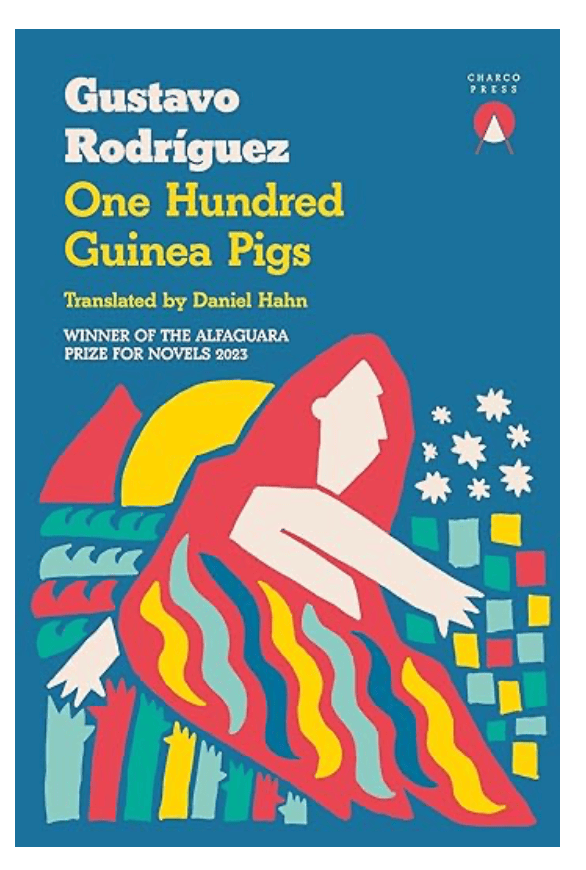
Lima-based Gustavo Rodriguez’s topical novel about assisted dying, which remains illegal in Peru, amid degenerative muscle disease sufferer Ana Estrada making international headlines in 2022, as she was granted the right to end her life without her doctors facing legal punishment. Originally published as Cien Cuyes in 2023, it went on to win $175,000 Alfaguara Prize for fiction that same year and is Rodriguez’s first book to appear in English, translated by Daniel Hahn.
Eufrasia Vela, a hardworking carer, on her way to tend to Doña Carmen, a lonely elderly bedridden widow living in the affluent Lima district of Miraflores, mourning both her independence and her lost view of the sea as their relationship slowly deepens into something unexpected.
One Hundred Guinea Pigs is a novel about loneliness, dignity, friendship and what it truly means to care for another person, with rich ethical questions and unforgettable characters, it is the kind of novel that sparks conversation and lingers long after the final page.
It’s a far cry from Simbal, the village in the Andean foothills where Eufrasia was born. She takes on the care of Carmen’s neighbour, Jack Harrison, a retired doctor stoically enduring cancer and facial paralysis with the help of a whisky bottle and his beloved jazz. Later she finds employment in the nursing home where a former client, Doña Pollo, now resides. There Eufrasia meets the friends who call themselves The Magnificent Seven. Rodriguez’s characters are united by the emotional glue of a love of film and music which crosses class divisions. Eufrasia, films open up a new world and provide answer to pressing questions, while the residents enjoy the memories revived by old favourites: “the recollection of that blaze of being truly alive”.
The residents’ family members rarely visit them, whereas Eufrasia, a single mother, sees more of her clients than she does her own son Nicolás. Eufrasia is a benevolent presence who genuinely feels for her frail charges. They, in turn, take advantage of her compassion by persuading her to enable them to die with dignity. Doña Carmen insists on paying, Eufrasia recalls the words from an uncle: “All you need are ten guinea pigs and you can start a business.” The doctor is more circumspect, meticulously planning his demise and supplying the means before involving Eufrasia.
Rodriguez’s image of six elders packed into an antiquated Volkswagen Kombi, nodding their heads to an ABBA soundtrack on their way to a rendezvous with death, is vividly written. We do not mourn the passing of his senior characters, all of whom have lived long, privileged lives. The real poignancy come with the story’s final twist. Rodriguez critiques Peru’s contradictions- its economic inequalities, social fractures and political turmoil- and an increasingly conservative society, as he targets conservative Catholicism, and how its restrictive mores impact homosexuality and reproductive rights. The doctor rails against society “that promotes a black market for rich girls to have successful abortions for which they pay a fortune while the poor girls bleed to death”.
One Hundred Guinea Pigs by Gustavo Rodriguez, translated by Daniel Hahn, Charco Press £11:99/$17.95, 272 pages.

