

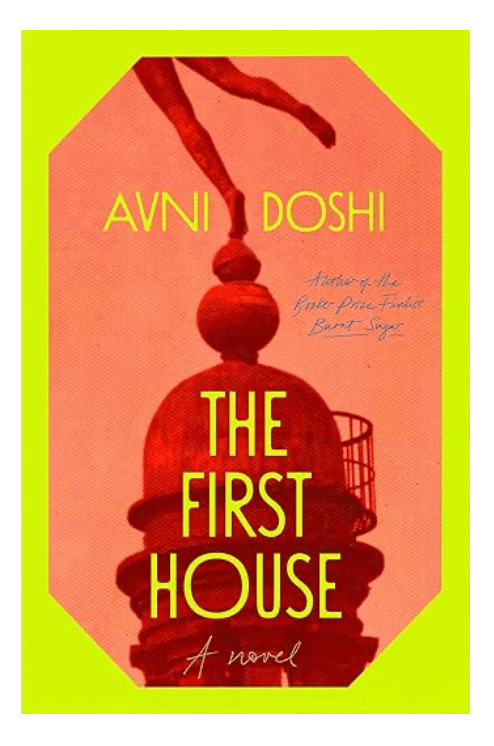
Avni Doshi, the Booker Prize finalist author of Burnt Sugar comes a fascinating novel of rupture and rebirth, of one woman’s journey to understand the fault lines in her marriage, her home, and her family, her betrayal, renunciation, and renewal, who swims to the other side and comes up for air.
When my husband comes into the bedroom we have shared thirteen years and tells me he doesn’t want to be married anymore, I reach for my neck. My head is missing. A husband announces he is leaving, that he was never happy. A woman is left behind with their two children in the house they built together, reeling at this forced recasting of the story of their marriage. She is wading, with her two daughters, into the marigold-strewn water of the Ganges in search of liberation. Everything becomes strange an encounter at the grocery store, a looming cicada horde, a statue of Diana that suddenly appears in her neighbour’s yard. Or was it always there? Can she do well, Women whose inner lives have become almost unbearably intense and families bound together by love, resentment and bewilderment. In The First House, Doshi’s heroine is unsparingly truthful in acknowledging the devastation of separation and the pain of betrayal. She is perceptive on how the end of a marriage can incur a desperation bordering on hysteria and how it demands almost superhuman strength to recalibrate a future left in utter disarray.
“The old ways of living were quickly forgotten, mopping the floor alone, she stops and stares”, “I felt the ground opened beneath me and I knew there was no end to how far I would fall. Where would I go and what shape would I take if he left me?”
He does leave and what happens is that the garden goes unwatered, the fridge languishes unfilled, garbage rots, she forgets to wash and eat and begins instead to fixate on a statue in a neighbour’s garden of the Roman goddess Diana drawing back her bow. There was clarity in anguish. Everything fell away. My pain was naked, there was no hiding, and against that bare skin, the world was sharp and full of colour.”
He lectures his stunned wife that “marriage was impossible for him, not just with me, but as a concept. Monogamy was unnatural, though we all pretended otherwise”. As her world becomes unstable, the narrator searches desperately for symbols and systems of meaning that might restore order to a life no longer obeys a familiar logic. She turns to astrology, Hindu goddesses and Roman myth. She obsesses over an infestation of cicadas, the pungent scent of the Bradford pear tree in her garden and a stray cat that installs itself in her home.
As she wades through the aftermath of her marriage her complicated family resurfaces. Although close to her parent, her relationship with them is strained, and she is fully estranged from her older sister – the perfect daughter – who still lives at home and always disapproved of her husband. So when die the trouble begin: And where will she go from here?
When she was a child, an astrologer in India told her parents that the family would die in water. Ever since, they’ve avoided pools and lakes and the ocean; no one ever learned to swim.
The First House is a disquieting novel about the strange textures of female consciousness under intense pressure.
The First House by Avni Doshi, Hamish Hamilton £16:99, 240 pages.

