

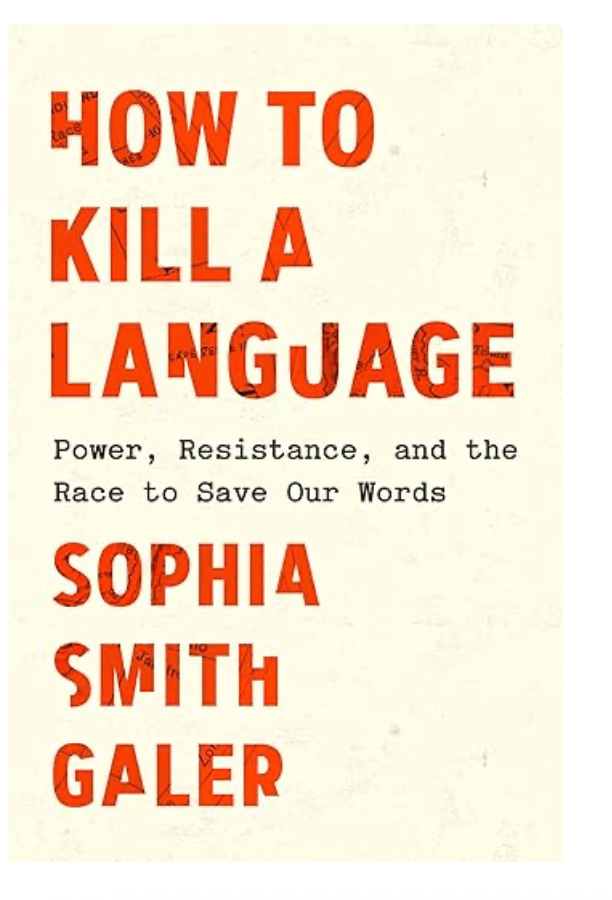
Journalist Sophia Smith Galer who learnt French and Spanish at school and added Arabic at university, travels across continents and generations to chart How to Kill a Language. She travel to Ghana to Kurdistan to explore minority languages that cling on, despite repression and neglect, and interview their speakers. In Ecuador, she sees first hand how shame deters parents from passing Kichwa onto their children. In Oman, she learns about languages with roots older than Arabic but never officially recognised. Smith Galer rushes to the 93-year-old emigrée’s beside in north London. In Italy, near Placenza where she grew up, she searches for her grandmother Nonna’s dialët, which is vanishing form diaspora communities and Italy itself. But languages can be reclaimed: We meet the Karuk tribe of California, pioneering a grassroots language immersion program, and the storytellers challenging the criminalisation of Kurdish. And in her discussion of Hebrew, Smith Galer reckons with the unintended consequences of raising a language seemingly from the grave.
How to Kill a Language is part investigation, part travelogue from a disappearing world that exposes the true costs of this mass extinction event. Smith Galer’s own experience with language loss, it’s a fierce rallying cry for a multilingual future. It is a timely call to arms for the teaching and learning of modern languages, having acquired French, Spanish and Italian, through respectively, birth, education marriage and professional development. In the Tuscan form written by Dante, was one of the great unifiers of the 19th century nation state, but its politically motivated rise consigned other indigenous languages, and Myriad regional varieties such as al dialét, a second class status. Only in 1999 did Italy give in to EU pressure to protect its minority languages, and even then it recognised only 12 of the 26 that existed. English comes across as a kind of linguistic colonial knotweed, “bloated and greedy”. US state was once home to 20 known language families (the EU has just three main ones: Slavic, Germanic and Romance and 80-90 different languages. Smith Galer travels to the forests in the north of the state to track down one, Karuk, the language of the indigenous tribe of the same name, which has only 12 adult speakers. “The disappearance of such languages would represent a loss of scientific knowledge, but preserving and even better, reviving them is “about something more fundamental, and more visceral. It’s so we don’t forget who we are” Smith Galer writes. The survival of Ukrainian is bound up with the survival of the nation itself. The book clearly make a strong case that the health of languages is intrinsically linked to the mental and physical health of the people who speak them, and the ecological and cultural heritage of the places where these languages are spoken.
Smith Galer wants to revive minority tongues amid growing homogeneity, and many complacent monolingual anglophones ride the inexorable rise of English, expecting to be understood everywhere, although Mandarin boasts more native speakers.
Languages can be killed in several ways: war, the climate crisis, nationalism, and even quite choices made at the dinner table. Around the world, an unprecedented shift is draqing speakers toward national and global lingua francas. For some, that means losing the language of parents or grandparents, for many, it is a permanent farewell to systems that carry knowledge, culture, and belonging. With half. Of our 70-00 languages due to disappear this century, linguicide is one of the most pressing cultural emergencies of our age.
How to Kill a Language: Power, Resistance and the Race to Save Our Worlds by Sophia Smith Galer, William Collins £22, 304 pages.

