

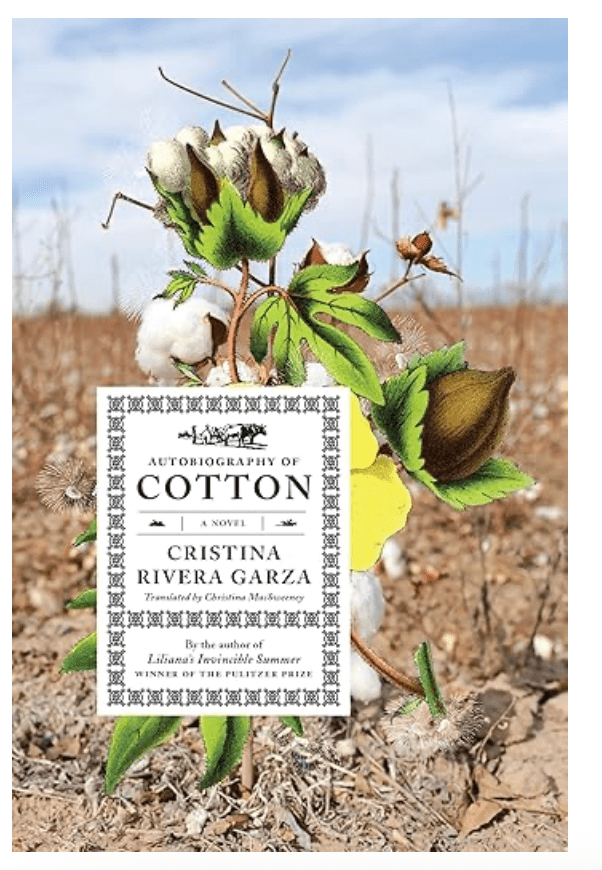
In1934, a young José Revueltás travelled to Tamaulipas to support the cotton workers’ strike in Estación Camarón, which became the basis of his landmark novel Human Mourning. In her own ground-breaking novel, Autobiography of Cotton, Cristina Rivera Garza, a doctorate in history, recounts her grandparents’ journey from mining towns to those same cotton fields as it intersects with Revuelta’s life in a vivid and evocative history of cotton cultivation along the Mexico-US border. She reveals the story of how cotton farming developed in post-revolutionary Mexico, capturing a moment of possibility and hope that “white gold” might transform the lives of poor agricultural workers, one that was quickly curtailed by exploitation.
Through archival research and personal narrative, Rivera Garza chronicles the way cotton transformed the borderlands by reconstructing the cotton workers’ strike and reveals how cycles of deprivation and ecocide persist across generations. Deeply personal and politically acute, Rivera Garza crafts a new kind of border novel that tells how a brittle land radically altered her grandparents’ lives and the territories they helped to develop. An intimate fictionalization, Autobiography of Cotton reveals a rich social history of agriculture colonization, labour activism, environmental degradation, and cross-border migration.
Total Recall of 1930s erased history
First published in Spanish in 2020 and newly translated into English by Christina MacSweeney, drawing on archival materials, literary works, political histories and family papers, all woven around the author’s first-person narration.
River Garza’s paternal grandparents, José Maria Rivera Doñez and Petra Pefia Martinez, who were among the thousands of cotton workers or compesinos inspired by an ultimately failed – and now little known- 1934 strike at Estación Camarón, and by political vision behind it. It is through their eyes that the novel’s setting is brought to life, often in scenes of work or quiet domesticity.
Petra and José cross paths with charismatic activist and author José Revueltas, whose writing Rivera Garza references throughout. She remembers the couple’s joyous occasions- including the birth of her father- as well as devastating losses to their family and livelihoods.
She reflects “moments of abundance and devastation have succeeded one another in increasingly brief, intense cycles on a desert that, far from acceptations that depict it as lifeless, emerges time after time with new and varied natural resources”.
Rivera Garza declares that “Memory is pure fiction” and in a recent interview she spoke of fiction’s power “to make everything open to questioning”.
Autobiography of Cotton by Cristina Rivera Garza, translated by Christina MacSweeney, And Other Stories £14.99/ Graywolf Press $17, 240 pages.

