
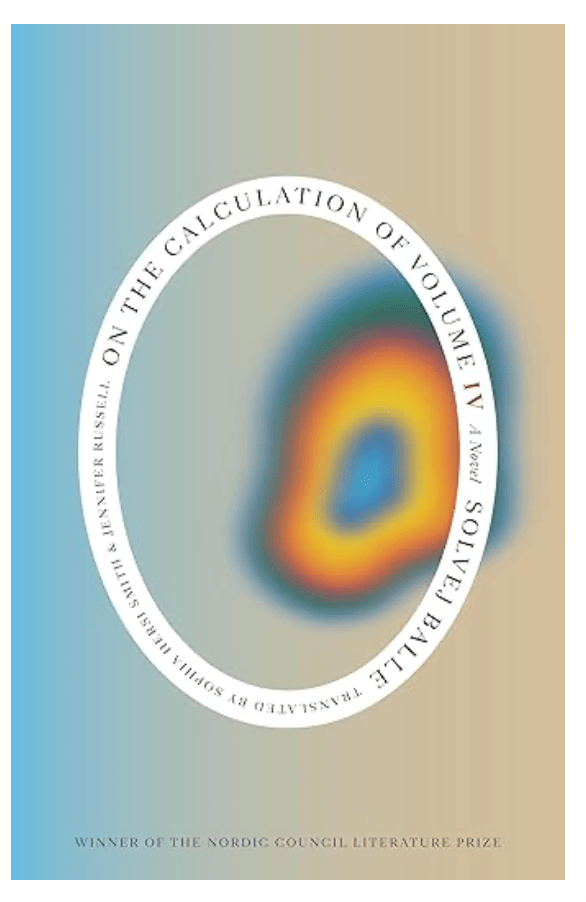
In the fourth instalment of Balle’s expansive, Danish writer Solvej Balle’s speculative fiction septology, we pick up with Tara Selter, former antiquarian book dealer, who has been repeating the 18th of November for 1,892 days, over five years, According to her calculations, she is now about 35 years old and teems with new faces, new people and voices from every corner of the western world.
She is no longer alone in her repetitions. In Book III, Tara met other people also trapped in the same repeating day, first sociologist Henry Dale, whom she encountered at a University lecture on Roman supply chains, then 17-year-old Olga ande her missing computer scientist friend Ralf Kern, Together, the four installed themselves in an uninhabited but thankfully well-stocked mansion outside Bremen. Now Book IV heralds the arrival of many others, and soon to be even more, roaming uncertainly through the same November day. Could this be the first stirrings of an alternative civilization? The big house in Bremen turns into the headquarters for this growing group of time-trapped individuals. But who are they and what has happened to them? Are they loopers, repeaters, or returners? Book IV is a brilliant modern spin on the myth of Babel in the Book of Genesis, and asks urgent questions concerning the naming of things, of people, and of the functions of language itself-must a social movement have a common language in order to exist? Snatches of conversations, argument, and late-night chatter crowd onto the pages of Tara’s notebooks.
Amid the buzz and excitement of a new social order coming into being, Book IV ends with a sudden, unexpected and tantalizing cliffhanger that no one – not even Tara, our steady cataloguer and cartographer of the endless November day- could have foreseen.
When the Book IV opens, five new people, likewise stuck in the 18th November, have arrived in the north German port city, having followed missing persons signs previously posted for Ralf. The two groups are excited to find others and they quickly recombine and reconsolidate into a whole: “I’m not sure when, the newcomers stopped being our guests and became the newest residents of the house” Tara reflects.
Tara and Henry’s term for a unit of 100 days – pass more people arrive at the house. A few strays come alone, but there are many groups, couples and pairs: there is plenty of space and they are always greeted warmly. “It feels as though we had each been walking along our own path in the same forest. As though we had got lost and had done so separately, but we were not along in being lost, because the others were on the paths too” Smith writes.
Together, the group question how to live responsibly in a rift in time. 18th of November although mysterious, what is consumed on the day is gone for ever. Tara and her group favour wilted vegetables, food about to expire or destined to the incinerator, hoping to leave less of a devastating mark on their world. They try to grow things: a sprouted potato and a potted lemon tree take. They make textiles out of odd clothes, ready other empty house nearby for future guests. They are building a future, perhaps even a society.
Tara’s own desire to be alone, at least sometimes, that pushes against her relief at finding others as Tara’s observations register hints of tensions, conflicts, her own doubts.
On the Calculation of Volume IV by Solvej Balle, Translated by Sophia Hersi Smith and Jennifer Russell, Faber £12.99/ New Directions $15. 95, 208 pages.
 The neptune Herald
Leave a comment