
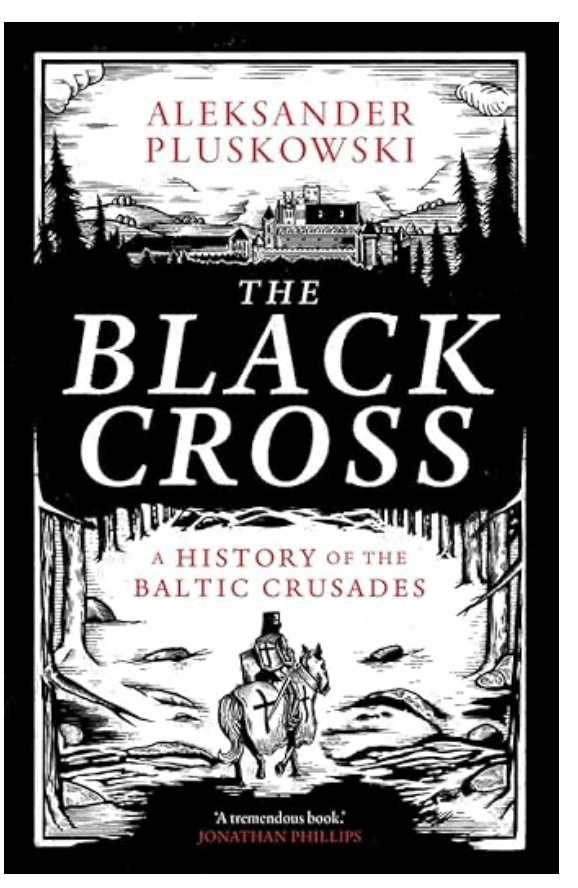
Crusading armies unleashed a relentless holy war against the last Pagan societies in northern Europe, particularly in the Baltic Sea region between the twelfth and fifteenth centuries. Led by Catholic rulers, churchmen, and most importantly of all, the warrior monks of the Teutonic Order, they sought to expand Christendom through conquest and conversion. In the process they forged a new world with a profound legacy that resogates into the present.
Aleksander Pulskowski, professor of medieval archaeology at the UK’s university of Reading, explores how the construction of castles and towns, and the introduction of new languages, technology, monetary economies, and religion transformed the conquered societies. Moving through the years, we see how the history of the crusades was reinvented in the twentieth century to serve nationalist aims, including those of the Third Reich. This is the concise study providing the impact of centuries of religious warfare across northern Europe, which became a model for Nazi expansionism. Western Christianity’s eastward lunge against Norse and Slavic variants of paganism laid the foundations, he writes, for the Baltic port cities of Riga, Tallinn, Lübeck and Bremen. Under the Teutonic Order, these and other seafaring cities became part of the medieval Hanseatic League, trading in amber, furs, wool, herring and pitch resin.
Early 13th century Teutonic Knights from the Germanic territories of Saxonu, Holstein and Bremen, as well as from parts of Sweden and Denmark rode into the eastern Baltic and, with swords and Bibles proselytised the idol-worshipping tribepeople.
Backed by Papacy, they were kin to the Crusaders fighting in Muslim-controlled Palestine. As the Knights settled in and around what is today Finland, the Baltic states, Belarus and north Poland, they built trading posts and spectacular fortified strongholds like Marienburg, the UNESCO-listed castle complex near Gdańsk now called Malbork. German Christian colonialism was as mercantile as it was militarised. The knights came to be known as the Baltic Germans. Under the Tsars they owned manorial lands on which serfs often toiled in misery. Baltic German social dominance of Estonia, Latvia and Lithuania lasted for seven centuries until 1939, when Hitler summoned ethnic Germans everywhere back home to the Reich.
The final crusade in the north was an attempt planned for 1521 by the Danes, to convert the pagan Inuit of far distant Greenland to Catholicism. Although Greenland was a step too far for Latin Christendom, as the Teutonic Order fell into decline in the late 14th century when it could no longer justify a holy war after its expansion east was blocked by the Grand Duchy of Lithuania. The Order was formally ended in 1809, when Napoleon ordered its dissolution and the confiscation of its remaining territories in the German states. The Teutonic knights are remembered as warrior monks who brought Latin Christianity and so-called law and order to the pagan world.
The Black Cross: A History of the Baltic Crusades by Alekander Pluskowski, Yale University Press £25, 480 pages.
 The neptune Herald
Leave a comment