
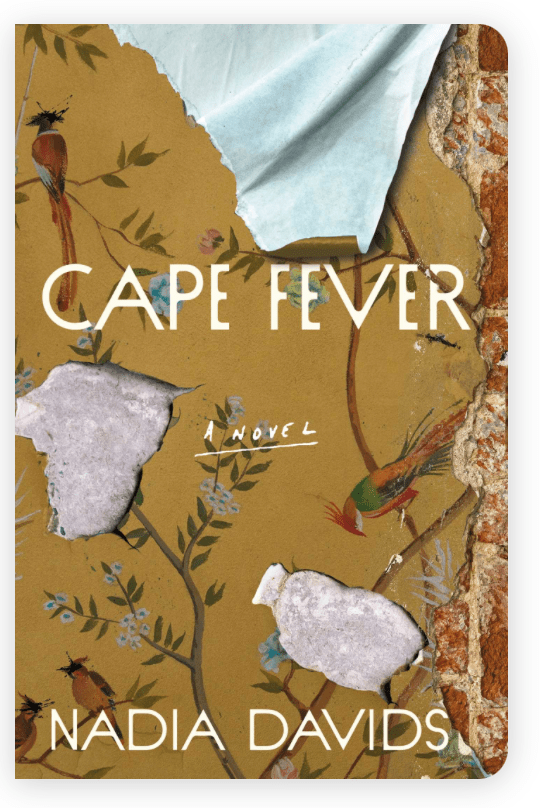
Nadia Davids, an award-winning South African author, paints a gothic psychological thriller set in the 1920s in her latest novel Cape Fever. A young Muslim maid finds herself entangled with the spirits of a decaying manor and the secrets of its enigmatic owner.
In small unnamed city in a colonial empire in 1920, Soraya Matas believes she has found the ideal job as a personal maid to the eccentric Mrs Hattingh, whose beautiful, decaying home is not far from The Muslim Quarter of a harbour city where Soraya lives with her parents. She comes highly recommended to Mrs Hottingh through sentences she tells her she can’t read. Mrs Hattingh decides to employ Soraya, who comes from a large, proud, but impoverished family- her father is a respected Islamic scholar and calligrapher- as a live-in maid.
Her freedom is restricted, her hours almost exclusively Mrs. Hattingh’s own.
When Soraya settles into her new role, she discovers that the house is alive with spirits.
While Mrs. Hattingh eagerly awaits her son’s visit from London, She offers to help Soraya stay in touch with her fiancé Nour by writing him letters on her behalf. So begins a strange weekly meeting where Soraya dictates and Mrs. Hattingh writes- a ritual that binds the two women to one another and eventually threatens the sanity of both.
Cape Fever displays battle of the wills between a housemaid and her mistress, set against a backdrop of colonisation in “Southern Cross Colony”. A region clearly recognisable as Davids’ native South Africa.
Mrs Hattingh rhapsodises over the dishes her new servant will cook: almond desert with rose water and cardamom doughnuts. She frames Soray’s serf-like status as a lucky break, impressing on her the widow’s publicly undertaken work for the less fortunate in the society. Both women are hiding something significant. Soraya’s obedient face is a result of her mother’s warning to “always keep something back”.
Mrs. Hattingh’s absent son, Master Timothy in London after being demobbed from the recent Great War, promising a visit home which is constantly postponed. Mrs Hattingh, short of money, has Soraya stuff the draughty windowsills with newspaper; grief stricken white mothers who have sons lost to battle abound. The “Grey Woman” the spirit of a former maid who lurks in Soraya’s sequestered quarters, urging her to imagine revenge towards Mrs Hattingh- “this house all aflame- her whole body a burning log” and thje painting of Rosa a beautiful girl of Soraya’s own background which Mrs Hattingh hangs in pride of place in the main house and which the lonely Soraya confides in. Mrs. Hattingh in the guise of a benevolent helper, writes letters dictated by a reluctant Soraya to Soraya’s rarely seen fiancé Nour and hints she can put in a word with the right officials to improve his prospects. “One eye fixed on the past, the other turned toward the future” – rivalry between two protagonists. “ I understand in this moment that every woman, rich or poor, madam or maid, dreams of escape.”
Caper Fever by Nadia Davids, Scribner £16.99/ Simon & Schuster $27, 240 pages.

 The neptune Herald
Leave a comment