
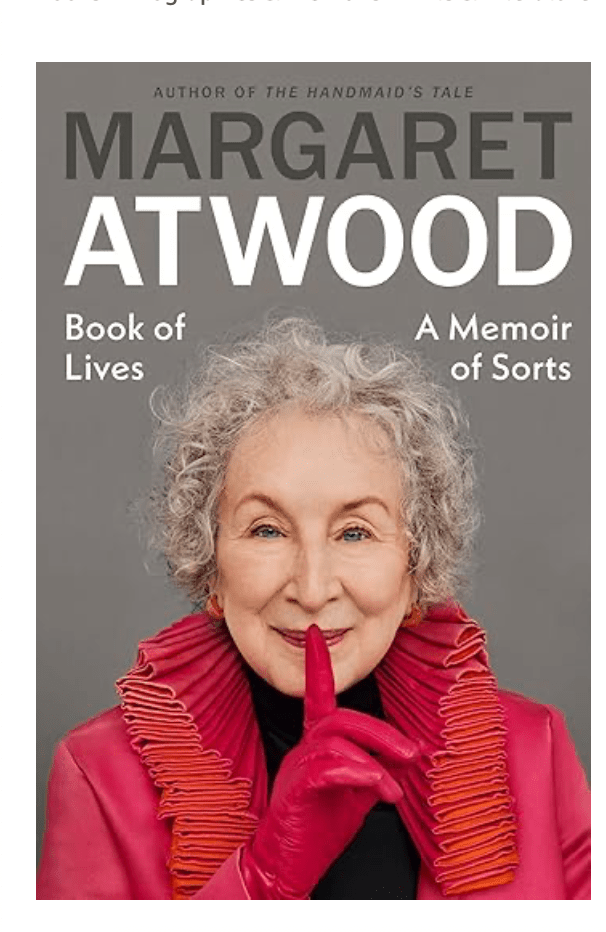
This is the amazing memoir of one of the greatest storytellers of our time, over six decades of writing, from 1961 onwards, with her towering influence, who wrote New York Times bestseller’s and modern classics like The Handmaid’s Tale (1985), or The Testaments or Alias Grace (1996) are a reproach to the Swedish Academy.
In 1939, with a world war under way, born in Ottawa and raised by ruggedly independent, scientifically minded parents- Carl, an entomologist father, and Margaret Dorothy, a former nutritionist mother. She and her siblings were taken by their mother to throw tin cans at a large cut-out of Hitler; Atwood writes their contribution to the war effort. Atwood spent most of each year in the wild forest of northern Quebec. Her childhood transpired at the family home on Red Pine Point, on the great Quebec lakes, summers spent fishing in the company of owls and beavers and bears. At five, she was writing tales of bunnies in Mischiefland, followed by Rhyming Cats, a collection of poems.
Her life was unfettered and nomadic, sometimes isolated like on her 18th birthday: “It sounds forlorn. It was forlorn. It gets more forlorn”, was thrilling and beautiful. By 25, she had already discovered that “Every writer is at least two beings: the one who lives and the one who writes”, her first published award-winning collection of poems, The Circle Game. By 1969 she published first novel , The Edible Woman, featuring a protagonist who slowly loses interest in food as she submits to a conventional marriage. Atwood who interest in Tarot, horoscopes and palmistry, has a gift for assessing the future with a clear year. The Handmaid’s Tale, hailed by readers around the world, giving a vision of the US as a totalitarian, fervidly religious state that stripped women of their rights. Atwood also reveals America’s Puritan past, from Pinochet’s regime in Chile, and from a visit to Berlin and Prague in 1984 in the midst of the cold war repression. In 2016, the University of British Columbia followed dur process in the case of Steven Galloway, a professor who lost his job, because of allegations of sexual misconduct. Atwood writes that she experienced a firestorm of anger “ a deluge of smears, hatred, and misinformation”, from many who accused her of betraying women.
Atwood’s vivid and exceedingly funny memoir, unfolds the story of her life, linking seminal moments to the books that have shaped our literary landscape, from the cruel year that spawned Cat’s Eye to the Orwellian 1980s Berlin where she wrote The Handmaid’s Tale. Her magical life with the widely charismatic writer Graeme Gibson and major political turning points, we meet poets, bears, Hollywood actors, and larger-than-life characters straight from the pages of an Atwood novel.
As we travel with her along the course of her life, more and more is revealed about her writing, the connections between real life and art- and the working of one of our greatest imaginations.
Atwood writes “ The idea of a memoir acquired a lurid, phosphorescent glow” over time, “I have dimmed and flickered, I have blazed and snot out sparks, I have acquired saintly haloes and infernal horns”.
Atwood writes “On we sail in our paper boats, we writers. Flimsy enough vehicles, but we don’t jump ship. Or at least I haven’t Or not yet.”
Book of Lives: A Memoir of Sorts by Margaret Atwood, Chatto & Windus £30, Double Day $35, 624 pages.

 The neptune Herald
Leave a comment