

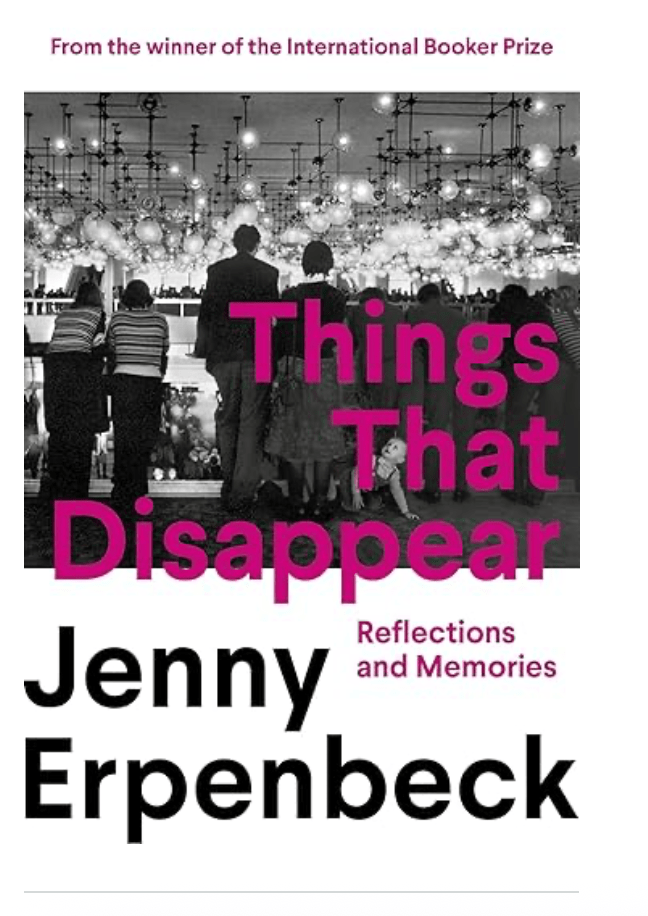
The Palace of the Republic, that once housed the East German Parliament, is demolished. A grandmother’s laughter passes from life into memory and the furniture that once made a home is taken to the tip. A friendship drops into silence. Old ways are erased by the new
In this fascinating collection of essays, most of them written for her column in the Frankfurter Allgemeine Zeitung, Winner of the International Booker Prize Jenny Erpenbeck meditates, with a sense of both deep melancholy and wry humour, on the disappearance and impermanence of things. Recalling the shop that used to darn tights in the days before you could just buy a new pair, reflecting on changing social attitudes, or considering the mysterious vanishing of a piece of cheese from her fridge.
Erpenbeck, an expert chronicler of this post-wall era, from the highs and hopes of 1990 to a pervasive Angst mode today among Germans about the outlook for a well-padded welfare state. She mediates on why Berlin’s corner patisseries have turned into chains selling inferior cakes in an inverse example of Schumpeterian distruption.
Erpenbeck asks why the rubber drip-catchers for traditional coffee jugs to protect lace tablecloths long replaced by West Germans favouring espresso machines. She writes, “It’s much more relaxed that way. Or something like that”, about altered cityscapes in the East, and the disappearance of the vast “Palace of the Republic” dubbed “Erich’s Lamp Shop” because of its over illuminated interior, in reference to the last durable East German leader Erich Honecker. Its demolition in the 2000s divided Berliners about whether this was restoration or erasure.
Erpenbeck’s Kairos, won the 2024 International Booker Prize, an intergenerational love story with abusive undertones. In Visitation (2010) she examined the changing ownership of a large lakeside property. In Go, went, Gone (2015), she dealt with double standards of a democracy proudly giving refuge to groups of needy foreigners only to offer a suspicious reception to the actual humans involved. In Things that Disappear, she describes the loss felt in parts of an intelligentsia who forfeited status in return for other freedoms and who look down on the habits of western consumerism. She writes of the courtyard of her apartment building, where children used to run freely between the tenements and after unification where “foreign children … ran around in knee socks”- a kind of diversity utopia. Now it is a “good neighbourhood” as the new owners have blocked off the shortcuts as demarcations between properties. “After all the Wall had fallen, thank God” said author. Many who wanted the workers’ and peasants’ state gone, and who voted with their feet open in 1989. Yet the traces of that society continue to vibrate in the unsettled politics of today’s Germany.
Things That Disappear: Reflections and Memories by Jenny Erpenbeck, Translated by Kurt Beals, Granta Books £12.99, New Directions $15.95, 128 pages.


This seems like a book that has being waiting to be written for a long time. It seems it is carefullly documenting the dying age of old traditions, posessions and habits in place of course with new ones! It might look good under a Christmas tree and provide some interesting facts to all those who read it. I hope it does well.
LikeLike