
For some AI researchers a large neural net that predicts next words seems to produce a system with general intelligence, although neuroscientists believe that the brain evolved precisely to predict the future- the “predictive brain” hypothesis.
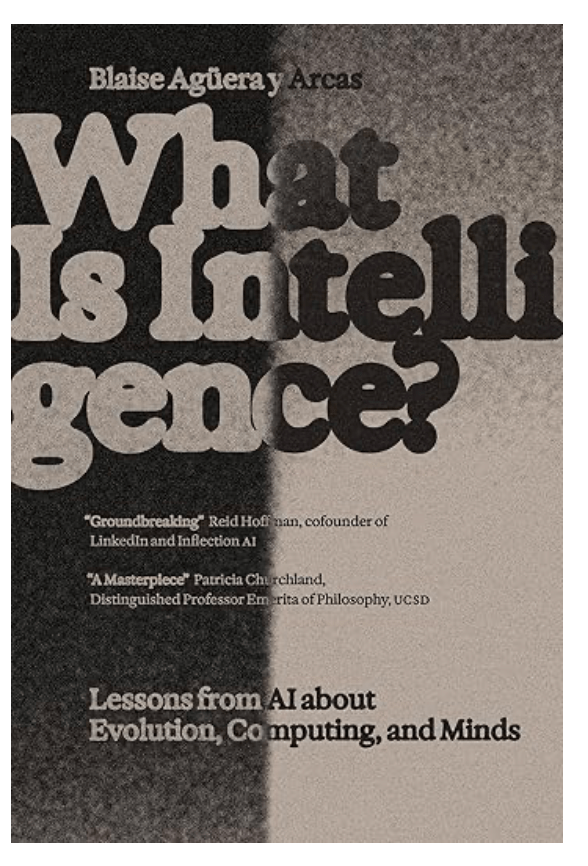
Blaise Agüera Y Arcas, vice president of Google, programmer and founder of its research team Paradigms of Intelligence, in What Is Intelligence, prediction is fundamental not only to intelligence and the brain, but to life itself – by exploring the wide-ranging implications. The radical perspectives on the computational properties of living systems, the evolutionary and social origins of intelligence, the relationship between models and reality, entropy and the nature of time, the meaning of free will, the problem of consciousness, and the ethics of machine intelligence.
What is Intelligence offers a unified picture of intelligence from molecules to organisms, societies and AI drawing from a wide array of literature in many fields, including computer science and machine learning, biology, physics and neuroscience. Combining technical rigor and deep up-to-the-minute knowledge about AI development, the natural sciences including neuroscience, and philosophical literacy, although certain AI systems claim to intelligence, consciousness and free will.
All the cells we are born with will be replaced several times during our lives. Our identity is visible, mutable wetware, which is constantly being replaced, our invisible immutable software- our genetic code- which instructs our cells how to reproduce themselves.
If you needed a kidney transplant you would not care whether it was made of living matter or carbon nanotubes as long it functioned. So according to Agüera Y Arcas, AI is just an algorithm that can run on any kind of computer, so intelligence can run on any substrates argues Agüera Y Arcas. So a powerful computer can just as readily implement intelligence as humans can, given the right code. “Few mainstream authors claim that AI is real intelligence. I do” Agüera Y Arcas writes.
He spans 4 billion years of biology and evolution, philosophy, neuroscience, physics, cybernetics, and the transformer technology that underpins generative technology that underpins generative AI.
AI is divided into three categories: artificial narrow intelligence, or the ability to perform discrete tasks, such as playing chess or reading handwriting: artificial general intelligence, when AI matches humans across all cognitive tasks; and superintelligence, when AI outstrips human intelligence and evolves in ways we will not be able to comprehend.
He suggests, we should envision a world of multiple intelligences, similar to what exists in the natural world, for example tiny Portia spiders smaller than 1cm in size have developed highly intelligent hunting strategies by spoofing their prey, planning crafty attacks and executing them – often via indirect routes- over the course of an hour.
Octopuses with eight arms sharing a common pair of eyes which distribute a lot of intelligence and some autonomy to their extremities. Octopuses can bite off one of their arms which can then attack a predator, allowing the rest of the animal to escape, as the new arm then regrows in the next 130 days.
Agüera Y Arcas writes “ If we believe life and intelligence are precious seeds, destined to bloom here are there in the universe, then spread the effloresce, we should ultimately expect our light cone to be populated by aliens of every description”.
What is Intelligence? Lessons from AI about Evolution, Computing, and Minds by Blaise Agüera Y Arcas, MIT Press $37, 624 pages

 The neptune Herald
Leave a reply to pennynairprice Cancel reply