
Female entrepreneurs, economic revolutionaries who defied the women’s roles as producers and reproducers and the sense that things might have different if homo economicus, had been joined by femina ecobomics. In ancient Athens, did you know about Phryne, the richest woman who offered to pay to rebuild the walls of Thebes after the city was razed by Alexander the Great, or in Georgian England, Priscilla Wakefield, the writer and entrepreneur, set up the first English “penny bank” to help women on low incomes to save money and children to save from an early age ? What about the everyday woman who, paid only a pittance, laboured for profit of others? In 2025, one of the terms introduced to the Cambridge Dictionary was “tradwife”: a figure of performative domesticity focused on child rearing and homemaking, which in America for many years it’s symbol of socially conservative – regressive gender politics.
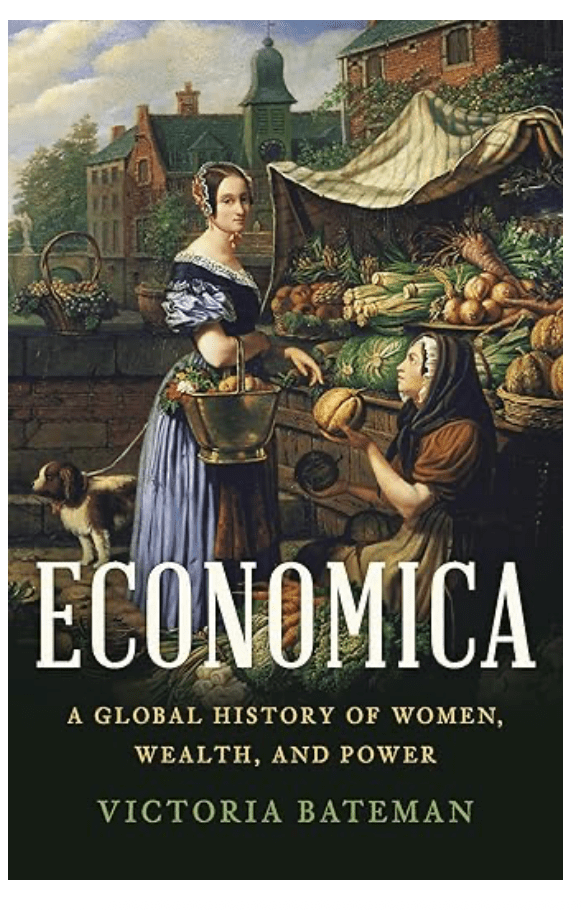
Victoria Bateman, a British feminist economist and academic in Economica reveals the epic story of women in economic history. For centuries women expanded their role in the formal economy were often followed by retrenchment when their role as producers threatened their reproductive role. Bateman explains the status and rights of women including the Prophet Mohammed’s first wife Khadija who was a wealthy merchant who employed Mohammed to manage a trade caravan to Syria and offered him marriage after he impressed her with his skills. In the 19th century China, Ching Shih, sex worker turned pirate, led a fleet three times the size of Chinese navy, guaranteeing safe passage in return for a yearly subscription.
Although the formal economy is a male domain, women have driven economic growth, as Bateman span centuries through continents from the Stone Age to the present day. For gender equality women have fewer freedoms that they did many centuries ago in places like Egypt, Iran, Syria. When women are useful in formal economy they are allowed to work, to start business and to control their fertility, although their role as producers are often threatening to their role as reproducers.
Bateman agrees with other economists’ that gender roles emerged with the invention of the plough, gave men natural advantage because of their physical strength, while women had less of a productive role in the field, the plough however elevated their reproducer role.
But other forms of technology have allowed women to combine roles as producer and reproducer, silk-weaving which could be done at home, the Chinese habit of foot-binding which kept women indoors and reproductively pure.
From the most successful women of their day to those who struggled to make ends meet, Economica takes you on a journey that begins in the Mesopotamia, Peru, Egypt, the Indus Valley, the Roman Empire, the Islamic Empire, China, Europe and the United States. Economica is more accurate history of us all.
Economica: A Global History of Women, Wealth and Power by Victoria Bateman, Headline Press £25/ Seal Press $35, 432 pages.

 The neptune Herald
Leave a reply to pennynairprice Cancel reply