
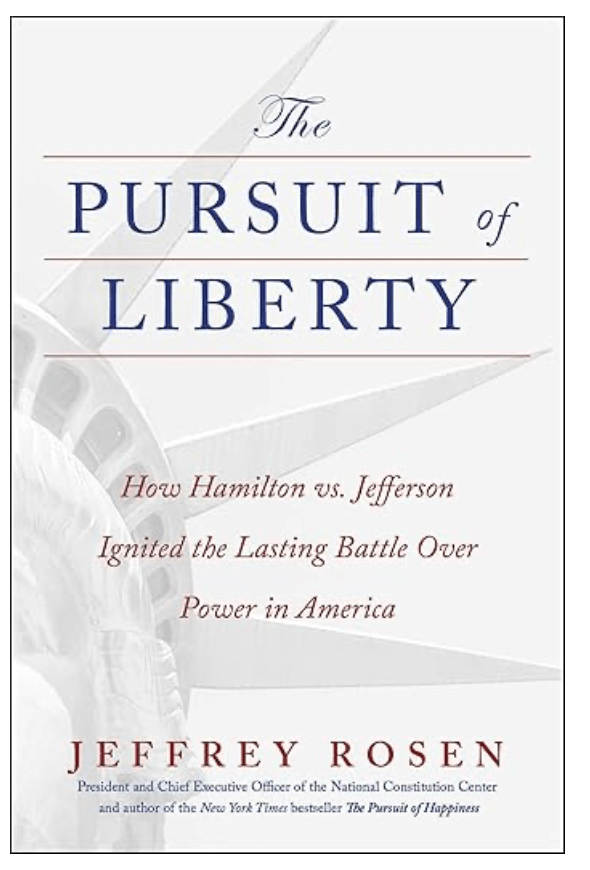
In The Pursuit of Liberty, bestselling author, Jeffrey Rosen, president of the National Constitution Centre, explores how the opposing constitutional visions of Thomas Jefferson and Alexander Hamilton have defined America for 250 years, influenced presidents from Washington to Trump, how to balance liberty and power, and continue to drive the debate over the power of government. While Hamilton pushed for a strong Federal Government and a powerful executive. This ongoing tug-of-war has shaped all the pivotal moments in American history, including Abraham Lincoln’s fight against slavery and southern secession, the expansion of federal power under Franklin Roosevelt’s New Deal, and Ronald Regan’s and Donald Trump’s conservative push to shrink the size of the federal government.
Rosen reveals how Hamilton and Jefferson’s disagreement over how to read the Constitution has shaped landmark debates in Congress and the Supreme Court about executive power, from John Marshall’s early battles with Andrew Jackson to the current divisions among the justices on issues from presidential immunity to control over the administrative state.
Hamiltonian and Jeffersonian ideals resonates today in America’s most urgent national debates over the question of whether modern presidents are consolidating power and subverting the Constitution – the very threat to American democracy that both Hamilton and Jefferson were determined to avoid.
Rosen warns about the dangers of demagoguery.
Many of Trump’s actions are consistent with unitary executive theory, advocating a vision of power that has had rightwing legal thinkers since at least the George W Bush administration and traces its intellectual origins to America’s founding itself.
Both Jefferson and Hamilton agreed on the importance of defending liberty against the threat of a popular or unpopular leader who could centralise power around themselves. Rosen explains “that initial debate between Hamilton and Jefferson has framed the epic battles about how to balance liberty and power that have unfolded throughout American history”.
Rosen elaborates on the myth: that Hamilton was a Caesarist, seeking to recreate the British monarchy in the form of a US president. This idea of presidency as such an imitation he writes is the “most significant conspiracy theory in American history”.
Rosen directs his argument to the Roberts Courts: “The explaination of presidential power was further enabled in the Trump era by a Supreme Court that took a Hamiltonian view of executive authority – embracing a broad view of the unitary executive theory, that might have gone beyond what Hamilton himself envisioned”.
The author reveals some of the social forces that not only transformed the office of the Presidency but heightened the chances of a populist leader in particular to the rise of mass media in the 20th century, and with it an understanding of presidents as operating in direct communication with their supporters. Rosen explains how both Jefferson’s and Hamilton’s reputation have waxed and waned as part of America’s political history itself.
The Pursuit of Liberty makes an excellent case for debates about liberty and federal power and also demonstrates the power of that tradition as a collective sense that bonds Americans together.
The Pursuit of Liberty: How Hamilton vs Jefferson Ignited the Lasting Battle over Power In America by Jeffrey Rosen, Simon & Schuster $31, 448 pages.

 The neptune Herald
Leave a reply to pennynairprice Cancel reply