

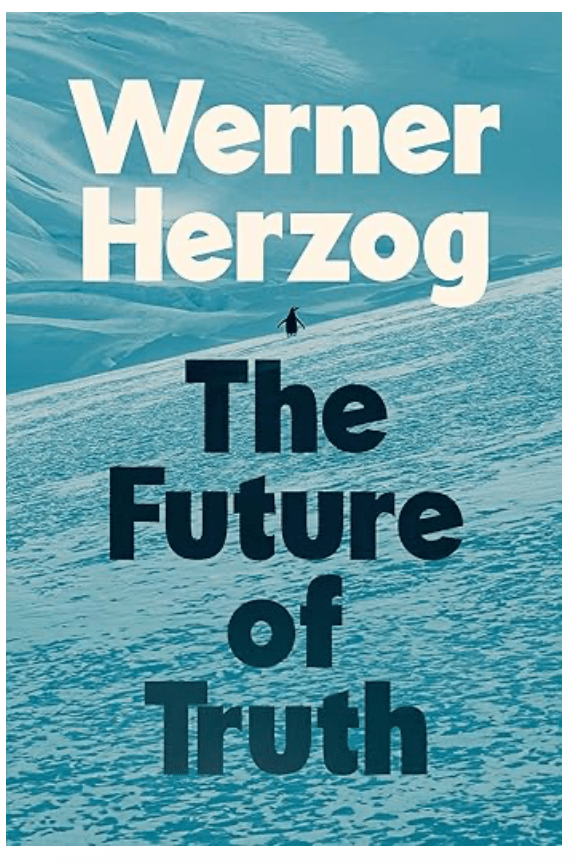
Werner Herzog, the legendary filmmaker and author’s deeply personal exploration of art, philosophy, and history that unravels one of our most elusive and contested questions: What is truth- and how to find it in out “post-truth” era?
We wade through the troubling realm of what we see and read, and wonder what AI might have in store for us. For over half a century, Werner Herzog has challenged, enriched, and expanded our understanding of the truth. His films and books have mixed fiction and non-fiction, documentary and drama, reality and imagination. Herzog definitely goes beyond the appearance of what is true in search of a higher truth, or what he has often referred to as the “ecstatic truth.” In The Future of Truth, a great artist ventures an answer to one of humanity’s deepest, most eternal questions. At a moment when Deepfake AI videos are proliferating, and most people have simply thrown their hands in despair at the ubiquity of what we now know as fake news- not to mention the constant lying and propagandising from certain public figures – Herzog seeks a remedy. Mixing memoir, history, politics, poetry, science and fierce opinion, he writes with dazzling originality and panache, urging readers to be unflagging and imaginative in the pursuit of truth, endless though the quest may be.
I don’t think truth is some kind of polestar in the sky that we will one day get to. It’s more like an incessant striving. A movement, an uncertain journey, a seeking full of futile endeavour. But it is this journey into the unknow, into a vast twilit forest, that gives our lives meaning and purpose; it is what distinguishes us from the beasts in the fields.
Herzog, a Catholic, explains human nature “Whatever is in human beings will end up on the internet. The human race is very violent, very debased,” he said.
In The Future of Truth, he shares field notes of his encounters with truth and its increasingly convincing simulacra, from deep fakes to wholly fabricated personalities, living full if fictive lives in cyber space. He brought us accounts from remote places and hard-to-reach people: the flying doctors of east Africa, scientists in Antarctica, a conservationist who loved bears but fatally overestimated how much they loved him back.
In the chapter “Kidnapped by Aliens”, Herzog recalls that while acting in a film as a priest, he was approached by a man who insisted that Herzog heard his confession: “His filmed confession to an actor playing a priest felt so much better…. Than the real thing”.
His film Fitzcarraldo, based on a real-life Irish rubber baron, who built an opera house in the South American jungle, which Herzog cites as a work “where there is no clear separation between imagination and reality”. Herzog slips in and out of dreams, as does the reader: did he really haul a steamship over a mountain to emulate a feat of his rubber tycoon? Yes: Herzog refused to fake this sequence with special effect, although it tourns out that the real Fitzcarraldo had the vessel disassembled, to spare his porters.
Herzog’s advice in the new information age, is to be sceptical and to read widely and well.
The Future of Truth by Werner Herzog, Bodley Head £14.99, Penguin $26, 128 pages.


“Be sceptical and read widely and well” seems a very fitting piece of advice from Werner Herzog. This latest book is full of gems of endearing situations and humour even appropriated to serious situations – for example the man and his love for live bears! Philosophy definitely features and it is always interesting to have a new take on that subject.
The topicality of this book is greater than many as it addresses AI and its effects on us now and in the future. Herzog’s accounts in his book would be of special interest to filmmakers also. I am sure you can find the time to buy a copy and have a good educational read! ENJOY! Penny Nair Price
LikeLike