
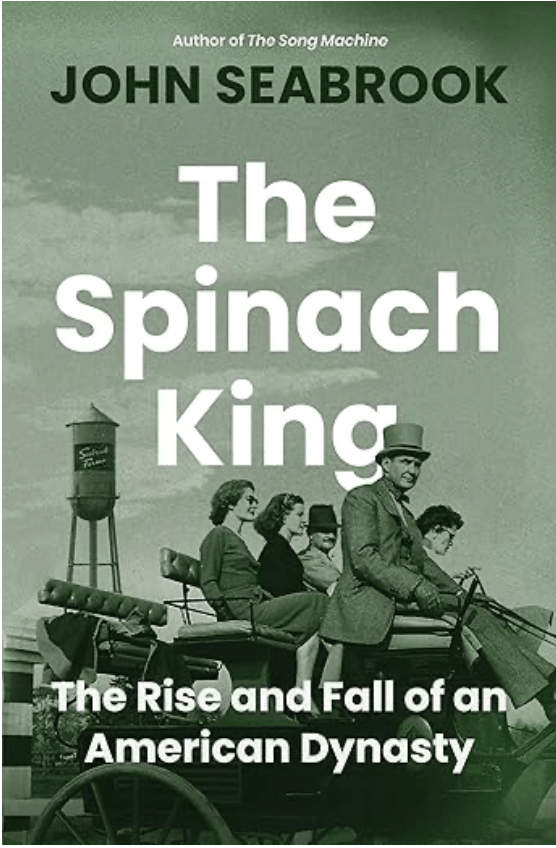
Life magazine’s photo on Seabrook Farms in 1955 New Jersey, calling it the “biggest vegetables in the US, stood triumphantly in front of 5, 000 workers and his father Charlie (CF) Seabrook, known as the Henry Ford of Agriculture. “Having left this material for his writer son, my father must have wanted the story told, even if he couldn’t bear to tell it himself”. This is the story of a forgotten American dynasty, a farming family from the bean fields of southern New Jersey who became as wealthy and powerful as aristrocrats – only to implode in a storm of lies.
His son Jack, a keen businessman, was poised to take over what Life called “the biggest vegetable factory on Earth”. But the carefully cultivated façade= glamorous outings by horse-drawn carriage, hidden wine cellars, and movie star girlfriends – hid dark secrets that led to the implosion of the family business.
At the heart of the narrative is a multi-generational succession battle. It’s a tale of family secrets and Swiss bank accounts, of half-truths, of hatred and passion- and lots of liquor. The Seabrooks’ colourful legal and moral failings took place amid the trappings of extraordinary privilege. But the story of where that money came from is not so pretty.
They say behind every great fortune there is a great crime. At Seabrook Farms, the troubling American histories of race, immigration, and exploitation arise like weeds from the soil. Great Migration Black laborers struck against the company for better wages in the 1930s, and Japanese Americans helped found a “global village” on the farm aft World War II. Revealing both C.F. and Jack Seabrook’s corruption, The Spinach King undermines the “great man” theory of industrial progress. It also shows how American farms evolved from Jeffersonian smallholdings to gigantic agribusinesses, and what such enormous firms do to the families whose fate is bound up in the land.
By 1960, the US enterprise and harmony imploded, with Jack Seabrook and his brothers trying to have their alcoholic, drug-addicted father declared insane, and CF responding by selling the family business and cutting them out of his will. So, ended the reign of the Spinach King and his anglophile playboy son.
John Sea brook, a New Yorker writer and author of books on culture and music, knew little of farming, but almost too much about his late father Jack and grandfather Charlie. The Seabrook males were dedicated tipplers but, as John quotes a psychologist writing “In my experience, the business itself is usually the family’s primary drug and other dependencies follow.” The industrial-scale farm, dating to the 19th century in the Garden State, was the substance they abused.
Seabrook elaborates How Seabrook Farms became one of America’s leading agricultural forces before flaming out, and that of the family and the Oedipal struggles of Seabrook sons to undermine their fathers’ reputations. Jack Seabrook affect Wasp bemusement at his son’s girlfriend (later wife) asking for a mere glass of wine, before descending to his wine cellar in search of a vintage bottle of decant by candlelight. At the rear of the cavernous cellar sits a safe whose combination has mysteriously been lost. Seabrook also highlights, when his parents met at the marriage of Grace Kelly and Prince Rainier in Monaco in 1956. He was a mid-century farm boy turned Manhattan socialite, and she was a gossip columnist for a New York newswire, who found a scoop about the theft of the jewels while launching with her future husband. The family business meanwhile recovered from going bankrupt in 1924, to agricultural hegemony under the capricious, autocratic CF. From his early experiments with crop irrigation, he jumped on the opportunity to freeze lima beans and spinach, helped by Clarence Birdseye. Later, Jack Seabrook developed the family’s own brand. Why Seabrook’s mother, when told before her death that he was thinking of writing about it, tried to warn him off. “Maybe she knew what I was going to find out,” he writes. CF and Jack’s weapons were trusts and lawsuits, Seabrook’s is the pen. The story darkens as he digs into family files and newspaper cuttings to detail the seamy side of the business. “Behind every great fortune lies a great crime.”
In 1934, CF and some henchmen violently broke a strike for higher pay by his farm workers and fired many of the Black employees, with the Ku Klux Klan massing support nearby, he writes.
Decades later, Jack Seabrook got involved in dubious consulting work with payments made to a Swiss Bank account and the details perhaps locked forever in that hidden safe. Seabrook judges that his family left “a legacy of cheating”.
Even CF whom he employed, including interned Japanese Americans. They remained grateful to him long after his death and as one local observed: “Just because you are an alcoholic doesn’t mean you can’t run a company.”
The Spinach King is a readable story of class and privilege, betrayal and revenge – three decades in the making, and explores the author’s complicated legacy and the ark corners of the American Dream.
The Spinach King: The Rise and Fall of an American Dynasty by John Seabrook, WW Norton & Co £35/ $31.99, 368 pages.
 The neptune Herald
Leave a comment