
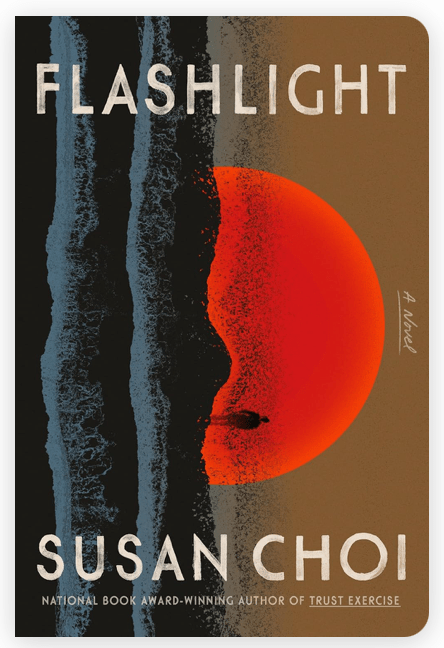
One night in August 1977, ten-year-old, Louisa and her father take a walk on the beach. He’s carrying a flashlight. He cannot swim. Later Louisa is discovered suffering from hypothermia and half-drowned found washed up by the tide, barely alive. Her father is gone, presumed drowned. Despite prolonged searches no trace of her father and the pair’s sandals remain side by sided where they were placed at the end of jetty. They become the objects of a temporary shrine of rice bowls, flowers, fruit and trinkets donated by local people, until they are washed away.
What is left following this catastrophe is a traumatised family- American mother Anne, and daughter, Louisa. The latter is angry, hitting out, eternally furious with her mother and as time passes, barely remembering her father, Serk, who was presumed washed out to sea.
Despite a psychiatrist’s delving, she has no memory, that will come much later, when “her body is leaden as if she has swim all that distance again, through the muscling, relentless, gelatinous cold force of the waves”.
Serk’s alleged drowning remains in the background until two-thirds of the way through the novel as the sea- helped by a large dose of the fatalism gives its secrets. Identity, names and statelessness their arbitrary bestowing and removal are central themes of this novel.
Before his disappearance Serk is a lecturer in engineering who emigrated from Japan to the US on a visa, although as an ethnic Korean his Japanese citizenship had been cancelled in 1952. Serk is known variously throughout as Hiroshi (his Japanese name), Seok ( Korean) and lastly, the Crab, by which time he has been almost subsumed into mythological status. His parents originally from Korea, were forced through poverty to move to Japan, several years after the second world war, which ended when Serk was six, they begin to make plans to return to a now divided country, communist North Korea, the DRPK. By this times, Serk ( the Americanisation of Seok) is about to graduate from college, his next sibling, a sister, Soonja, hastily marries, to avoid leaving Japan. Their parents seduced by the promised paradise that awaits them and their three youngest children, make the journey home. After their return, their letters are scarce, stating only their great happiness, which sits oddly alongside urgent requests for basic food and clothing, for medicine and blankets. The letters gradually cease.
Chois narrative winds back and forth over some 50 years, spanning Louisa as child, then a college student, then a married woman with children of her own to Anne, her mother, to Serk and Tobias, Annie’s son by another man, Aged 19, she had been forced to give him up for adoption directly after giving birth. Anne’s and Serk’s marriage foundered from the start, blighted by his arrogance, silences and their better arguments.
By the time Serk’s disappearance Louisa’s relationship with her parents resembles that of “ a Venn diagram” with the chid as the only common factor.
In the US her father is overprotective, to the point of obsessiveness. But when they relocate to Japan for what is meant to be his year-long secondment, Louisa is expected to be independent, like a Japanese child.
Having felt that she was not white enough for the US, she is too tall for Japan, and initially she struggles (later as a student travelling in France, she will be subject to a horrible instance of racist violation that prefigures the darker revelations that Choi has in store).
In Japan, Anne is the outsider, just as Serk always seemed in the US, confined to their damp flat with a mysterious wasting illness, while Serk takes Louisa on visits to meet a stranger, a woman from his past.
Choi writes “ Time is not a river moving ceaselessly into the future but a stagnated pool. Breathing its surface, drowning in its depth, are the same.”
Susan Choi’s Flashlight, takes an appalling aspect of Japanese-Korean history and turns it into a rich generational saga. Flashlight focuses on the hidden lives of characters, their careless and destructive lies, vulnerability and extraordinary ability to survive.
Flashlight, begins as a New Yorker short story, in the suburban Indiana, downtown Los Angeles, the Japan of both city and shore, late 1980s Paris and London.
What really happened to Louisa’s father? Why did he take Louisa and her mother to Japan just before he disappeared? And how can we love, or make sense of our lives, when there’s so much we can’t see?
Flashlight by Susan Choi, Jonathan Cape £20/ Farrar Straus and Giroux $30, 464 pages.

 The neptune Herald
Leave a reply to pennynairprice Cancel reply