

One afternoon in 1942, in a squash court beneath the stands of University of Chicago’s football stadium, a group of scientists watched as Enrico Fermi coaxed the world’s first controlled nuclear chain reaction from a pile of dusty carbon bricks, unlocking the enormous energetic possibilities of the atom’s nucleus, completing Manhattan Project’s mission the construction of a war winning atom bomb.
There’s no satisfactory answer to the risks of nuclear conflict, those consequences that gave physicist Eugene Wigner an eerie feeling.
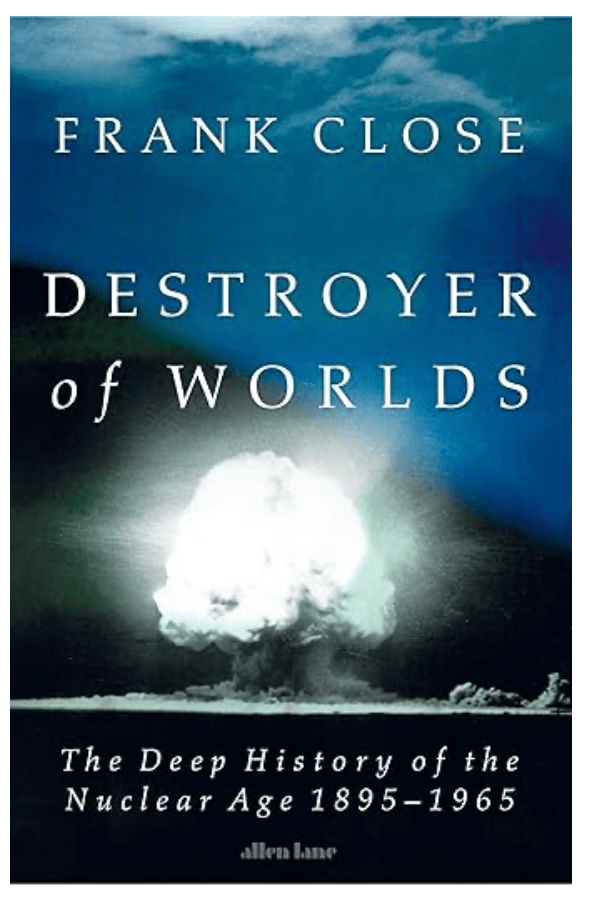
Destroyer of the Worlds is the story of how pursuit of this hidden source of nuclear power, which began innocently and collaboratively, was overwhelmed by the politics of the 1930s, and following devastation of Hiroshima and Nagasaki opened the way to a still more terrible possibility: a thermonuclear bomb, the so-called “backyard weapon”, that could destroy all life on earth- from anywhere.
The story spans decades and continents, moving from Becquerel to Ernest Rutherford, the Cambridge-based, New Zealand scientist who first split the Atom, expands to include Enrico Fermi in Rome, Otto Hahn and Lise Meitner in Berlin and the Joliot-Curies in Paris, leading to the appearance of Robert Oppenheimer before climaxing with increasingly horrifying developments in the USA and USSR. The roles of three remarkable women Lise Meitner, Ida Noddack and Irene Curie- are re-valuated, and there were new insights in to the work of Ettore Majorana, Fermi’s mercurial but brilliant assistant, who mysteriously disappeared in 1938, possibly after foreseeing the explosive power of nuclear energy. Above all, this is a story of how knowledge is often advanced by personal convictions and relationships, and indeed by chance in a remarkable way.
Modern nuclear reactors bear little, if any, resemblance to his primitive, unshielded device. Much more is known about the consequences and risks of fission. The world is lurching towards a new nuclear age, with both old perils and new possibilities. US and Israeli bombs have been dropped on nuclear installations in Iran, a reminder of the atom’s long association with conflict amid the potential of nuclear power so central to the world’s energy needs.
After post-Chornobyl retreat, the pace of reactor-building is picking up, as more than 60 are under construction around the world, and a further 100 are planned. Many believe that net zero won’t be possible without substantial help from the atom, others remains equally firmly convinced that this is the wrong direction.
Award-winning science writer, and a professor of theoretical physics at Oxford, Frank Close writes in Destroyer of the Worlds, “The first inkling…. was so trifling that it was almost missed”. Close writes about the resulting experiments and investigations -each nudging humanity a step closer to what he calls the “third industrial revolution” the first two being steam and electricity. When his collaboration with the British chemist Frederick Soddy uncovered the mind-boggling fact that radioactive decay changed the atom of one element into another, Rutherford worried that “they will accuse us of being alchemists”. Soddy was no less awestruck: “ We stand today where primitive man first stood upon discovering the energy liberated by fire.”
In 1930s the mood darkened with discoveries such as the neutron it became clearer that this energy might have unimaginable explosive properties. The accelerating race towards the chain reaction and the Manhattan Project are stories that have been told before, but Close adds his own mordant asides and observations which enliven the journey.
Ettore Majorana, a young Sicilian physicist, whom Fermi rated as a genius to rank alongside Newton and who did much to unravel the mysteries of atomic structure. He disappeared from the Palermo-to-Naples ferry in 1938 at the age of 31. Close bemoans the futility and the waste of the arms race, culminating in the 1961 test of Russia’s 50-megaton Tsar Bomba, a “ machine of genocide, a city destroyer, an impossible and pointless weapon”.
We are now in a world in which China is an increasingly assertive player, with the emergence of India and Pakistan as mutually antagonistic nuclear powers willing to launch air strikes on each other’s territory, and the ever-present destabilising conundrum of North Korea. Israel has gone to war to thwart Iran’s nuclear pretensions.
The breakthrough of Henry Becquerel’s accidental discovery in 1896 of a foggy smudge on a photographic plate that he’d left in a dark drawer next to some uranium salts could easily have been overlooked, but sparked a chain of discoveries which would unleash the atomic age. Becuerel ‘s example inspired the scientific community to explore the strange phenomenon, which led to an astonishing cascade of discoveries as Marie and Pierre Curie first revealed new elements and then coined the term “radio activity” to describe the mysterious emanations they produced.
.Destroyer of the Worlds: The Deep History of the Nuclear Age:1895-1965 by Frank Close, Allen Lane £25, 336 pages, Basic Books $32, 352 pages.


All people reading this book and this review will have grown up with nuclear powers casuing news and views and scares regarding this. It is shocking that some agents, cognoscenti, investigators and reporters have gone missing or been ill treated and that from time to time nuclear plants are bombed or decimated enlisting scares throughout the world and in some cases fallout of radioactive elements which affect the health of all close by and so it goes on. This does not allow for the awful thought of a radioactive nuclear plant self combusting and causing the same reactions health and safety wise as Chernobyl for example. I suggest that you read the book if you have the time and digest its contents which I hope are accurate. Peace, Aymen.
LikeLike