

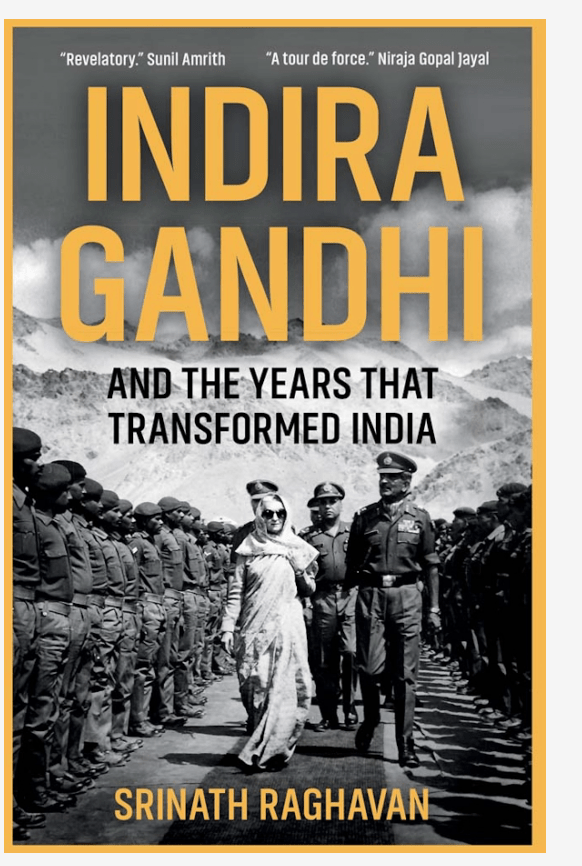
Indira Gandhi’s ascent as prime minister in 1966, and ruled for fifteen years, which was unforeseen and soon emerged as one of the most powerful political leaders of her times, who transformed the world’s largest democracy.
Historian Srinath Raghavan, tells the story of Indira Gandhi’s political career and the momentous changes that India experienced under her leadership. From her tentative start in high office to her remarkable electoral victories, the dark days of the Emergency of 1975-1977, and her assassination at the hands of her Sikh bodyguards in 1984. Raghavan sheds new light one her politics and government, as well as her adversaries and critics. He reveals how the 1970s were the hinge on which the history of the country turned- and how Indira Gandhi transformed the new postcolonial nation into the India of today.
Behind the authoritarian curtain, her Congress party government quietly began reimaging the country- not as a democracy rooted in checks and balances, but as a centralised state governed by command and control. Professor Raghavan shows how Gandhi’s top bureaucrats and party loyalists began pushing for a presidential system – one that would centralise executive power, sidelining an “obstructionist” judiciary and reduce parliament to a symbolic chorus.
Inspired by Charles de Gaulle’s France, the push for a stronger presidency in India reflected a clear ambition to move beyond the constraints of parliamentary democracy- even if it never fully materialised.
In 1975, when BK Nehru, a seasoned diplomat and a close aide of Gandhi, wrote a letter hailing the Emergency as a “hour de force of immense courage and power produced by popular support” and urged Gandhi to seize the moment.
Nehru wrote “Parliamentary democracy has not been able to provide to our needs”. In this system the executive was continuously dependent on the support of an elected legislature “which is looking for popularity and stops any unpleasant measure”.
What India needed, Nehru said, was a directly elected president- freed from parliamentary dependence and capable of taking “tough, unpleasant and unpopular decisions’ in the national interest, Professor Raghavan writes. Nehru imagined a single seven-year presidential term, proportional representation in Parliament and state legislatures, a judiciary with curtailed powers and a press reined by strict libel laws with censorship. He even proposed stripping fundamental rights- right to equality or freedom of speech, of their justiciability.
Nehru urged Indira Gandhi to “make these fundamental changes in the Constitution now when you have two-thirds majority”. His ideas were “received with rapture” by the prime minister’s secretary PN Dhar. Gandhi then gave Nehru approval to discuss these ideas with her party leaders but said “very clearly and emphatically” that he should not convey the impression that they had the stamp of her approval. According to Raghavan the ideas met with enthusiastic support from senior Congress leaders like Jagjivan Ram and Foreign minister Swaran Singh. The chief minister of Haryana state was blunt “Get rid of this election nonsense. If you ask me just make our sister Indira Gandhi President for life and there’s no need to do anything else”. M Karunanidhi of Tamil Nadu- one of two non-Congress chief ministers consulted was unimpressed.
A document titled “A Fresh Look at Our Constitution: Some suggestions” drafted in secrecy and circulated among trusted advisors, proposing a president with powers greater than even their American counterpart, including control over judicial appointments and legislation. A new “Superior Council of judiciary” charted by the president, would interpret “laws and the Constitution”- effectively neutering the Supreme Court.
Gandhi sent the document to Dhar, who recognised it “Twisted the Constitution in an ambiguously authoritarian direction”. Congress president DK Barooah tested the waters by publicly calling for a “thorough re-examination” of the Constitution at the party’s 1975 annual session.
Although the idea never fully crystallised into a formal proposal, as its shadow loomed over the Forty-second Amendment Act, passed in 1976, which expanded Parliament’s powers, limited judicial review and further centralised executive authority.
The Amendment made striking down laws harder by requiring supermajorities of five or seven judges and aimed to dilute the Constitution’s “basic structure doctrine” that limited the parliament’s power.
Emergency also gave federal government sweeping authority to deploy armed forces in states, declare region-specific Emergencies and extend President’s Rule – direct Federal rule- from six to twelve months. It also put election disputes out of the judiciary’s reach.
Emergency cleared way for a powerful executive, marginalised judiciary and weakened checks and balances.
In December 1976, the bill had been passed by both houses of parliament and ratified by 13 state legislatures and signed into law by the president.
After Gandhi’s shock defeat in 1977, the short-lived Janata Party – a patchwork of anti-Gandhi forces- moved quickly to undo the damage. Through the Forty-third and Forty Fourth Amendments, it rolled back key parts of the Forty Second, scrapping authoritarian provisions and restoring democratic checks and balances.
However, Gandhi was swept back to power in January 1980, from the safe seat in Chikmaglur, Karnataka, south India, after the Janata Party government collapsed due to internal divisions and leadership struggles. Two years later, prominent voices in the Congress party again mooted the idea of a presidential system.
In 1982, with President Sanjeeva Reddy’s term ending, Gandhi seriously considered stepping down as prime minister to become president of India.
According to Prof Raghavan, there was a hint of presidential drift in the early 1970s, as India’s parliamentary democracy- especially after 1967- grew more competitive and unstable, marked by fragile coalitions.
“During emergency her primary goal was short-term: to shield her office from any challenge. The Forty Second Amendment was crafted to ensure that even the judiciary couldn’t stand in her way”. The itch for presidential system within the Congress never quite faded. As late as April 1984, senior minister Vasant Sathe launched a nationwide debate advocating a shift to presidential governance- even while in power.
Some advantages during the Emergency were, arresting smugglers and criminals under Maintenance of Internal Security Act ( MISA) and giving ultimatum to multinationals like Coca Cola to produce its essence in India or leave India. Both IBM and Coca Cola were forced to leave India, and in its place three drink companies emerged (Campa, 77, ThumpsUP) with similar flavour of Coca Cola.
Emergency, a 21-month period from June 1975 to March 1977 was marked by massive media censorship, restriction on civil rights and a forced mass sterilisation campaign.
Six months later, Indira Gandhi was assassinated by her Sikh bodyguards in Delhi, and with her, the conversation abruptly died. India stayed a parliamentary democracy.
Indira Gandhi and the years that transformed India by Srinath Raghavan by Yale University Press £25.
 The neptune Herald
It seems that this book should be on school and university curriculums. The detail is immense and reading it would definitely aid in a true understanding of the politics surrounding the time of Indira Ghandi’s power.
LikeLike