
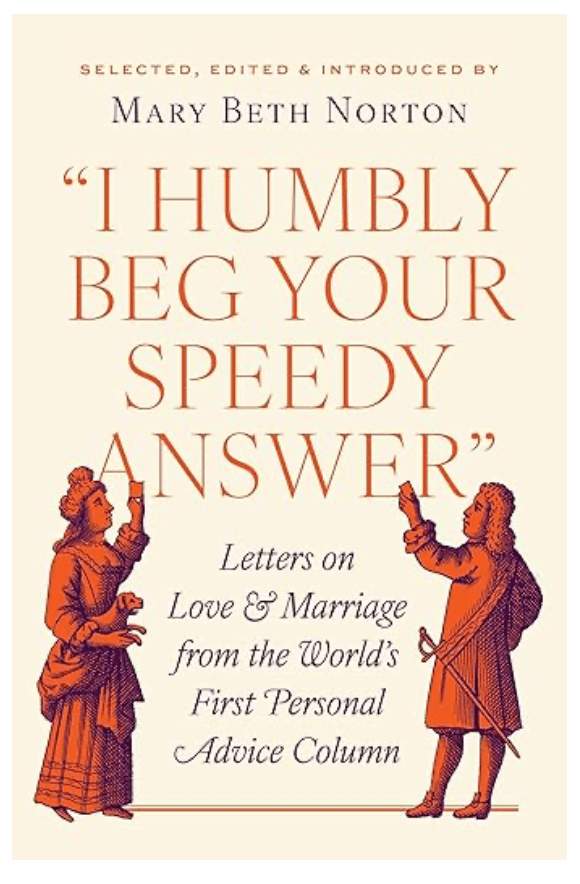
The Athenian Mercury – a London-based broadsheet, one-page, two-sided periodical, brainchild of John Dunton, a printer, not a therapist whose main aim was to make money. Walking in a London park one day, it occurred to him that the (male) patrons of London’s fashionable coffee houses might like to gin up their intellectual discussions with questions posed to a panel of experts – just Dunton and his brothers-in-law- and would pay to see the answers. Published and advertised as “Resolving all the most Nice and Curious Questions Proposed by the ingenious of Either Sex”, in 1690s London which included the world’s first personal advice column. Acclaimed American historian and Pulitzer Prize- finalist Mary Beth Norton’s “I Humbly Beg Your Speedy Answer” is a remarkable collection of questions and answers drawn from this ground-breaking publication.
Anonymous readers look for help with their most intimate romantic problems- about courting, picking a spouse, getting married, securing or avoiding parental consent, engaging in premarital sex and extramarital affairs, and much more. Spouses ask how to handle contentious marriages and tense relationships with in-laws.
Who wants advice from a perfect stranger, who will analyse from distance of the impartial scribe, to your intimate challenges. In the Victorian-era mass printing mass literacy, brought the “Problem-page” to publications such as The English Woman’s Domestic Magazine. From the 1950s, America stages Ann Landers (in her second iteration) and Dear Abby, who just happened to be twin sisters, brought their tart reflections to millions of readers, mainly thanks to syndication.
Happy families as described by Leo Tolstoy, it’s not a take that stands up to scrutiny, especially when you start to read the questions and answers from the world’s first personal advice column.
Norton, a scholar of Women’s and gender history, first came across these letters while researching an earlier book on women’s lives in colonial Atlantic world. She has selected questions and answers from the 20 volumes of the Mercury, and focuses solely on queries about “courtship, marriage and sexual behaviour”.
The lonely wonder how to meet a potential partner- or how to spark a warmer relationship with someone they already have an eye on. And both men and women inquire about how to extract themselves from relationships turned sour. Many of these concerns are delightfully strange and surprising, reflection forgotten social and romantic customs and using charmingly unfamiliar language in which, for example, “kissing is a luscious diet, a marriage might provide “much love and moderate conveniences,” and an “amorous disposition can lead to trouble,
Q: Who are the wisest, those that marry for love or for convenience?
“A: They are both fools if they marry for one without the other. Love without the necessary conveniences of life will soon wear thread-bare. Conveniences without love are no better than being chained to a post for the sake of a little meat.”
A self-described old maid writes regarding an offer of matrimony from “a gentleman I like”. Her parents are long dead, but her relations disapprove, “though I don’t know why”. The answer “You owe them no more than the possibility of taking their advice.”
In England, before 1753, there was no legal definitions of marriage, leading to several questions about the significance of contracts and or promises made between lovers.
The Mercury’s last issue appeared in 1697.
Norton’s book is delightful and entertaining, providing a unique, intriguing, and revealing picture of what has- and hasn’t- changed over the past three centuries when it comes to love, sex and relationships.
“I Humbly Beg Your Speedy Answer”: Letters on Love & Marriage from the World’s First Personal Advice Column by Mary Beth Norton, Princeton University Press £20/$24.95, 216 pages.

 The neptune Herald
Leave a comment