
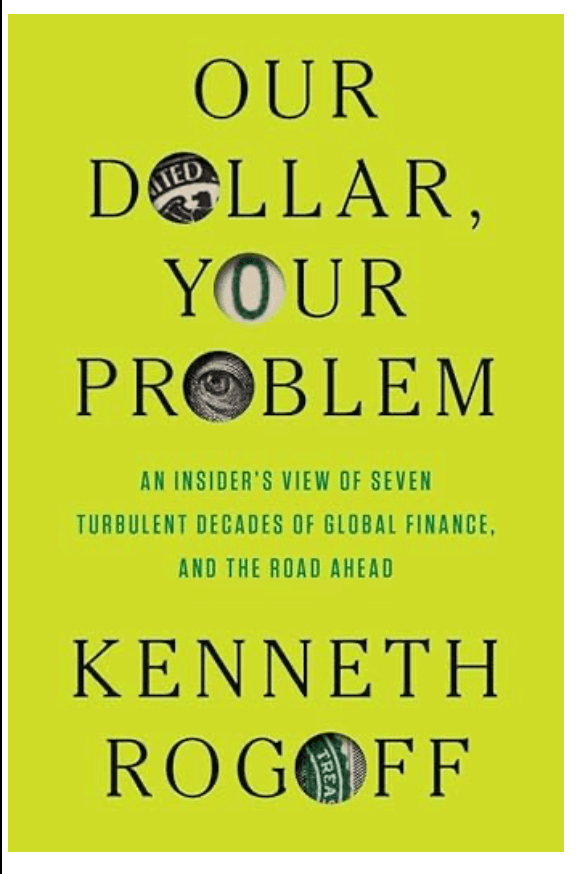
Professor of economist at Harvard and former chief economist at the IMF, Kenneth Rogoff explores the global rise of the U.S. dollar and reveals why the future stability is far from assured and argues that America’s currency might not have reached today’s lofty pinnacle without certain amount of good luck.
The sharp sell-off of US Treasury bonds following Trump’s April 2 announcement of America’s highest tariff wall for a century confirmed Rogoff’s view that the recently prevailing belief that real interest rates will be “lower forever” is a dangerous myth.
He sees America’s, and hence the dollar’s, “Achilles heel”, as being the country’s $36tn stock of federal debt and the associated danger that a rising interest burden could lead it towards a fiscal crisis.
The Washington administration has believed “ all foreigners are out to screw us and it’s our job to screw them first”, the words of John Connally, President Richard Nixon’s Treasury secretary, in 1971 when he and his boss were bringing an end to the Bretton Woods Exchange rate system that had pegged currencies to the dollar and gold since 1944, and briefly imposed a 10 per cent tariff on imports until a new currency agreement was reached.
Rogoff means that America would do whatever it wished with its currency, and the world would just have to live with the consequences. The dollar has been the world’s dominant reserve, trading and investment currency since 1945. Ninety per cent of all foreign exchange transactions involve the dollar on one side or the other; the US economy accounts for about a quarter of global output, but 60 per cent of foreign exchange reserves are held in dollars.
Several chapters explains why in turn the Soviet Union ) though never really the rouble), Japan’s yen, Europe’s euro and China’s renminbi have all been speculated upon as potential rivals, but all have so far failed to topple the might dollar. The green-back’ sheer convenience, thanks to the unmatched liquidity of US financial markets, a widely held faith in the rule of law in America and the trustworthiness of its institutions, and the country’s global role in military security and in financial oversight have all kept it supreme.
America’s increasing use of financial sanctions in recent years to punish or put pressure on adversaries, most dramatically on Russia following the full-scale invasion of Ukraine in 2022, and the associated extraterritorial use of US law, had held some efforts to diversify away from dollar by setting up new payments mechanisms and even by dreaming up new shared currencies, such as one discussed by “Brics” group.
China who worked hard to make itself less vulnerable to US sanctions in the event of a future conflict by building its own payments system. But none of this so far looks likely to weaken the dollar’s sway, as long as China makes it hard to trade the renminbi or convert it into other currencies.
The real threat to the dollar lies within America itself, as he sees the country’s insouciant, reckless attitude to its rising levels of public debts, combined with a potential undermining of institutions such as the Federal Reserve as and when inflation revives and political pressures to interfere rise again, as they did in the Nixon era.
The inflationary impact of the tariff wall that Trump is establishing and of the trade war he is conducting with China. The sell-off in US Treasuries and fall in the dollar following “liberation day” owed a lot to a loss of trust in American assets by foreign holders but also to rising expectations of inflation thanks to the direct impact of import taxes and the potential for supply chain disruptions. Rogoff drew a great deal of attention, and some criticism, by their observation that countries’ economic growth rates tend to be slower if their public debts exceeded 90 per cent of GDP. America’s gross public debt now exceeds 120 per cent of GDP, giving it the fourth-highest such debt among rich countries after Japan, Greece and Italy.
The exorbitant privilege of the dollar has been that interest rates on US Treasuries have been lower than they might otherwise have been thanks to the world’s thirst for dollar assets. Some Trump advisers complain that a strong dollar made US exports less competitive, they now need to be careful what they wish for, as faith in American assets among the foreigners who hold about 30 per cent of US Treasuries can fade quickly, sending interest rates spiralling damagingly higher.
According to Rogoff, “ if runaway US debt policy continues to crash up against higher real interest rates and geopolitical instability, and if political pressures constrain the Federal Reserve’s ability to consistently tame inflation, it will be everyone’s problem”.
Donald Trump believes the security burden borne by America is unfair and that other countries have been ripping it off for years on trade and defence. Rogoff animates the remarkable post-war run of the dollar – how it beat out the Japanese yen, the Soviet ruble, and the euro – and the challenges it faces today from crypto and the Chinese yuan, the end of reliably low inflation and interest rates, political stability, and the fracturing of the dollar bloc. Americans cannot take for granted that the “Pax Dollar era” might be coming to an end, not only because many countries are deeply frustrated with the system, but also because overconfidence and arrogance can lead to unforced errors. Rogoff shows how America’s outsized power and constant privilege can spur financial instability- not just abroad but also at home.
Our Dollar Problem: An Insider’s View of Seven Turbulent Decades of Global Finance, and the Road Ahead by Kenneth Rogoff, Yale £25/$35, 360 pages.

 The neptune Herald
Leave a reply to pennynairprice Cancel reply