
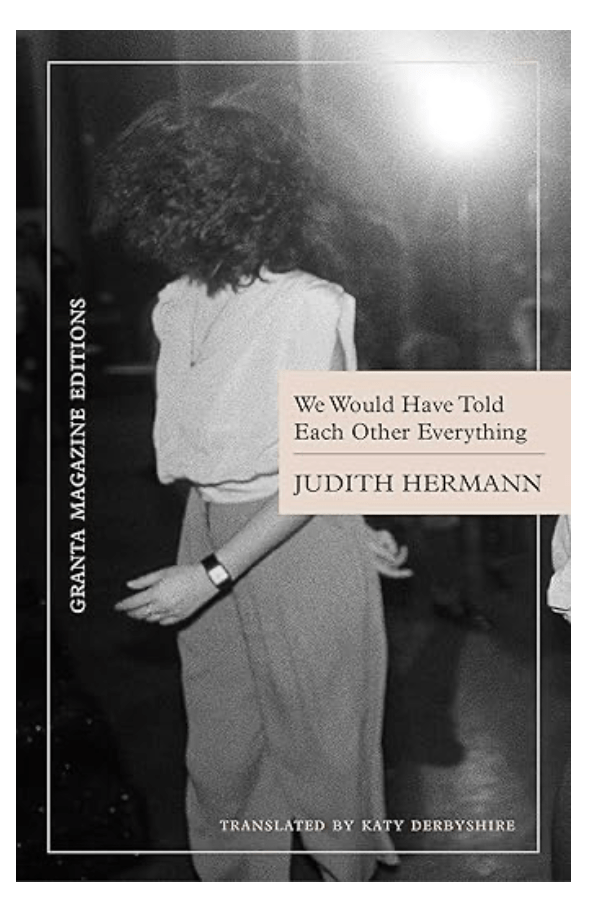
German Novelist Judith Hermann weaves together themes of psychology and friendship, unconventional childhoods, summers of the North German Sea shore in a series of three interconnected stories.
Children are born and grown up, careers established and abandoned, love affairs, marriages and friendships made and dismantled. Contemporaries sicken and die, parents get old.
“Every story has its first line. Not the line with which the story begins in the book; the line with which it begins in my mind”. This is a literary narrative reflection on when life becomes fiction, now dependable memory can be, and how close one’s dreams can come to reality.
Translated by Katy Derbyshire “Some time ago, in a 24-hour minimart on Berlin’s Kastanienallee, in the middle of the night, I happened to run into my psychoanalyst – two years after the end of my analysis and for the first time outside of the room where I’d lain on his couch for years. I was out that evening with G, my only writer friend. We’d eaten an Italian place on Eberswalder Straße, drunk a few glasses of wine together outside a bar, then G had walked me to my tram and on the way to the tram we’d started talking about out mothers. It was that mother conversation, our slight drunkenness and the fact that we were retracing old paths – Arkona, Rheinsberger, Wolliner, streets where we’d spent our youth an actual quarter-century ago, that is, in the days when show still fell and the world around us was black and white and pure poetry- that led me to skip one tram after another and to sit down with G on the steps in a doorway on Kastanienalle, both of us immediately craving a cigarette, even though we’d give up smoking ages ago.”
Marco is part of her past, her Wahlfamilie, or chosen family, those replacements for the origin family who are so often found in youth. Living and dead, he looms large as a striking physical presence through the narrative; as does Ada, an equally charismatic, forceful character. It was via Ada, an equally charismatic, forceful character. It was via Ada’s recommendation that Hermann found the psychuarist – at which point their friendship, intense but never close, ceased.
The psychiatrist and former patient, on this charged night, will drink together. The book’s second section delves deep into the analysand’s exploration of her childhood and, subliminally, the reasons for her seeking analysis at all. An itemised feast of memory and trauma, directly experienced and handed down, as Hermann builds up the story of her family and place in it.
Her paternal grandmother was Russian as a child “ She had been brought to Germany on a sled during the revolution and sometimes wore a silver brooch modelled on a troika”. This relative occupies centre stage in Hermann’s upbringing in cold war “divided Berlin”, the Est “foggy and lifeless”. Her mother works all day as a florist and the father is prone to severe and debilitating depression. “My father came home unfathomably late, sometimes I felt I had only imagined my mother.” Her father built his daughter a doll’s house and later a puppet theatre – what better symbols for a dysfunctional family?
We Would Have Told Each Other Everything by Judith Herrman, translated by Katy Derbyshire, Granta £12.99, 208 pages.

 The neptune Herald
Leave a reply to pennynairprice Cancel reply