

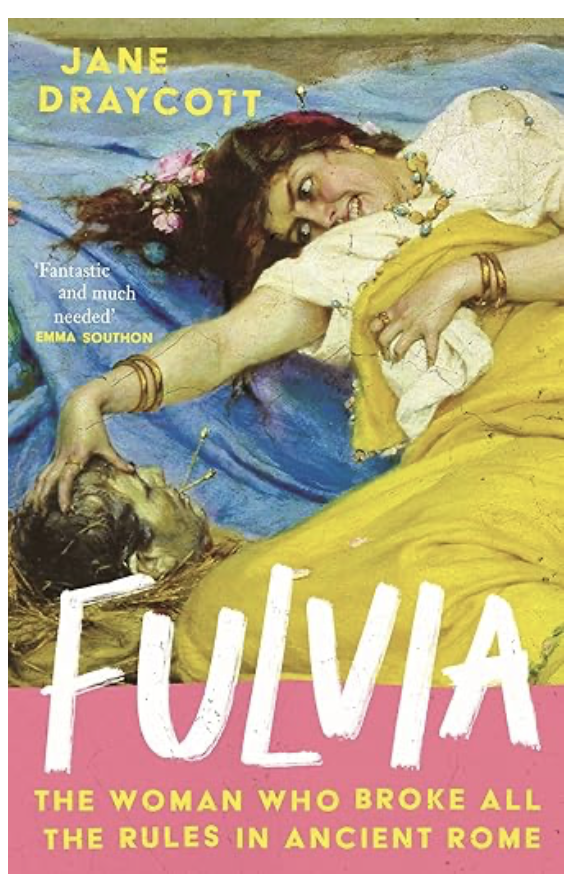
Charismatic Fulvia amassed a degree of military and political power that was unprecedented for a woman in Ancient Rome. Married three times to men who moved in powerful circles, including Marc Anthony, Fulvia was not content to play the usual background role that was expected of wife – instead she challenged the Roman patriarchy and sought to increase her influence in the face of determined opposition.
Fulvia is a relative of Julius Caesar, Augustus’s mother-in-law, and a love rival to Cleopatra, She was according to Pultarch, “a woman who took no thought for spinning or housekeeping”, and instead became a key political and even military figure, as well as the first woman on a Roman coin.
Acclaimed historian and archaeologist, Jane Draycott, who is a lecturer in Ancient History at the University of Glasgow, in her latest popular history book, Fulvia, a Rorschach test for scholars. To some, Fulvia is the “first Princess of Rome”; to others she is just a footnote, part biography, part social history. Draycott makes us follow Fulvia from girlhood, playing with dolls dressed as Amazons, to her role as a politician’s wife (mafia wife) to her three husbands, Clodius Fulcher, Curio and Mark Antony- as a mother to her five children, and finally as a warmonger and eventual scapegoat for the perusine war if 41-40BC between Mark Anthony’s supporters and those of Octavian, the future Augustus.
Fulvia Wields political power behind the scenes. Fulvia never speaks: no account from her survives, so we can only ever see her at a distance. This silence is emphasised by the loudness of the men in her life, who communicate with their letters and poems and memoirs. Fulvia in her wedding veil, the colour of egg yolks; Fulvia inciting the crowd to build Clodius’s funeral pyre inside the Senate House; Mark Anthony disciplining soldiers by torturing them in Fulvia’s living room, blood splatting across her face. Fulviastabbing the tongue of her dead enemy, Cicero, with her golden hairpin.
Draycott explains Fulvia suffering one sling bullet found at the site of the Perusine war saying “I’m aiming for Fulvia’s clitoris!” -m by depicting her first and foremost as a loving wife and mother. Cicero describes her as “ a thoroughly rapacious woman”.
It’s rare to know so much about a particular Roman woman, but Fulvia was so despised by her male detractors that she was much written about.
Fulvia: The Woman Who Broke All the Rules in Ancient Rome by Jayne Draycott, Atlantic £20, 268 pages.

 The neptune Herald
Leave a reply to pennynairprice Cancel reply