
Political Neuroscientist attached to Cambridge University, Dr Leor Zmigrod discovers the biological factor that drive ideologies to extremes and her research into the physical and psychological origins of extremism. Her definition of ideology is a rigid and dogmatic way of thinking that discourages thought in favour of a pre-determined and hermetically sealed belief system. Her findings “Prejudiced children’s rigidities were not constrained to one domain: they were everywhere. Rightly spilled into every response, every reasoned thought and miscalculation.”
Zmigrod reveals the hidden mechanisms driving our beliefs and behaviours. She using powerful tools of neuroscience to show that our political beliefs are not transient thoughts in our minds – ideologies actually change our cells. While some individuals are more susceptible to dogmatic thinking than others, all of us can strive to be more flexible.
The response prejudice is indicative of a precursor to what Zmigrod calls ideological thought, as there are other ways of correlating rigid thinking to political extremes.
She describes the Wisconsin Card Sorting Test, which measures how people perform when the rules of the game they think they are playing suddenly change; and the Alternative Uses Test, which asks participants to name as many uses for an object – say a Brick as they can in two minutes, measuring their creativity or “generative flexibility”.
When the results of these tests are set against the political and social attitudes of participants, Zmigrod, explains how the correlations are clear; ideological conservatives – of left or right are less flexible and less imaginative.
She discovered one in how the hormone dopamine is distributed through the brain. Variations in our genetic make-up mean that such distribution isn’t uniform. Stephen Miller one of Donald Trump’s top aides, do his schtick about migrants being criminals, you would be watching someone whose single nucleotide polymorphism has nudged him towards intolerance, or maybe he has a frontal lesion, which one study found to correlate to political conservatism?
The rejected child may have been born with the dopamine distribution of an open-minded, flexible subject, but her experience will affect how parts of brains interact. Zmigrod writes “there is no advantage to inflexible behaviour – in fact, it is a disadvantage inflexibility exemplifies a lack of adaptability, an absence if inventiveness, and insensitivity to changing evidence”. In essence Zmigrod says “There is an important physical component to our political outlooks”.
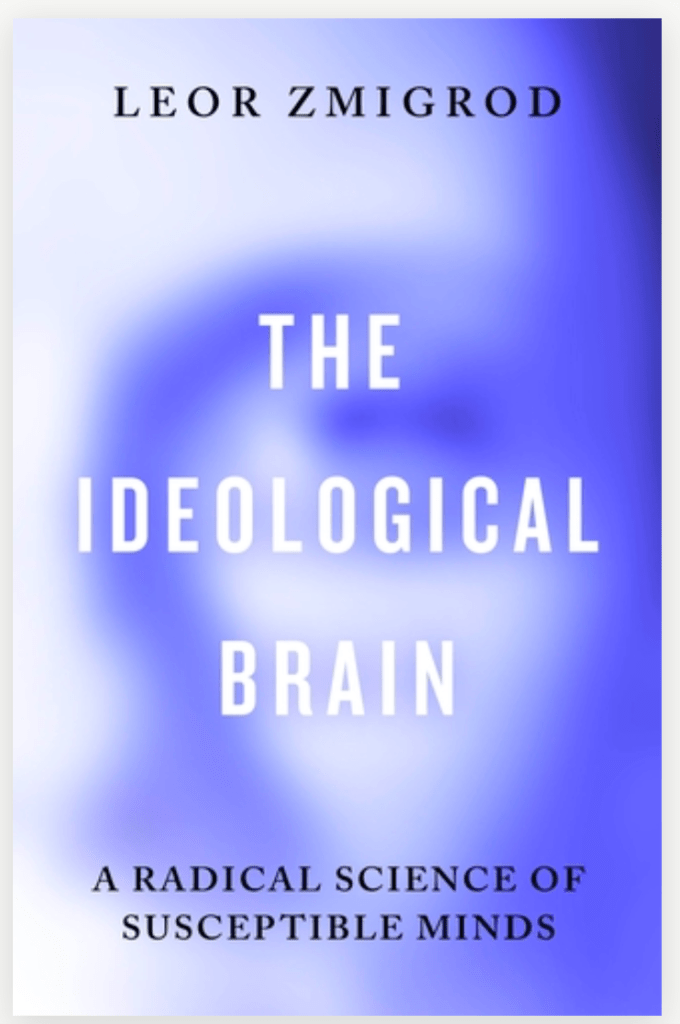
The Ideological Brain: A Radical Science of Susceptible Minds by Leor Zmigrod, Viking £22, Henry Hoff $29.99, 336 pages.

 The neptune Herald
Leave a reply to pennynairprice Cancel reply