
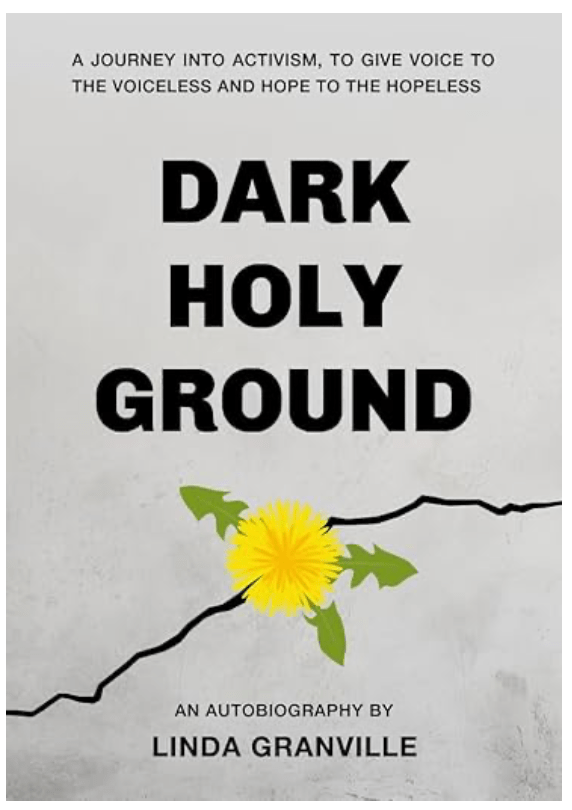
Introduction to DARK HOLY GROUND by Linda Granville
DARK HOLY GROUND: A Journey into Activism to Give Voice to the Voiceless and Hope to the Hopeless is a deeply personal and politically potent memoir from British activist and writer Linda Granville. Set in Middlesbrough, a once-thriving industrial town devastated by deindustrialisation and economic abandonment, this book is both a testimony of survival and a call to moral action.
Granville’s story begins in the heart of hardship: an unemployed single mother navigating life on society’s margins in a town where iron and steel, shipbuilding and the chemical industry once provided prosperity but now lie in ruins. Her experience of ostracisation transformed into a force for social change. Her memoir is unapologetically honest about the toll of marginalisation but also powerfully redemptive in its vision.
At the core of DARK HOLY GROUND is Granville’s unwavering Christian faith, which fuels her refusal to accept the dominant narratives that devalue the poor, the unemployed, and the socially excluded. Instead, she lifts up those who have been cast aside, drawing attention to the diamonds forming beneath the surface of their struggle. This metaphor, beautifully rendered through her chance discovery of sea coal on a beach — layered with pressure and potential — becomes the central image of the book’s message: there is beauty and brilliance in places the world refuses to look.
Her writing brings to life not only her own journey but also the overlooked stories of countless others — individuals and families trapped in poverty, discriminated against, or dismissed by government and society alike. Yet Granville’s work is not one of despair. Far from it. With equal parts clarity and compassion, she reveals how hope survives in the cracks of concrete, like the defiant yellow dandelion that becomes another key symbol in her narrative. The book invites us to reframe what we call “weeds” — in nature and in humanity — as potential healers, as sources of strength and wisdom.
This memoir does more than chronicle a life. It functions as a fierce critique of failed economic systems, the scapegoating of the vulnerable, and the moral bankruptcy of those in power. But it is also a how-to manual for change. Granville lifts up the work of grassroots organisations, faith groups, and activist networks that have offered practical and profound support to those society has forgotten. When no such groups existed, she helped build them. In this way, DARK HOLY GROUND becomes a map — emotional, spiritual, and political — for anyone seeking to create a more just and compassionate world.
What makes this book essential reading is its rare blend of personal authenticity and historical significance. It is a book that deserves to be archived in national libraries and discussed in classrooms and community centre’s alike. With raw honesty and luminous hope, Linda Granville offers us an unflinching look at the dark — and reveals the holy within it.
Penny Nair Price
 The neptune Herald
Leave a comment