
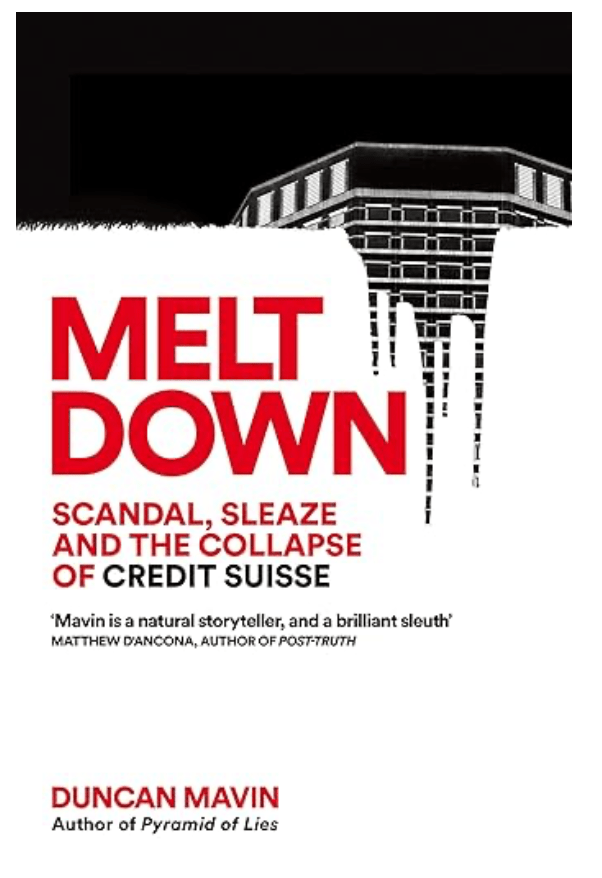
Former Wall Street Journal reporter, editor and Bloomberg’s investigative journalist Duncan Mavin’s Melt Down exposes a crisis year for Credit Suisse’s 2023 implosion, with a lucid account of how greed and complacency of bosses and employees destroyed the bank. For centuries Swiss banks have served the globe’s wealthiest individuals, employing a strict culture of anonymity and gaining massive wealth in the process. In March 2023, bank runs and panic among depositors of smaller US lenders spread to customers of Credit Suisse. As the crisis deepened Credit Suisse remained highly solvent across a reassuringly wide range of metrics, but said it would be helpful if the Swiss National Bank stepped in with a promise of financial support, as Credit Suisse was teetering on the brink of collapse. That weekend, larger rival, UBS took over Credit Suisse for the bargain price of $3.25bn, an acquisition engineered by Swiss authorities triggered by the prospect of a wider financial crisis.
Mavin writes the collapse of Credit Suisse “had been decades in the making. The whole of the bank’s troubled history was prelude to this humbling, humiliating meltdown”.
When Credit Suisse collapsed, the veil of secrecy came down and the world was suddenly privy to the corruption, scandal and empty hubris that keep our biggest banks alive.
It was a 166-year-old bastion of Swiss banking, amongst the most important and influential financial institutions in the world- but a veneer of high-class service disguised a darker, dirtier reality. From its sterile Zurich headquarters, the bank catered to a clientele that included dictators, drug dealers and former Nazi officers, and helped fleece its own clients out of billions of dollars. This continued for decades, even as Credit Suisse continued to expand, acquiring smaller banks and granting its own executives lucrative bonus contracts.
Meltdown is the story of how the house of cards came tumbling down. Mavis takes readers inside the bank’s hushed marble corridors, detailing its secretive culture and the series of increasingly selfish decisions, made by a handful of men at the top, which ultimately led to disaster. Mavis’s brutally honest look into a previously-unknown world of greed, lies and unrelenting human ambition.
It was a landmark moment in European finance. A great institution with a history stretching back to 1856, meant to be a paragon of safety and secrecy, had imploded in public view. Bankers in southern Europe enjoyed Schadenfreude. Credit Suisse’s most notorious clients include Lex Greensill, an Australian melon farmer turned fintech champion. Greensill Captial which employed David Cameron as a Whitehall lobbyist and international frontman, turned out to be a house of cards. Credit Suisse had a weakness for appointing deal hungry Wall Streeters such as Allen Wheat and Brady Dougan to senior roles. In banking misaligned incentives can encourage misbehaviour, staff may reap short-term rewards for deals that may prove, costly to their employer in the longer term.
The 1970s Ponzi scheme funded by Italian tax dodgers to a 2021 face plant by New York Hedge found client Archegos and provides a fair assessment of Tidjane Thiam’s five-year attempt to turn the business around. The French-Ivorian ran the bank from 2015 to 2020, creating a new reporting structure and reining in the investment bank. Critics claim this incomer from humdrum world of insurance was out of his depth at Credit Suisse. Supporters believe the trouble shooter was undermined by self-serving middle managers and Switzerland’s business elite, their distrust tinged by racism.
According to Mavin, Thiam although stabilised Credit Suisse financially, but antagonised potential allies with his presidential style of leadership. It is dangerous to make you awareness and smartness of these disparities too obvious. Thiam tried to distance himself from the surveillance by Credit Suisse of wealth management boss Iqbal Khan, who had become his rival. Threatened with the sack in 2020, he quit instead and was replaced by Thomas Gottstein, a low-key Swiss.
Outsiders have historically suspected Barclays and Deutsche Bank of harbouring rotten culture of their own, but they are still standing.
Meltdown: Greed, Scandal, and the Collapse of Credit Suisse by Duncan Mavin, Pegasus $29.95/ Pan Macmillan £22, 336 pages.

 The neptune Herald
Leave a reply to pennynairprice Cancel reply