
We live in a manufactured world, Unless you are floating naked through space, you are right now in direct contact with multiple manufactured products. How ofoten we stop to think: where do the things we buy actually come from?
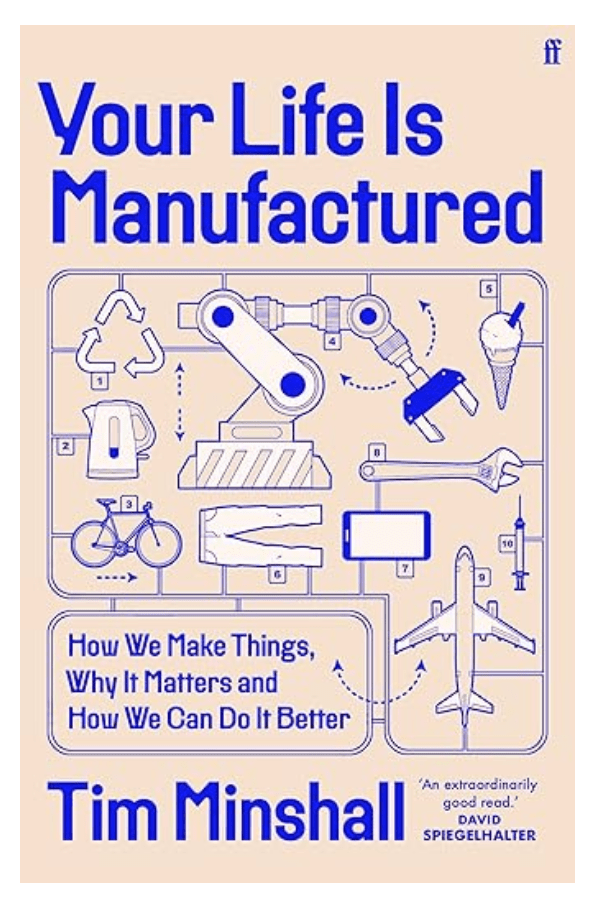
American President, Donald Trump, promised in his recent inaugural address, America would soon become “a manufacturing nation once again”. His planned tariffs, will encourage some global companies to relocate factories back to the US. Academic expert on innovation and technology at Cambridge University, Tim Minshall’s Your Life Is Manufactured is about perils of losing touch with the art of making things .
This book is part admiring the sophistication of modern factories and logistics systems, and part warning about the way they can go awry.
“ This system has developed two emergent properties we are less happy with: It is mind-bogglingly complex and worryingly fragile” he writes. When manufacturing supply chains are disrupted- as happened during the Covid pandemic- their various independent parts are often affected simultaneously. Problems ripple back and forth through the system, from material suppliers and industrial facilities to logistics and consumers, increasing the risk of shortages, or even outright collapse.
He zips between several different facilities – from a local bakery in Cambridge to a vast electric car factory in eastern China able to produce 300, 000 vehicles a year. The average UK supermarket contains 30, 000 different categories of products, all of which need to be made somewhere.
He explains how a “giga factory” (Tesla) model produces huge numbers of batteries for electric vehicles.
Amid all these clever processes there are several often-interlocking process problems that need fixing. Some supply chains have become too efficient, creating fragility. Others are too wasteful, give the environmental costs of shipping parts and components around the world, rather than making and supplying them locally.
He calls the “nonsense of post-industrialisation”, which imply that countries can subsist simply by relying on investment banks and management consultants. Successful nations such as Switzerland and Singapore, which are often assumed to be models of service-based sophistication. Switzerland’s manufacturing sector has held roughly steady since 2000 at about 18 per cent of its economy. Britain’s share declined from, 13 per cent to 8 per cent, while the US fell from 15 per cent to 10 per cent.
Minshall is a critique of both outsourcing and globalisation, which risk hollowing out industries. “ If you’ve outsourced your manufacturing to other companies faraway countries, you will slowly but surely lose your ability to make things. Once lost, this ability is very hard to regain”, he writes.
The far reaching disruptions caused by the war in Ukraine, from energy prices to shipping routes, are noted only passing. Minshall fails to grapple with the specific challenges posed by China’s vast manufacturing engine, which makes up more than a quarter of its GDP. Global supply chains heavily dependent on Chinese components could be weaponised in a future conflict if Beijing decides to stop supplies, as western governments increasingly fear.
Companies are driven by short-term incentives, they are poor at seeing the brittleness of their own systems, and find it hard to prepare sensibly for events that “ have an incredibly low likelihood of happening”, even if the effects would be disastrous.
There exists a nearly invisible, awe-inspiring global system of manufacturing that enables virtually every aspect of our existence. The things we surround ourselves with take surprising and often byzantine journeys to reach us – be it the thousands of litres of water needed to make a single pair of jeans or the components of our smartphones travelling over six times around the world to reach us. From mega-factory floors, engineering laboratories and seaports to distribution hubs, supermarkets and our own homes. Tim Mins hall traces these journeys to reveal the hidden world of manufacturing.
Minshall reveals the seismic impact manufacturing has had on our lives and the natural world, exploring how it could offer us path to a truly sustainable, more equitable future. Minshall wants to make the supply chains shorter, cleaner and more resilient, from urban farming for agriculture to recycled materials for clothing. He is an admirer of a future low-waste “circular economy”, in which companies cut down on inputs and reuse outputs in other processes. Some of these ideas might work, albeit at higher prices for consumers, Minshall grants us the ability to make better choices for ourselves, our communities and the planet.
Your Life is Manufactured: How We Make Things, Why It Matters and How We Can Do It Better by Tim Minshall, Faber £20, 336 pages.

 The neptune Herald
Leave a reply to pennynairprice Cancel reply