
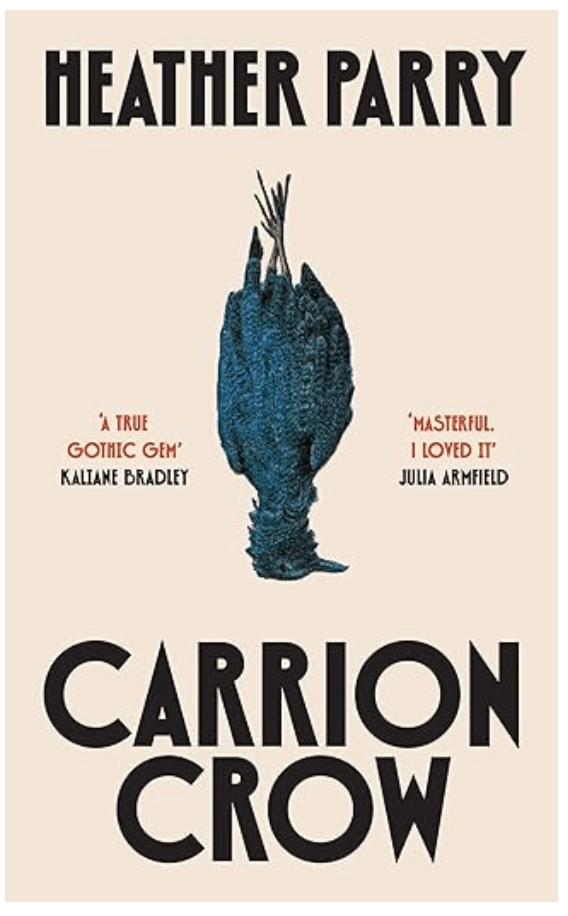
Carrion Crow is Glasgow-based Heather Parry’s fourth book, set in London’s Chelsea in the late 19th century, where Marguerite Périgord, a 19-year-old daughter of once aristocratic French family, is confined to the attic by her mother “for the sake of her well-being”. Her mother Cécile doesn’t believe she is quite ready for married life. So she leads Marguerite to the attic, where the lack of light will allow her to “acquire the upper-class Pallor” required of a new wife, and the small meals that Cécile delivers on a tray will help Marguerite “establish within herself the reserved palate and physical restraint of the married lady”. Cécile is concerned that Marguerite’s engagement to Mr George Lewis, a much older, near penniless solicitor, will drag the family name – her husband’s name, that is- into disrepute. And for Cécile, who has worked hard at her own betterment, this simply won’t do. Cécile’s life has taught her that no matter how high a woman climbs she can just as readily fall. For company Marguerite has only he works of Victor Hugo, Mrs Beeton’s book of Household Management, and a black-and-gold sewing machine – she is surrounded by expectations of her class and her gender. She starts poking around in the crumbling rafters and discovers a carrion crow nesting in the roof. As Marguerite begins to feel more and more abandoned, she notices the crow has laid eggs and is preparing to raise its own family.
At first Marguerite believes she is being kept in the attic for a couple of weeks. Then she begins to lose track of time, but thinks the number of nights are increasing between her mother’s meal deliveries. Mr. Lewis stops writing her letters. Her hair beings to fall out.
Parry writes “Marguerite could entertain herself for hours with the investigation of her own tonsils”, making herself retch in order to bring up “a beige nugget of matter” that she then plays with, enjoying its putrid smell. On another occasion she steals an egg from the crow’s nest and eats it – raw. Later she takes a doll she has made from torn bedsheets and dreaming of becoming a mother, stitches it on her stomach, “beneath a divot where her ribs met”.
Marguerite thinks often of someone named Alouette, whom Parry describes in avian metaphors “ Alouette made her own money, she shook it from her wings every evening. They would go about their days without a concern, raising their baby birds”, to the extent that you wonder if Marguerite is dreaming up the crow as some kind of illusory lover.
What would lead a mother to treat her daughter with such cruelty?
Marguerite’s patience turns into rage, the boundaries of her mind and body start to fray.
Both Cécile’s father and her husband, incidents that left Cécile alone with three children before the age of 30 and drove her to cut her wrists. A doctor advised that she stays inside, in a manner that mirrors Marguerite’s imprisonment:” She was confined for one year. It was for her own good”.
Parry reveals how trauma can be inherited, and that women themselves can be complicit in handing down the worst of the patriarchy.
Parry has written the novel with such Claustrophobic precision, exploring the control we assert upon on another, as neither woman recognise what the other is becoming.
Carrion Crow by Heather Parry, Doubleday £16.99, 256 pages.
 The neptune Herald
Leave a comment