

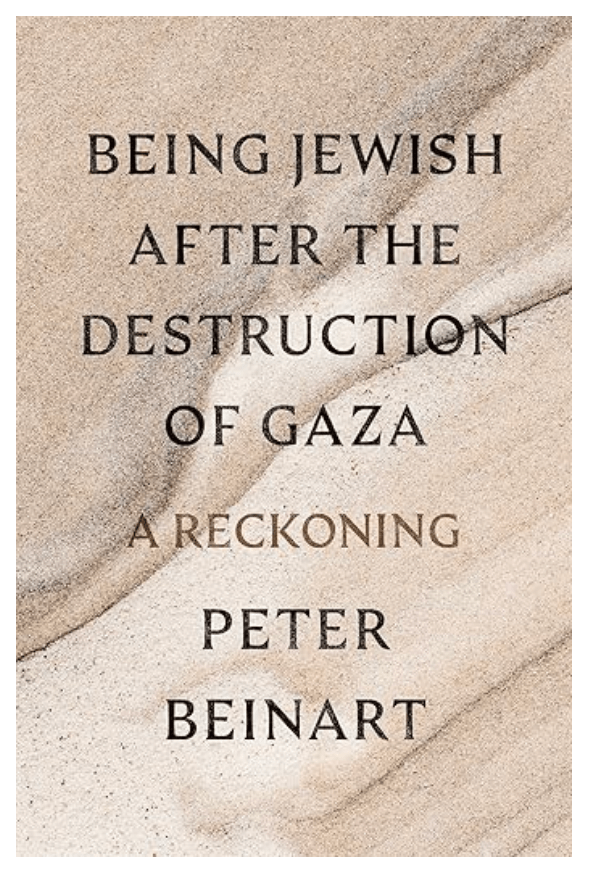
According Peter Beinart, one story has long dominated Jewish communal life: that of persecution and victimhood. It is a story that erases much of the nuance of sacred Jewish tradition and history, and also warps our understanding of modern history. After Gaza, where Jewish texts, history and language have been deployed to justify mass slaughter and starvation, and he argues, Jews must tell a new story. After this war, whose horror will echo for generation, they must do nothing less that offer a new answer to the question: What does it mean to be a Jew? This is the story in which Jews have the right to equality, not supremacy, and in which Jewish and Palestinian safety is not mutually exclusive but intertwined. One which we inhabit a world that recognizes the infinite value of all human life, beginning in the Gaza Strip.
Peter Beinart questions why supporting Israel seems for so many to rule out acknowledging the scale of Palestinian suffering, and Jewish nationalism may do moral damage to Judaism itself going back to the very beginnings of Zionism.
Earlier this week as the Middle East was still trying come to terms with Donald Trump’s vision of Gaza as a Mediterranean Florida when police in Jerusalem raided and thrashed a well-known Palestinian bookstore on the grounds that its owners were disturbing peace, as diplomats from eight countries appeared in the courtroom for the hearing in a show of solidarity with the arrested men, while customers flocked to the bookshop.
In Israel there is a widespread public indifference towards Arab suffering evident long before the existential shock of the Hamas massacres on October 7, 2023, was definitely a precondition for the collective destruction of Gaza and the huge scale of Palestinian death toll.
Peter Beinart’s Being Jewish after the Destruction of Gaza addressed to American Jews, struck by the modes of mental and rhetorical evasion that allow many of his friends to reconcile their deep emotional attachment to Israel with the growing ethno-nationalism of its rightwing leadership and the violence of its policies.
He calls it “ways of not seeing” have generated a “permission not to care” – which easily turned into outright criticism of anyone who said they did care about what the Palestinians in Gaza were suffering. Beinart seeks to persuade his fellow Jews they need to do more to acknowledge the Palestinian plight. He insists, American Jews are a heterogenous population in terms of outlook and views that cannot be reduced to those of the leading American Jewish organisations. Charges of antisemitism have thus become one way of not seeing. This does not do very much to make Israel safer but it has harmed free speech and helped Jewish concerns to be dragged into America’s increasingly nasty culture wars. “Jews are never responsible for antisemitism”, he writes, “We are however responsible for fighting it wisely. And Conflating Israel and Judaism does exactly the opposite”.
As a practising Jew, Beinart sees the destruction of Gaza as a moment of truth for Judaism itself. How long he asks can Jews go on viewing themselves as “history’s permanent virtuous victims” when faced with the horrors that “a Jewish country has perpetrated, with the support of many Jews around the world.” Palestinians face the threat of the total erasure of their existence in Gaza, Israel seems set to become harder, more introverted and more isolated.
Being Jewish: After the Destruction of Gaza: A Reckoning by Peter Beinart, Knopf $26/£22, 192 pages.


For every action there is an equal and opposite reaction – not sure if it is always equal but war is a two way situation – or in many cases there are more than two “sides” in a war. History has left certain groups vulnerable to the past, the present and the future. Those who are “tarred” by these issues still have to live their lives on planet earth but surely there is something to learn from the past? Some of us “bury” experiences we have personally had in our lives. As I am a practicing Christian, I try to do that too. As one goes around one finds those who support one group and those who support another group. This can lead to altercations with those whom one fraternises with but using diplomacy and silence may help.
We all hope this war will reach a ceasefire and rebuilding of peoples’ lives involved soon. Peace. Aymen.
LikeLike