
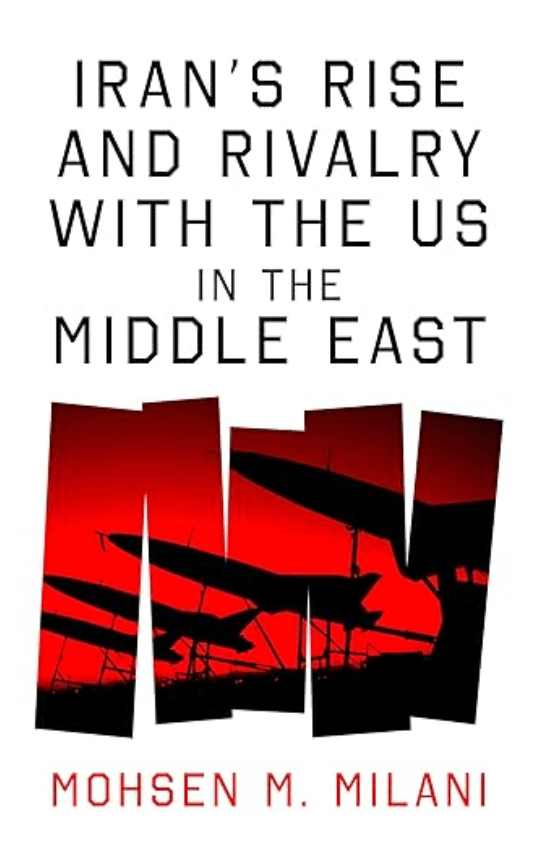
The 1979 Islamic Revolution triggered a cold war between Iran and the United States – former fast friends. Despite the US’s relentless efforts at containment, Iran has risen as a formidable power in Iraq, Syria, Lebanon, Yemen and Gaza. Its newfound status not only frustrates the US but has swiftly become a thorn in the side of Israel and Saudi Arabia. How did Iran rise so rapidly and as it faces ever increasing pressure at home and abroad, can it hold onto its power?
Iran is weaker now than it has been since the Iran-Iraq war of the 1980s, in the Axis of Resistance – the Tehran sponsored network of regional militias – Hizabollah and Hamas have diminished military and political power. Iran’s closet ally, the Assad regime in Syria, has collapsed. The missile exchanges between Israel and Iran last year ended with Israel establishing dominance. Tehran faces a strategic choice: does it go full speed for nuclear weapons, risking a pre-emptive US-Israel military strike to destroy its underground nuclear facilities? Or does it seek a new deal with a Donald Trump-led America which would require the regime to recast its approach to regional power?
Moshen Milani’s Iran’s Rise and Rivalry with the US in the Middle East, analyses how Iran has built up its regional power over the past 70 years. He covers the time when Mohammad Reza Pahlavi reigned as Shah ( 1941-79) showing that many of Iran’s alliances straddle both regimes. “In the 1960s Shah helped to empower the marginalised Shias as a counterforce against pan-Arabism in Lebanon, while also providing military assistance to anti-Gamal Abdel Nasser loyalists in the North Yemen civil war” writes Milani.
These were the same communities that the Islamic Republic turned to when it formed Hizbollah in response Israel’s 1982 invasion of Lebanon, and when it armed the Houthis after the Saudi intervention in Yemen in 2015. Milani details how the brutal war waged by Iraq through the 1980s served to invigorate the revolution in Iran. Half a million Iranians were killed in the war, but Iran lost no territory and the people rallied around the regime. The conflict led to the rise of the Revolutionary Guard (IRGC) which mobilised Shia militias in Iraq to engage Saddam’s forces in asymmetric warfare – a tactic they went on to use widely in the region.
Milani says “the Islamic Republic’s regional power had seemingly peaked”. Iraq was emasculated, the relationship with Syria was robust, Hizbollah was becoming a political as well as a military force in Lebanon and ideological ties were forged with Palestinian militants. Two event, 20 years apart, led to Iran’s further rise and then sharp decline this century. The first US invasion of Iraq in 2003, which reinvigorated Iran’s influence in the region, as America’s rapid victory deposed Iran’s main enemy, Saddam Hussein, and was followed by a drawn-out agony for US forces during which Iran became the major external player in Iraq for the US tactical success, strategic failure.
The second event Hamas’s murderous assault on Israel on October 7, 2023, also looks like early tactical success for the perpetrators followed by a massive reverse for Hamas and its Iranian backers.
Israel is determined never again to allow a hostile militia to exist on its borders and is willing to go beyond the usual rules of war to achieve that goal. The overthrow of Assad’s regime in Syria in December can now be traced to Russia. Hizbollah and Iran each losing the capacity and will to sustain the Syrian regime as a consequence of October 7.
Hama’s attack also put a just settlement to the Palestinian question even further out of reach. The region’s tables have been turned in Israel’s favour and Iran has paid the strategic price, exactly opposite of what Yahya Sinwar, the architect of Hamas’s assault who was killed in an Israeli strike last October, had intended.
Qassem Soleimani, Milani describes the head of the IRGC’S extraterritorial forces as a master strategist and network builder who co-ordinated the various parts of the Axis of Resistance. He was killed by a US drone in January 2020, marking the start of the decline in Iranian power, with the militias he marshalled becoming more independent.
The highest priority of Iran’s leaders is to preserve the Islamic regime, despite the lack of consent for it among Iran’s people. Milani writes “Today, the Islamic Republic has become increasingly disconnected from the lives of ordinary Iranians. The state is heading in an unsustainable direction”.
Milani lifts the veil on Iran’s foreign policy strategy and its implications for the region, the US and Iran itself.
Iran’s Rise and Rivalry with the US in the Middle East by Mohsen M Milani, One World £25, 368 pages.

 The neptune Herald
Leave a reply to pennynairprice Cancel reply