
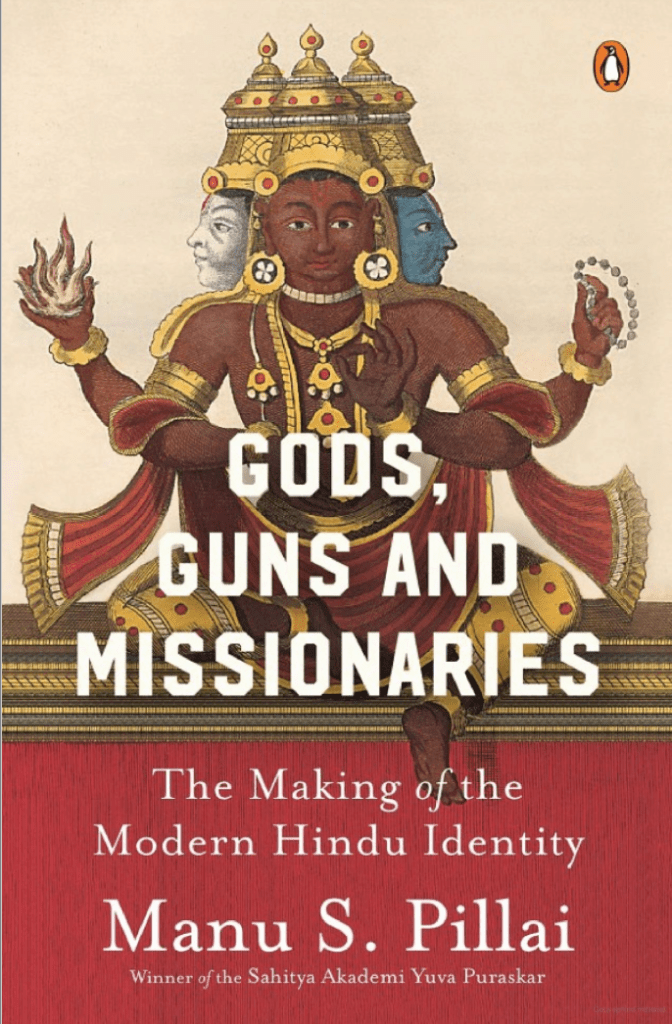
One of India’s most accomplished historian makes a vital intervention, about Hinduism that begins with a maharaja’s cow sounds, reptiles with spices, mystery and backward traditions. When Europeans missionaries arrived in India in the sixteenth century, they entered a world both fascinating and bewildering. Hinduism as they saw it, was a pagan mess a worship of devils and monsters by a people who burned women alive, performed outlandish rites and fed children to crocodiles. But soon it became clear that Hindu idolatry was far more layered and complex than European stereotypes allowed, surprisingly even sharing certain impulses with Christianity.
Manu S Pillai, narrates Madho Singh II’s journey from Jaipur in the west of India to imperial London for Edward VII’s coronation in 1902 becomes the gateway to a deft exploration of what Hinduism actually means as a faith. Drawing on the lives of missionaries, maharajas and men of the Dutch, French, and British East India Companies, he develops a story of a system marked by adaptability, dynamism and compromise rather than ossified archaisms.
In India itself, the image of a “faith under siege” is a core part of the Hindu nationalist rhetoric wielded by the Bharatiya Janata Party, that has now led the world’s most populous nation for more than a decade.
Pillai argues that even before the arrival of imperial powers, Hinduism was hardly a settled affair, emerging instead from Brahmins negotiations with a bewildering variety of counter thoughts and alternative visions. As India’s priestly class was not unified adapting to local traditions ranging from sun worship to matrilineal succession as needed.
Vasco da Gama, upon arriving in Kochi, Kerala in 1498, was less quick to judge: he entered a Hindu temple and participated in rituals, dismissing frescoes of multi-armed beings with big teeth as local forms of saints. As some priests engaged with Brahmins, only to find that the trappings of many gods are simply a humanised vision of something more akin to a familiar and orthodox monotheism. Italian missionary Roberto de Nobili swapped his cassock for the robes of local priests in an effort to better win over converts.
Missionaries became a threatening force as European power grew in India. Western ways of thinking gained further ascendancy during the British Raj: while interest in Hindu thought influenced Enlightenment thinkers like Voltaire in Europe, Orientalism and colonial rule pressed Hindus to reimagine their religion.
Portuguese padres in Goa, facing the pressure of the Reformation at home, clamed down on paganism abroad by burning temples. One, Father Acquaviva, disappointed at the tolerance he found at the court of Mughal Emperor Akbar the Great, received his desired martyrdom after erecting a cross at a destroyed Hindu temple. The British East India Company shifted from distrust of missionaries as an impediment to trade to support for its civilising mission thanks to pious parliamentarians and pressure groups. Pillai argues about the catalysts for the Great Rebellion of 1857, were evangelicals waving Christian texts at Hindu festivals.
Pillai explores the shaping of Hindutva ( Hindu Nationalist) identity and how outside pressures knitted a huge variety of traditions into something like a unified whole. The history of conquerors is central to a kind of postcolonial paranoia that sees Hindus’ failure to resist as rooted in their naivety and good nature.
Pillai argues, in resisting foreign authority, they adopted the missionaries’ own tools and strategies, that has given Hinduism its present shape, also contributing to the birth of an aggressive Hindu nationalism.
Lucid, ambitious, and provocative, it is at once a political history, an examination of the mutual impact of Hindu culture and Christianity upon each other, and a study of the forces that have prepared the ground for politics in India today.
The book closes with Bijay Chand Mahtab, maharaja of Burdwan, almost informing the pope of the “revolting” idolatry of Madonna shrines in early 20th century Italy. The inversion of early monstrous travelogues is more than a reminder of the underlying complexities of Hinduism, which also reflects the deep similarities between faiths.
Gods, Guns and Missionaries: The Making of the Modern Hindu Identity by Manu S Pillai, Allen Lane £35, 624 pages.

 The neptune Herald
Leave a reply to pennynairprice Cancel reply