
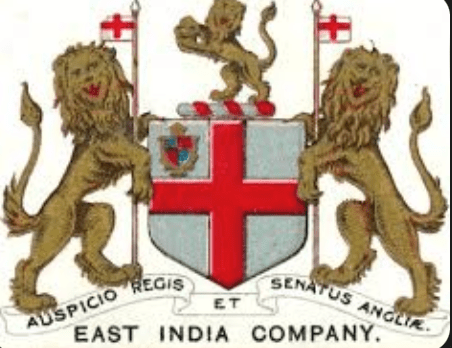
In 1800s British East India Company conquers India, and by the beginning of the 19th century, as one of its directors admitted “an empire within an empire”, with the power to make war or peace anywhere in the east having ruled India for 200 years.
The East India Company created a sophisticated administration and civil service in India, and built much of London’s Docklands. Its annual spending in Britain £8.5m exceeded about a quarter of total British government annual expenditure. They successfully transferred India’s then prospering GDP to Britain. It is no wonder the Company now referred to itself as “the grandest society of merchants in the Universe”.
Their private armies then were larger than those of almost all nation-states and its power encircled the globe.
Now there is no blue plaque or memorial today marks the site of its former headquarters on Leadenhall Street in the City of London, which lies buried beneath the foundations of Richard Rogers’s glass-and-steel Lloyd’s building. But the fact remain East India Company remains history’s most ominous warning about the potential for the abuse of corporate power and interests of shareholders can seemingly become those of the state.
Horace Walpole, an 18th-century commentator who said the East India Company wealth had corrupted parliament “ What is England now? but a sink of Indian wealth filled by nabobs with a senate sold and despised” he asked.
The Anglo-Persian Oil Company was able to bring down the government in Iran just by lobbying and United Fruit that of Guatemala in the 1950s, just as ITT lobbied to bring down Salvador Allende’s Chile in the 1970s and Just as Exxon Mobil has lobbied the US more recently to protect its interests in Indonesia, Iraq and Afghanistan, East India Company was able to call in the British navy to enhance its power in India in the 18thcentury.
Then East India Company was able to buy the services of Lord Cornwallis, who surrendered Yorktown to Washington.
East India Company began on September 24, 1599, just when William Shakespeare was drafting Hamlet in his house from the Globe in Southwark, a group of Londoners gathered north, 20 minutes-walk across the Thames in a rambling half-timbered building in Moorgate Fields. Then London Mayor Sir Stephen Soame, accompanied by Sir Thomas Smythe, a former auditor of the City of London who made a fortune importing currants from the Greek Islands and spices from Aleppo. The group gathered with one purpose: to petition the ageing Queen Elizabeth I, then bewigged painted woman of 66, to start up a Company “ to venter in the pretended voiage to ye Est Indies and other Ilands and Cuntries thereabouts there to make trade”. The East India Company was from the very first conceived as a joint stock corporation, open to all investors, although there would be no return on investment for several years as the commodities they wished to buy were extremely expensive, carried in hug ships which needed to manned by large crews and protected by artillery masters and professional musket-men. The idea of a joint stock company was one of Tudor England’s most brilliant and revolutionary innovations. The idea was to bring in passive investors who had the cash to subscribe to a project but were not themselves involved in the running of it. Such shares could be bought and sold by anyone, and their price could rise or fall depending on demand and the success of the venture. At that time, England was a relatively impoverished, largely agricultural country, which had spent almost a century at war with itself over the most divisive subject of the time: religion. Many of its wisest minds as an act of wilful self-harm, the English had unilaterally cut themselves off from the most powerful institution in Europe, so turning themselves in the eyes of many Europeans into something of a pariah nation. Having isolated from their neighbours, the English were forced to scour the globe for new markets and commercial openings further afield, and to do so they had no competition but to use, for the first time in history, unbridled corporate violence.
In 1550 Spanish and Portuguese maritime giants dominated the world, as England’s navy sits in their shadows. In 1588, the defeat of the Spanish Armada, England’s navy strengthens. In 1592, the capture of the Madre de Deus, Queen Elizabeth is funding and benefiting from privateers acts of privacy. In 1600 Queen Elizabeth I, grants a Royal Charter.
In 1601, The East India Company’s first voyage “red Dragon” ship sent to Spice islands and returns with pepper. The Red Dragon and Hector sail onto Bantam, on the island of Java, to procure spices in exchange for silver.In 1602 the East India Company captured and boarded a Portuguese vessel on its maiden voyage in and had to wait till 1765 to cease resemble a conventional trading corporation, dealing in silks and spices, when in the Mughal Fort of Allahabad, the young Mughal emperor Shah Alam, exiled form Delhi and defeated by East India Company troops, was forced into an involuntary privatisation. He was forced to issue an order to dismiss his own Mughal revenue officials in Bengal, Bihar and Orissa and replace them with a set of English traders appointed by Robert Clive – the new governor of Bengal and the directors of the Company, the chief of illustrious warriors, the English Company”.
In 1607, The Hector became the first ship to sail 10, 000 miles directly to India, and proceeds to Agra, carrying a letter of introduction from King James I. By 1612, East India Company defeats the Portuguese in battle of Swally which marks the beginning of the ascent of the company’s presence in India. In 1613, East India Company’s ship “Clove” reaches Japan to sign the first trade agreement. By 1615, a request from London for a pot of best sort of chaw in Meaco, added the word tea in English, and Sir Thomas Roe is sent on a mission to conclude the trade treaty with Emperor Jehangir in India. In Arabia, in Sufi monasteries of Yemen, coffee beans were first roasted and brewed in similar way of coffee from Mocha.
The collecting of Mughal taxes was subcontracted to a powerful multimedia corporation- whose revenue collecting operations were protected by its own private army. Within a few months, 250 company clerks backed by the military force of 20, 000 locally recruited Indian soldiers had become the effective rulers of the richest Mughal provinces, showing the power of an international corporation, for the very first time, transforming itself into an aggressive colonial power. It is only a matter of time before the East India Company was straddling the globe, almost single-handedly, it reversed the balance of trade, which from Roman times had led to a continual drain of western bullion eastward. The East India Company ferried opium east to China, and in due course fought the opium wars in order to seize an offshore base at Hong Kong and safeguard its monopoly on narcotics. It shipped Chinese Tea to Massachusetts, where its dumping in Boston harbour led to the American war of Independence, as one of the principal fears of the American patriots in the run-up to the war was that parliament would unleash the East India Company in the Americas to loot there as it had done in India.
By 1803, East India Company captured the Mughal capital of Delhi and monarch Shah Alam, trained up a private security force of about 200, 000 twice the size of the British Army and marshalled more firepower than any nation-state in Asia. In 40 years they had made themselves masters of almost all the subcontinent, whose inhabitants exceeded 60 million.
It was not the British government that began seizing chunks of India in the mid-18th century, but a dangerously unregulated private company headquartered in one small office, five windows wide, in London and managed in India by a violent, ruthless and mentally unstable corporate predator – Robert Clive, India’s transition to colonialism, took place under a for-profit corporation, which existed entirely for the purpose of enriching its investor. The support that the East India Company enjoyed from the British parliament was crucial factor.
How to cope with the power and perils of large multinational corporations remains totally unanswered. Edward, First Baron Thurlow remarked during the impeachment of East India Company Governor Warren Hastings, “Corporations have neither bodies to be punished, nor souls to be condemned. They therefore do as they like”.
East India Companies demonstrated how large companies can become more powerful, and sometimes more dangerous than nations or even empires.
Now without all that power or prosperity, East India Company is owned by Sanjiv Mehta, an Indian-Born British businessman.

 The neptune Herald
Leave a reply to pennynairprice Cancel reply