
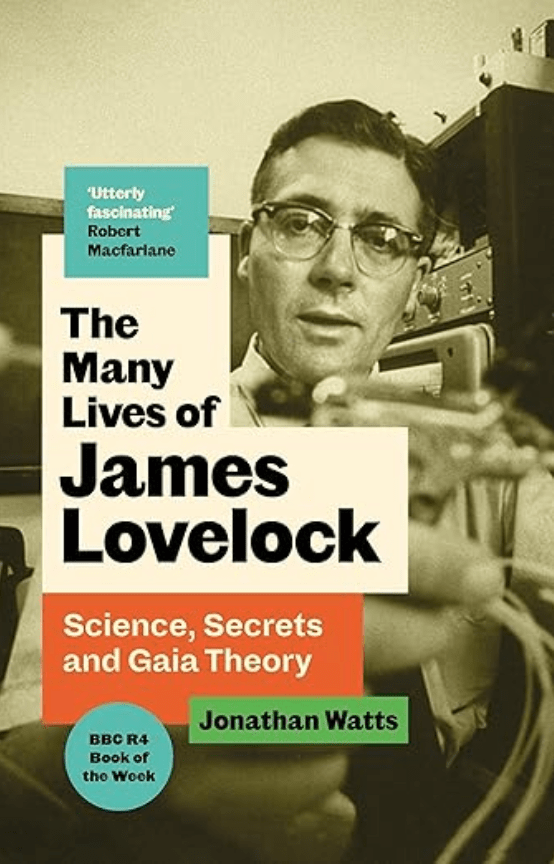
James Lovelock, the scientist who styled himself as an independent researcher and discovered the chemicals that were destroying the ozone layer, predicted the dangers of climate change, and even helped the British secret services to detect Irish Republican Army bombs. Lovelock known as the father of Gala Theory, the idea that life on Earth is a self-sustaining system in which organisms interact with their environments to maintain a habitable ecosystem.
During the Second World War he worked at the National Medical Research Institute, where his life-long interest in chemical tracing began. In the 1960s he worked at NASA and for MI5 and MI5 during the cold war. He was also the science advisor to the oil giant Shell, who he warned as early as 1966 that fossil fuels were causing serious harm to the environment. He invented the technology that found the hole in the Ozone layer.
He made epochal discoveries about the environmental impact of the industrial age and rubbed shoulders with global warming sceptics towards the end of his 103-year life.
Jonathan Watts, The Guardian’s global environment editor, highlights the flaws of a man whose interdisciplinary interests spanned vast areas of the 20th-century research. Lovelock who died in 2022, emerges as an emblem of an era typically highlighted by extraordinary scientific discoveries and their consequences for good and ill.
Lovelock was the unplanned child of Nellie, a local council clerk, and Tom, a gas works employee. Their ambition was to open an art shop in London, so Lovelock initially with his grandparents in Letchworth Garden City, north of London, began to set the habits of a lifetime, wandering alone and observing nature.
“London’s Science Museum was his “playground”, his young mind soaking up knowledge that was beyond most adults” writes Watts.
Lovelock spend some time in the US, in the hunt for life on Mars enjoying “cerebral and physical coupling” with researcher Dian Hitchcock. These helped Lovelock to develop and deploy the electron capture detector, which enabled him to discover much high than expected concentrations of Chlorofluorocarbons (CFC’s) suggesting that it was caused by human activity. As Lovelock did not raise the alarm about fossil fuel burning or CFC buildup,
It was left to scientists from the University of California, Irvine, to show how CFC’s damaged the Ozone layer, winning a Noble Prize and leading to the phasing-out of the chemicals.
In early 1970s, Lovelock’s Gala Theory, co-created with the US biologist Lynn Margulis which proposed that Earth was itself like an organism, regulated by many interactions between its living and non-living parts.
For Lovelock’s 100th birthday, Watts describes a gathering in his honour at Sir Winston Churchill’s Oxfordshire birthplace of Blenheim Palace. “Lovelock rediscovered relationships lost or neglected for centuries between life and the atmosphere, between humans and nature. Our relationship with the Earth – and, crucially, how far we can push it” Watts explains.
The Many Lives of James Lovelock- Science, Secrets and Gala Theory by Jonathan Watts, Canongate £25, 320 pages.

 The neptune Herald
Leave a reply to pennynairprice Cancel reply