
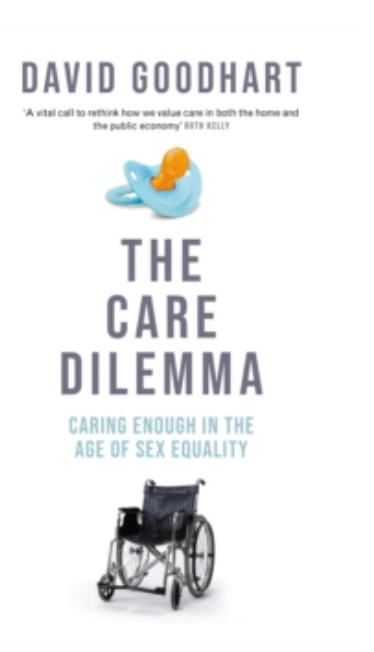
Over the past 60 years family life has changed dramatically with greater choice and autonomy, especially for women and a more equal domestic sphere have brought great gains for human freedom. David Goodhart, argues there have been losses and unintended consequences too – in family instability, children’s declining mental health, and ever-rising demands on the welfare state and social care system. Sharp falling birth rates also present major challenges.
Especially in the bottom half of the income spectrum, the costs are now too high. The Care Dilemma argues that we need a new policy settlement that supports gender equality while also recognising the importance of stable families and community life, and sees having children as a public as well as private good.
David Goodhart saks “Is raising a child a job for society or for mothers. The Four Horsemen of liberal modernity are the UK’s social care crisis, the decline in family stability, mental health problems among the young, and falling birth rates. All have been exacerbated, he claims by the devaluation of the domestic realm. Goodhart who had four children with the high-achieving Lucy Kellaway former Financial Times Columnist argues society has free-ridden on women for too long, taking for granted their caring attributes. He rages at the injustice of women still earning less than men in low-skilled jobs. He wants to cancel nursing debt, give care work more status, extend paternity and maternity leave and provide incentives for grandparents to live close by.
The Care Dilemma plea to value the domestic realm builds on this concern that society has disenfranchised the “Somewheres” and devalued the practical abilities and emotional intelligence. Goodhart claims, believe that men and women are essentially identical and that family structure is irrelevant to life chances. Balancers embrace equality but worry more about he consequences of unstable family life.,,, and want to reform than abolish the gender division of labour. Most voters are balancers but their voices are not being heard by politicians. He writes “Young women should certainly continue to be encouraged into STEM jobs, However, that does not necessarily mean that a 50:50 balance is either possible or even desirable”. Few women would say their men are acting as interchangeable when it comes to household chores.
The book contains detailed analyses of the failures of both childcare and social care. On Childcare, Goodhart says that the UK has some of the most stringent care-to-infant ratios in formal care settings in the rich world. The UK ratio for children under two is 1:3, in France it is 1:5. He makes a strong case for government to give parents the money, rather than subsidising formal settings.
Social care he thinks has the potential to be more of a preventive service with high status.
He describes his father Philip Goodhart beat Margaret Thatcher to a parliamentary seat in Beckenham, after a mainly female selection panel griller her- but not him –on how to combine the MP role with children.
He disapprovingly quoted Joeli Brearley, founder of Pregnant then Screwed, a charity that help mothers, for saying that “maternity leave can be desperately, achingly lonely”.
Caring can provide more meaning for many of us than work will ever do.
The Care Dilemma: Caring Enough in the Age of Sex Equality by David Goodhart, Forum £25, 256 pages.

 The neptune Herald
Leave a reply to pennynairprice Cancel reply