
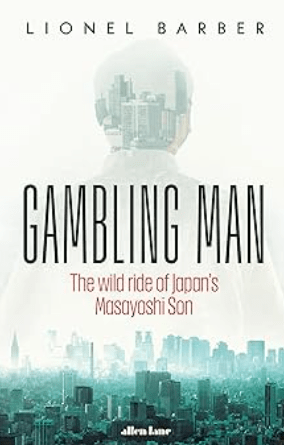
Masayoshi Son, as an ethnic Korean in Japan, Son has overcome adversity, born in Korean poverty and forced to pass as Japanese, driven by the need for acceptance in a famously regimented society despite discrimination to become Japan’s best-known businessman and empire-builder, but he remains elusive, intensely private figure. He had chips on his shoulders put chips in pockets. In Gambling Man, we learn what drives Son on, and whether he really is a genius or a madman. Son merely wants to show off his Japanese garden, although there are no rosebud moment, but he enigmatic as ever.
SoftBank founder Japan’s Masayoshi Son, is perhaps the most powerful mogul of the twenty-first century but who is not a household name.
Masayoshi Son has made and lost several fortunes, investing or controlling assets worth $1 trillion in the past two decades through his media-tech giant, SoftBank. He bankrolled the successful Alibaba. China’s internet colossus, even before the world had heard about it, plotted with Steve Jobs to turn the iPhone into a wonder product and also financed hundreds of tech start-ups, fuelling the biggest boom Silicon Valley has ever seen.
Lionel Barber, former editor of The Financial Times, takes you on Son’s wild ride, from his birthplace in a Korean slum in post-war Japan to the modern day temples of power. He even speeds through Donald Trump’s golden skyscraper in Manhattan, the royal palaces of Riyadh and the throne rooms of China’s Marxist rulers, all places where Son has deployed his unique blend of financial engineering and crazy risk-taking.
Son’s story captures a 25-year-span of hyper-globalisation in which money, technologies and ideas flowed freely. From the launch of microchip to the advent of artificial intelligence, he has ridden the technological wave which has created extraordinary wealth and economic change. His topsy-turvy business career is testimony to the power of optimism, daring to dream even in search of
The Next Big Thing.
Gambling Man reveals the man behind the money, what drives him, why he matters, and what he plans for his next big act.
His career is an almost surreal string of personal highs and lows. He has been present at- and indeed often responsible for – almost every big turning point in global tech over the past four decades.
Son has been “the single largest foreign investor in capitalist America as well as communist China, the biggest start-up funder in the world, and the boss of one of the top ten most indebted firms, continually threatening a financial implosion.
His first big coup came in 1995, an audacious punt on Jerry Yang’s Yahoo! Saw him outmuscle the flower of America’s venture capitalists to secure the largest external shareholding in what became the bellwether stock of the dot-com bubble. By the time the market peaked in early 2000, SoftBank was being feted as the company that had single-handedly dragged Japan out of its lost decade, and Son was the richest man in the world. The subsequent crash brought equally extreme ignominy, as SoftBank’s captalisation fell 98 per cent. Son himself lost $67bn. The Asahi Shimbun newspaper headlined public repudiation of one-time secular saint “ Hunt for Class A War Criminal”. In adverse condition Son instantly discovered an ace up his sleeve in the shape of a modest $20mn ticket SoftBank had written 18months earlier to secure a 30 per cent stake in a then unknown Chinese ecommerce start-up Jack Ma’ Alibaba. The resulting leveraged bet on China’s explosive growth turned out to be one of the most spectacularly profitable investments of the next decade and helped bankroll SoftBank’s new expansion into broadband and telecoms on both sides of the Pacific.
Son’s second coming also came unstuck. In the 2008, credit crunch SoftBank’s vast borrowings and its off-piste adventures in sub-prime derivatives came back to haunt it, focing Son into a fire sale of his personal shareholding to meet margin calls. He said “ I lost almost all my worldly assets”.
Son squeaked through the chicane, 2009 inaugurated a new era of ultra-low interest rates, and Son went back on the offensive. For the third decade in a row, he got a single big thing right, when it mattered, this time round, the new rules for sourcing mountains of capital in a multipolar world awash with money.
Son obliged a new generation of leaders in the Middle East to transmute their fossil-fuel fortunes into investments in global tech to give birth to $100bn Saudi and UAE-backed backed SoftBank Vision Fund – the largest tech investment vehicle the world had ever seen.
SoftBank became the poster child for this brave new era’s eventual appointment with reality, First came the debacle of a $14bn writedown of its investment in office-sharing start-up WeWork in what Barber calls, not unfairly, “One of the biggest swings and misses in the history of investing”. Then great post-pandemic inflation put an end to the age of free money. In May 2022, the Vision Fund booked $27bn loss as its start-up portfolio cratered. In November, Son announced that he was finally stepping down as the face of SoftBank.
Gambling Man: The Wild Ride of Japan’s Masayoshi Son by Lionel Barber, Allen Lane £30, 416 pages.

 The neptune Herald
Leave a reply to pennynairprice Cancel reply