
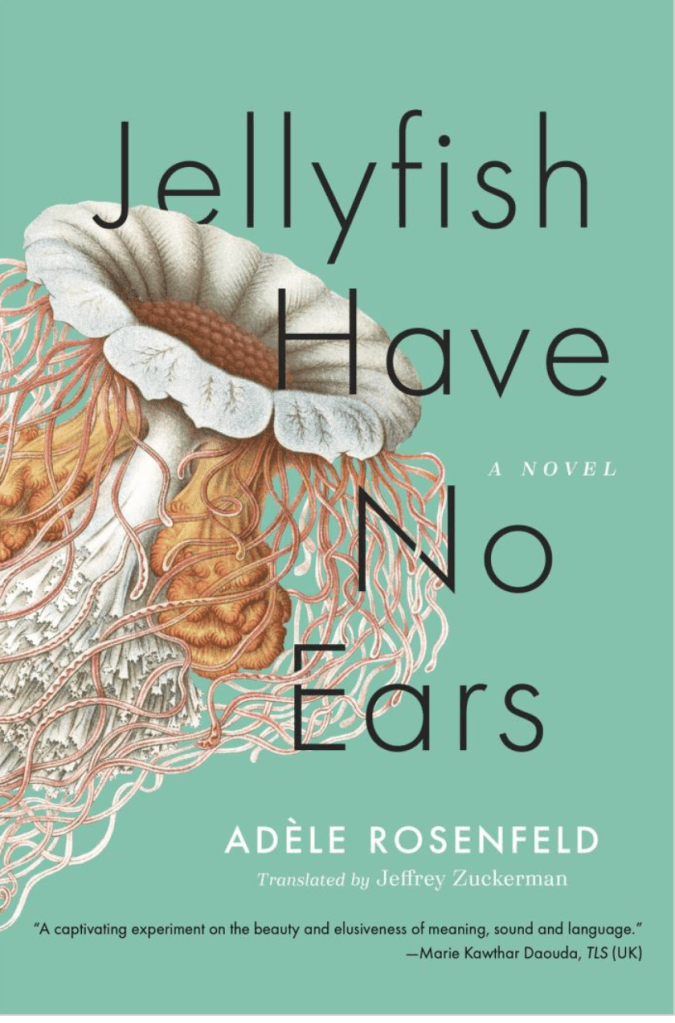
Adele rosenfeld’s novel Jelly Fish Have No Ears – was the finalist for Prix Goncourt du Premier in 2022 – explores what it is likely to live with an invisible disability. Louise F is partially deaf and have always felt adrift between communities not deaf enough to be part of deaf culture, not hearing enough to be fully within the hearing world. Hearing for Louise is inseparable from reading other people’s lips.
Through sight, she perceives words and strings them together like pearls to reconstruct a conversation.
After an audiology exam reveals that she lost a further 15 decibels, her doctor suggests a cochlear implant. With this irreversible intervention, Louise would gain a new, synthetic sense of hearing – but she would lose what remains of her natural hearing, which has shaped her unique relationship with the world, full of whispers and shadows. “the warmth of Timbres, this soft sheen of wind, of colour, of all sound’s snags and snarls”. She muses her struggle to understand and be understood. Even an encouner with a waiter in a restaurant is frought with anxiety.
As she weighs the prospect of surgery, she must also contend with the chaotic reality of her life as she falls in love, suffers through her first job, and steadies herself with friends.
She is employed by local government office because she helps them meet their disability quota. After informing her collegues that she needs to lip readshe observes ” It was nothing short of poetic that I needed light to hear. That was untilthey had to repeat what had already been said more than twice: all poeticness went to pieces and I went from poet to idiot.”
Louise’s misunderstandings and how she occasionally exploits her condition by turning of her hearing aid when people bore her or the traffic noise become overwhelming.
Jellyfish’s ability ot survive without ears and Louise uses similar means to communicate with her boyfriend in the bath.”The reverberation of sound from his mouth travelled across the surface… vibrations alone enveloped us. In those moments I was Thomas’s voice , and he mine, and I felt like nothing would disappear.” Ina music bar she discovers Thomas’s friend has adapted John Coltrane’s Blue Train to her aural range.
Lousie’s contradictory impulses are lyrically evoked: “I was used to the darkness of silence, but I could not forget about the part of me that was hearing.”
She worries that the implant wil indelibly change her or that she will no longer recognise her mother’s voice.
A masterclass in wordplay and language’s possibilities and limitations, this fiercely original debut plunges readers into Louise’s world as she grapples with loss, and considers what she might gain in the process.
When one sense is impaired, threre is often a neutral reorganisation in the brain. Her imagination is heightened as she communes in her head with “spectres of Trauma” a soldier from frist world war, a one-eyed dog and a botanist who she conjures while exisisting in sate of limbo.Meditation on deafness and the impact of sensory loss has on human realtionships.
Jellyfish Have No Ears by Adele Rosenfeld, Translated by Jeffrey Zuckerman, MacLehose Press £!0.99/Grey Wolf Press $17, 224 pages

 The neptune Herald
Leave a reply to pennynairprice Cancel reply